The Lamb of God Symbolism Explained

A title spoken before a picture was painted
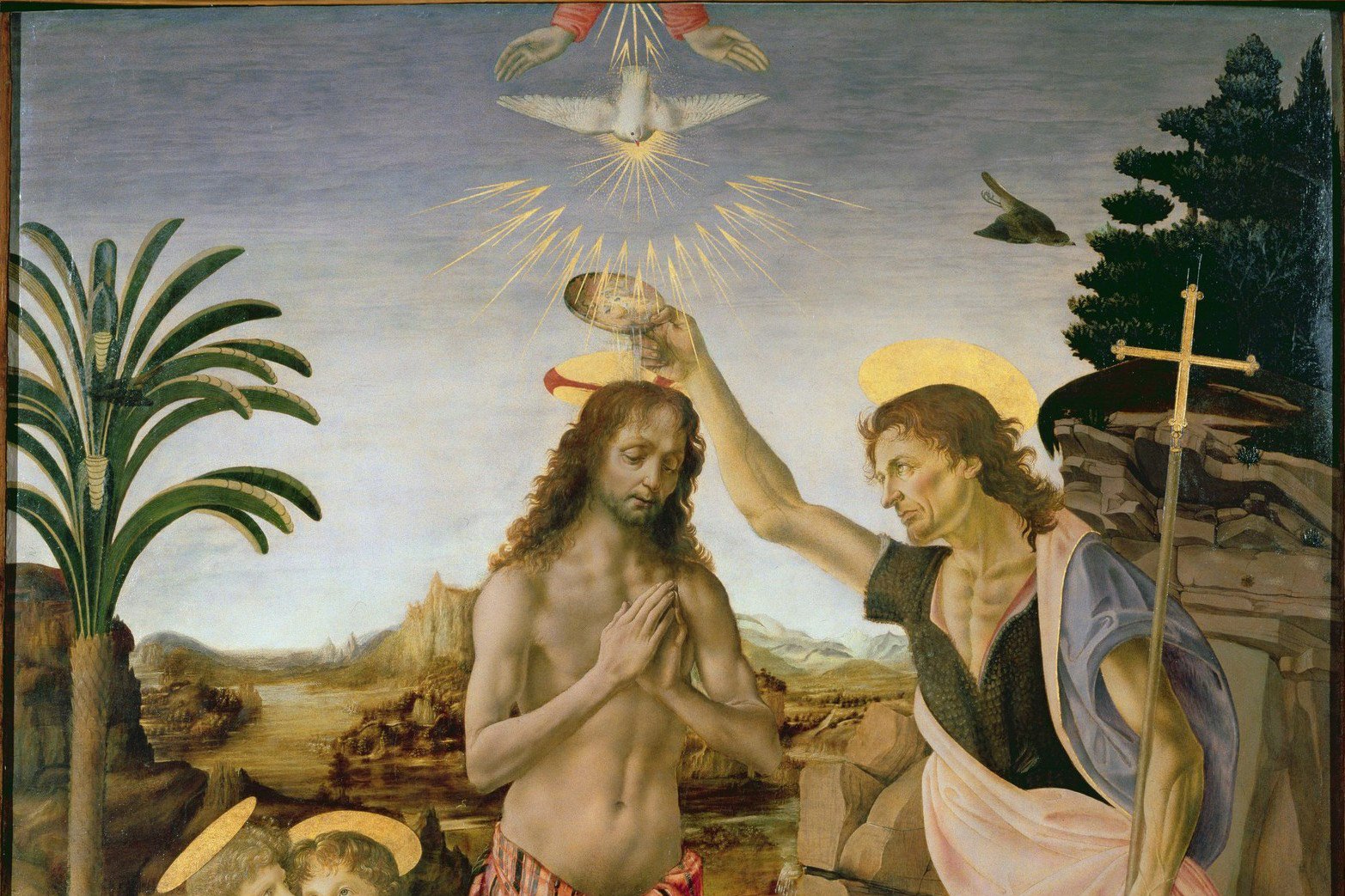
Unlike some symbols that developed slowly through artistic tradition, the Lamb of God begins with a specific spoken sentence in the Gospels. Saint John the Baptist, seeing Jesus approach him at the Jordan River, announces him with words that gave Christian sacred art one of its most enduring images: "The next day he saw Jesus coming toward him and said, 'Behold, the Lamb of God, who takes away the sin of the world'" (John 1:29, NABRE). For John's original audience, steeped in a world of temple sacrifice, calling a man a lamb wasn't a gentle metaphor about mildness — it was a direct claim about his coming death and its purpose.
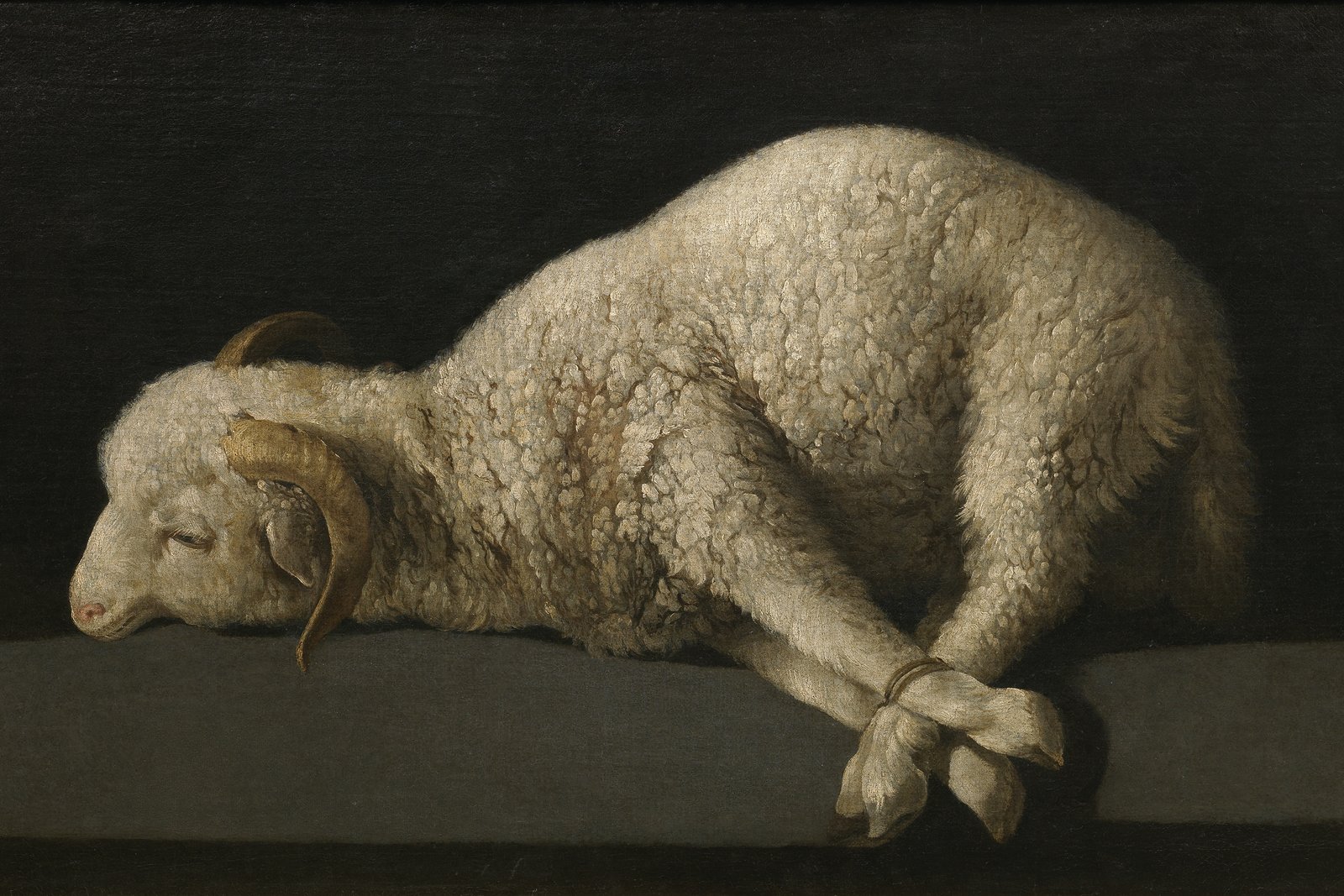
Francisco de Zurbarán, "Agnus Dei," c. 1635-1640, Museo del Prado (version), Madrid — public domain.
The sacrifice behind the title
To understand why "lamb" carried that weight, the reference point is Passover. In the Book of Exodus, God instructs the Israelites to sacrifice a lamb whose blood, marked on their doorposts, would cause the angel of death to pass over their homes during the final plague in Egypt. The instructions specify the animal precisely: "Your lamb must be a year-old male and without blemish. You may take it from either the sheep or the goats" (Exodus 12:5, NABRE). Christian tradition reads Christ's crucifixion as fulfilling that ancient sacrifice rather than replacing it with something unrelated — the Gospel of John, notably, times Jesus's death to coincide with the slaughter of the Passover lambs in the Jerusalem Temple, a detail scholars believe John included deliberately to make the connection unmistakable. Once that theological link was established, painting Christ literally as a lamb became a natural shorthand for the entire chain of meaning: Passover, sacrifice, blood, deliverance from death.
A bound and silent animal
Zurbarán's Agnus Dei, shown above, represents one branch of Lamb of God imagery at its starkest: a single lamb, legs bound, lying on a stone ledge against total darkness, eyes closed, offering no resistance. Zurbarán painted several versions of this composition in the 1630s and 1640s, and their power comes from restraint — no crown of thorns, no halo, no explicit crucifixion imagery at all, just an ordinary animal rendered with such physical presence that the theological reference becomes unavoidable. This stripped-down approach echoes a prophecy from Isaiah, long read by Christians as anticipating Christ's suffering, describing one "led like a lamb to the slaughter" who did not open his mouth. Artists working in this tradition weren't illustrating a scene from the Gospels directly — no lamb literally appears at the crucifixion — but visualizing the title John the Baptist gave Jesus, stripped down to its rawest form.
A different lamb: standing, and carrying a flag
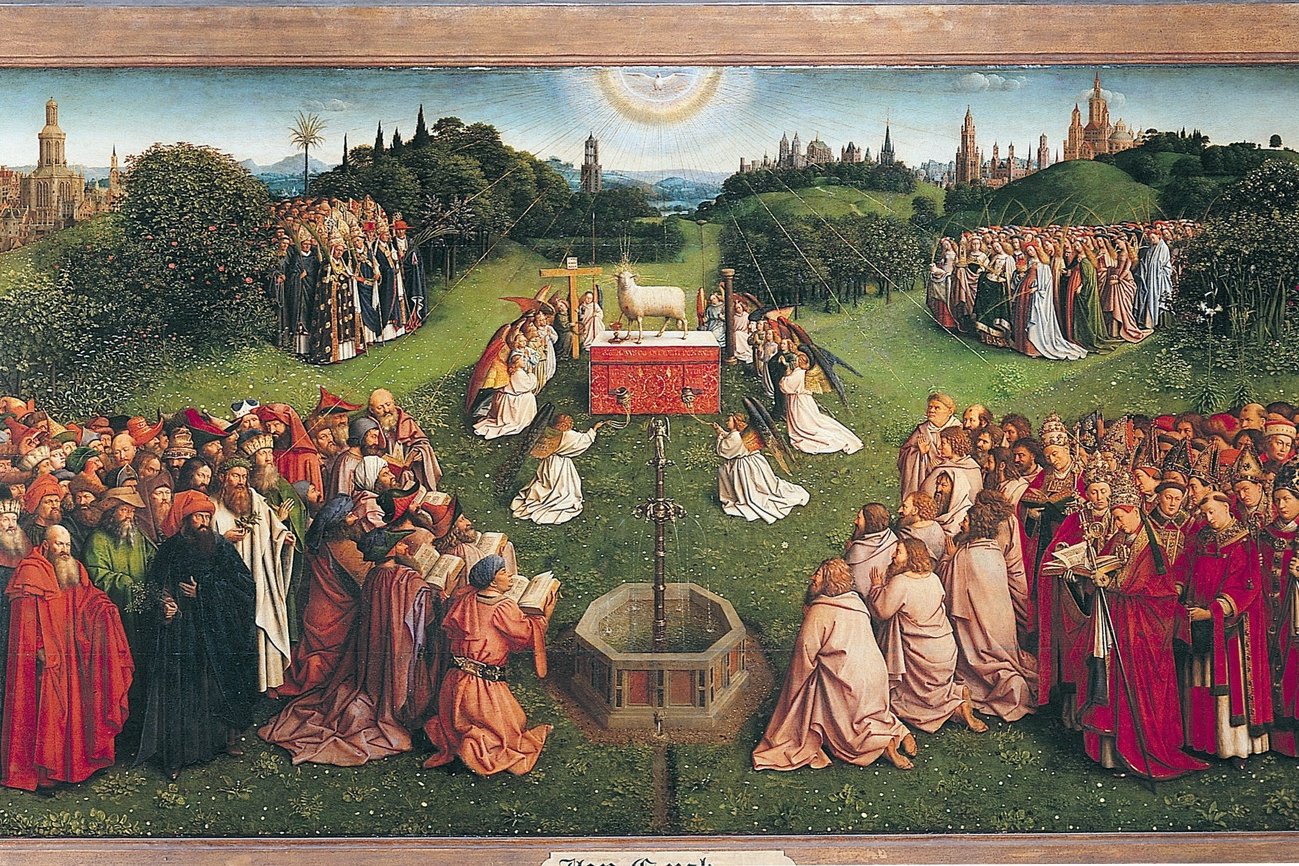
Not every Lamb of God image emphasizes sacrifice and stillness. A second, equally common tradition shows the lamb standing upright, often on a small hillock, carrying a thin banner or pennant marked with a red cross. This is the Agnus Dei triumphans — the triumphant Lamb — and it draws on a different scriptural source: the Book of Revelation, where John's vision describes "a Lamb that seemed to have been slain" standing at the center of heaven's throne room, worshipped by every creature (Revelation 5:6, NABRE). The wound of sacrifice is still present in that vision — the lamb "seemed to have been slain" — but the posture is victorious rather than passive, and the banner artists added centuries later became a visual shorthand for resurrection: death absorbed and overcome rather than avoided. Jan van Eyck's famous Ghent Altarpiece places exactly this standing, bleeding-yet-triumphant lamb at the center of its most celebrated panel, gathered crowds of saints and martyrs converging on it from every side.
The lamb at Mass
The Lamb of God's presence in Catholic life extends well past painted or carved images into the liturgy itself. Near the end of every Mass, just before Communion, the congregation recites or sings the Agnus Dei — Latin for "Lamb of God" — asking Christ under this exact title for mercy and peace, a prayer whose wording traces directly back to John the Baptist's proclamation at the Jordan. The same title also names small wax medallions, traditionally stamped with an image of the lamb and blessed by the pope, that have been distributed to the faithful as devotional objects since at least the early medieval period. Between the prayer recited at every Mass and the paintings hung in churches and homes, the Lamb of God may be one of the most frequently invoked images in the entire Catholic tradition — spoken and pictured so often that it's easy to forget both trace back to one sentence spoken at a riverbank two thousand years ago.
Two images, one meaning
Seen side by side, the bound lamb of Zurbarán and the standing, banner-carrying lamb of van Eyck might look like they belong to different traditions entirely — one silent and defeated, the other upright and victorious. Christian art has always held both at once deliberately, refusing to let either image stand alone for long. The bound lamb keeps the cost of the sacrifice in view; the standing lamb insists that the story doesn't end at the cross. Read together, the two versions of the same animal trace the same arc John the Baptist compressed into a single sentence at the Jordan River: sin taken away through a death, and a death that did not stay a defeat.
Trivia
Why is Jesus called the Lamb of God?
What is the connection between the Lamb of God and Passover?
What does Agnus Dei mean and where is it used?
Why is the lamb in Christian art sometimes shown holding a banner or flag?
You May Also Like
Related Reading