Fragments of the True Cross: Relics of the Crucifixion Across the World

A discovery beneath a pagan temple
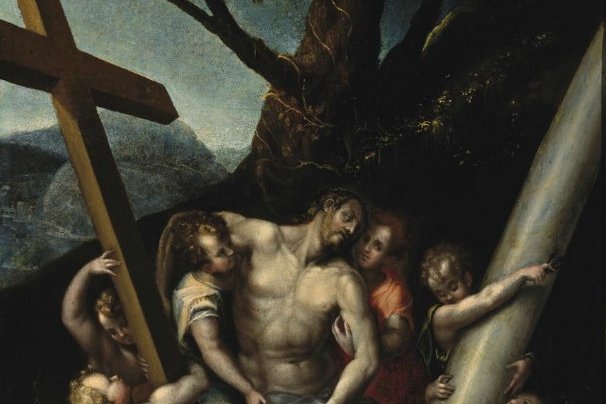
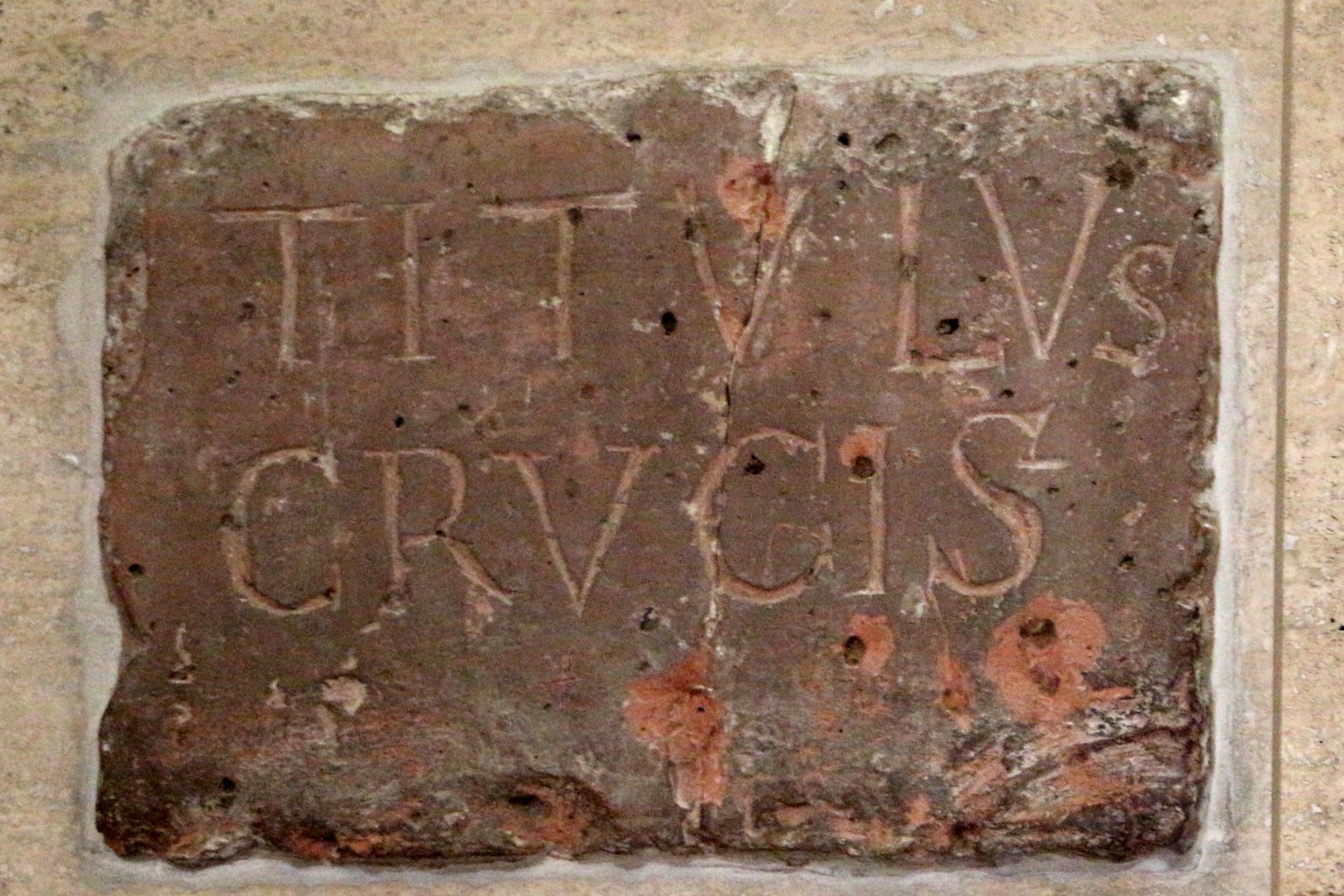
The tradition is specific enough to sound almost like a detective story. Around 326 AD, Saint Helena — mother of the emperor Constantine, by then in her late seventies — traveled to Jerusalem, a city the Romans had leveled and rebuilt as a pagan colony two centuries earlier after crushing a Jewish revolt. Under the direction of Jerusalem's bishop, Macarius, workers began excavating near the site traditionally identified with Calvary, clearing away a temple that had been built over the area. What they found, according to the tradition that crystallized over the following decades, were three wooden crosses and the separate titulus, the inscribed placard Pilate had ordered nailed above Christ's head.
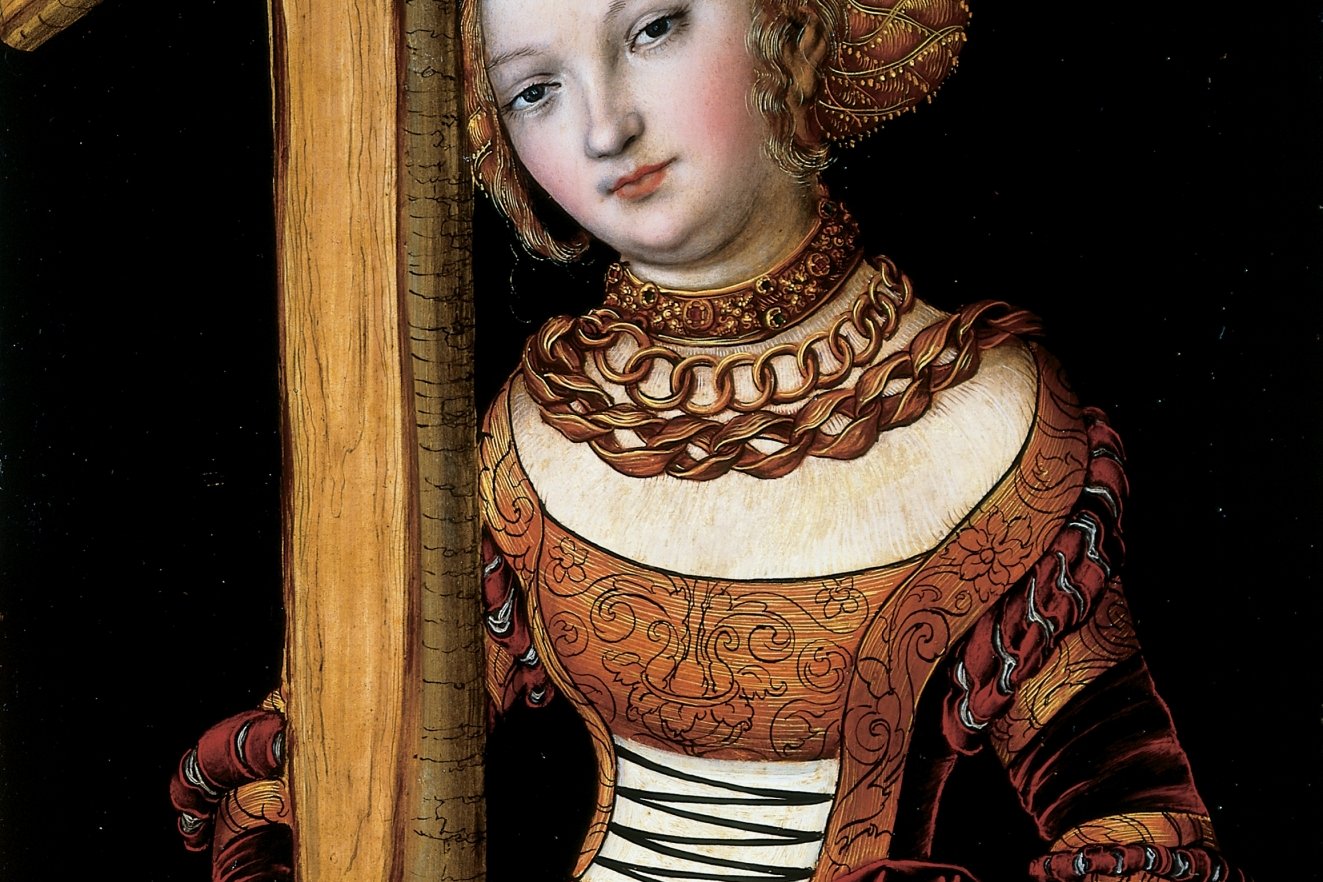
Lucas Cranach the Elder, Saint Helena with the Cross (1525). Public domain, via Wikimedia Commons.
How the identification of the true relic from among the three crosses actually happened varies by source and grew more elaborate with each retelling — later legend has a dying woman miraculously healed by contact with the correct cross, for instance — but the core claim, that the wood of the crucifixion was recovered during this excavation, is attested remarkably early. Saint Cyril of Jerusalem, writing just twenty years after the event, in 347 AD, already refers to "this sacred wood" in catechetical lectures delivered on the very site, and states elsewhere that relics of it had already been "distributed all over the world." An inscription from Roman North Africa dated to 359 AD — found at Tixter, near Sétif in modern Algeria — lists a fragment of the cross among a collection of relics, showing how quickly pieces were already traveling.
The event is commemorated in church tradition as the Invention of the Cross — "invention" here used in its older Latin sense of inventio, meaning "discovery" or "finding," not fabrication. A vivid eyewitness account from a pilgrim named Silvia (also known as Egeria), writing around 380 AD, describes the annual Good Friday veneration ceremony in Jerusalem in detail: the bishop seated before a table bearing the relic in a silver-gilt case, the faithful filing past one by one to kiss the wood and the titulus, forbidden to touch either with their hands — a rule enforced, Silvia notes dryly, after one worshiper was once caught trying to bite off a splinter to keep for himself.
From one cross to thousands of fragments
What happened next is the part of the story that makes the True Cross unlike almost any other relic: rather than staying in one place, it was deliberately broken up and given away, repeatedly, for centuries. Constantine himself reportedly presented a portion to the newly built Sessorian basilica in Rome — known today as Santa Croce in Gerusalemme — which still displays several relics of the Passion in a dedicated chapel. Later popes sent fragments abroad as diplomatic and devotional gifts: Pope Saint Gregory the Great sent a piece to Theodolinda, the Lombard queen, and another to Reccared, the first Catholic king of Spain, in the late 6th century. In 569, the Frankish queen Radegund obtained a celebrated fragment from the Byzantine emperor Justin II for the monastery she founded at Poitiers — an occasion that produced the hymn "Vexilla Regis," still sung at feasts of the Cross, composed by the local bishop, Venantius Fortunatus.
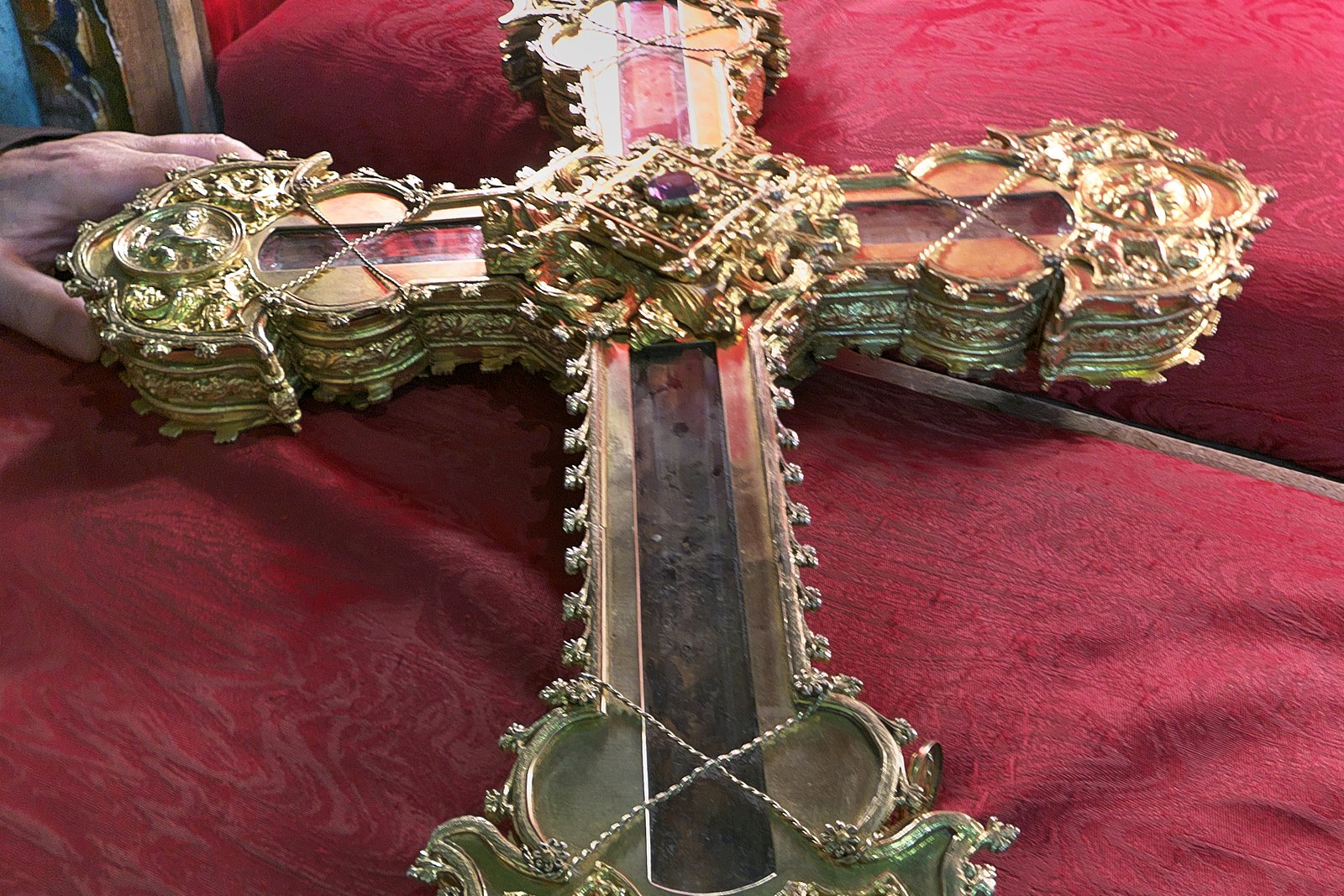
The pattern continued after Jerusalem's main relic was carried to Constantinople, where it became the city's most prized sacred object until the catastrophe of 1204, when crusaders sacked the Byzantine capital during the Fourth Crusade. Relics looted or distributed in the chaos scattered further across Western Europe, feeding reliquaries in France, Germany, Italy, and beyond. By the late medieval period, fragments of the True Cross — genuine, dubious, and outright fraudulent — had become one of the most widely claimed relics in Christendom, kept in cathedral treasuries, monastery chapels, royal collections, and the personal reliquaries of nobles who wore slivers of wood around their necks as protective pendants, a practice Saint John Chrysostom mentions already in the 4th century.
Where fragments are venerated today
Santa Croce in Gerusalemme in Rome remains one of the most historically continuous holders, its relic chapel also displaying what is venerated as a fragment of the titulus inscription, a nail, and two thorns traditionally associated with the crown of thorns. In Paris, Notre-Dame Cathedral holds its own fragment of the True Cross alongside its far more famous relic, the Crown of Thorns — both were dramatically rescued from the cathedral's 2019 fire by the Paris fire brigade's chaplain, Father Jean-Marc Fournier, and both were returned to the restored cathedral in the years since. Other long-documented fragments are venerated at monasteries and cathedrals across the Christian East and West, from Mount Athos to Toledo, each with its own chain of custody stretching back, in varying degrees of documentary solidity, toward Jerusalem or Constantinople.
"Enough wood to build a ship"?
The sheer number of claimed fragments invited skepticism early, and the most famous jab at the whole tradition comes from the Protestant reformer John Calvin, who argued in his 16th-century treatise on relics that if every splinter venerated as part of the True Cross were gathered together, the pile would be large enough to fill a ship — an absurdity, he suggested, given that the Gospels describe a single condemned man (or in some accounts, Simon of Cyrene) carrying the actual cross alone.
It's a memorable line, and it stuck for centuries as shorthand for relic-skepticism generally. But it was also directly tested. In the 19th century, a French scholar named Charles Rohault de Fleury set out to catalogue every documented fragment of the True Cross he could find worldwide, and calculated their combined volume against an estimate of the original cross's size. His conclusion, published in 1870, was that all known surviving fragments together amounted to well under a third of the wood a typical Roman execution cross would have required — nowhere near Calvin's "shipload." That calculation doesn't prove any individual fragment is authentic; it only shows that the overall quantity in circulation isn't, by itself, a knockdown argument against the tradition. The deeper question — whether any specific splinter in any specific reliquary actually touched Golgotha in the first century — remains, as with so many ancient relics, a matter of faith and historical probability rather than scientific certainty.
The Feast of the Exaltation of the Holy Cross
The liturgical calendar preserves a direct echo of this history on September 14, the Feast of the Exaltation of the Holy Cross. The date originally marked the dedication, in 335 AD, of the basilica Constantine built over both Calvary and the Holy Sepulchre in Jerusalem — the same complex connected to Helena's discovery nine years earlier. Later tradition layered a second commemoration onto the same date: the Byzantine emperor Heraclius's recovery of the cross in the early 7th century, after it had been carried off by the Persian Empire during their sack of Jerusalem, and his restoration of the relic to the city. The feast remains one of the principal observances connected to the Cross in the Church's calendar, distinct from Good Friday's commemoration of the crucifixion itself — this feast celebrates the Cross as a triumphant sign, not a scene of suffering.
What the Church actually says about certainty
It would be easy to read this whole history and conclude the Church stakes its credibility on a particular splinter of wood being provably first-century. It doesn't. The Second Council of Nicaea, in 787 AD, settled the Church's theology of relics and sacred images on different grounds entirely: the honor shown to a relic or image, the council taught, "passes to the prototype" — meaning the veneration directed at an object ultimately reaches the person or event it represents, not the material object itself treated as something divine in its own right. The Catechism of the Catholic Church reflects the same logic today, listing "the veneration of relics" among the Church's encouraged forms of popular piety (no. 1674) while grounding devotion to sacred images more broadly in the mystery of the Incarnation rather than in forensic verification (no. 1192).
In practice, that means a Catholic can venerate a fragment of the True Cross — bow before it, ask for its intercession in prayer, feel moved by standing near it — without the Church requiring, or even offering, a guarantee that the specific piece of wood in front of them was cut from a tree in first-century Judea. That posture has let the devotion survive centuries of reasonable skepticism intact: whether or not any single fragment could pass a modern dendrochronology test, the tradition they all point toward — the belief that the instrument of Christ's death became, through the Resurrection, a sign of victory rather than defeat — is the thing actually being venerated. The splinters are simply how that larger memory took physical, portable, and strangely enduring form.
Trivia
Who discovered the True Cross, and when?
Where are fragments of the True Cross kept today?
Is it true that there's enough 'True Cross' wood in circulation to build a ship?
What is the Feast of the Exaltation of the Holy Cross?
Does the Catholic Church teach that any specific fragment is authentically from Christ's cross?
Related Reading