The Holy Nails: Relics of the Crucifixion Across Europe

A nail that outlived an empire's memory of itself
For most of the Roman world, a crucifixion nail was the cheapest, most disposable object imaginable — a few inches of iron, driven in and left to rust once the body came down. Nobody was meant to keep one, let alone venerate it centuries later in a cathedral. And yet, by the fourth century, Christian tradition already spoke of specific nails from Christ's own crucifixion being recovered, kept, and distributed as treasured relics — a reversal of fortune for a few scraps of iron that only makes sense in light of what Christians believed had happened on the cross they pierced.
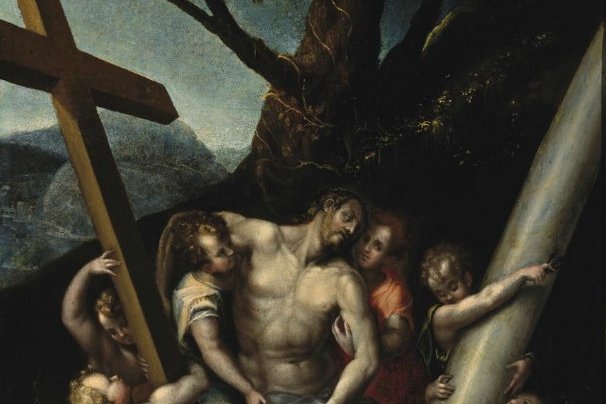
Lavinia Fontana, Christ with the Symbols of the Passion (1576), El Paso Museum of Art. Public domain, via Wikimedia Commons.
What the Gospels actually say — and what archaeology adds
Scripture is spare on this point. All four Gospels record that Christ was crucified (Matthew 27:35, Mark 15:24, Luke 23:33, John 19:18), and John separately notes the wounds in his hands were still visible to the apostle Thomas after the Resurrection (John 20:25), but none of the Gospel writers describes the nailing itself, names a number of nails, or says what became of them afterward. The tradition of three or four nails — a count familiar from centuries of crucifixion paintings, including angels cradling three nails in works like the one accompanying this article — grew out of later devotional art and reflection, not out of any explicit biblical count.
What the Gospels don't supply in physical detail, archaeology has partly filled in from an entirely different direction. In 1968, construction work near Jerusalem, in a neighborhood now called Givat ha-Mivtar, broke into a first-century Jewish burial cave. Inside one ossuary — a stone box used to hold a deceased person's bones after their flesh had decayed — were the remains of a young man identified by an inscription as Yehohanan. His right heel bone (the calcaneum) still had an iron nail driven through it, roughly four and a half inches long, with a fragment of olive wood caught between the nail's head and the bone; the tip of the nail had been bent into a hook, apparently after striking a knot in the upright beam, which is likely why it was never recovered and reused — the usual Roman practice, since nails were valuable enough to be salvaged. Yehohanan lived and died sometime in the first century, within decades of the Gospel events. His heel bone remains, to this day, the only direct archaeological confirmation that Roman crucifixion in Judea really did involve driving iron nails through a condemned man's limbs — exactly the physical reality the Passion narratives, and the later relic tradition built on them, both assume.
Saint Helena's search and the nails that followed the Cross
The nails enter Christian tradition by the same route as the True Cross itself. According to the tradition recorded by several fourth-century writers, Saint Helena, mother of the emperor Constantine, directed excavations in Jerusalem around 326 AD that uncovered what was venerated as the wood of the Crucifixion — and, in some versions of the story, nails recovered alongside it. Unlike the Cross, which was deliberately broken into countless fragments and dispersed for veneration across the Christian world (a history this site's companion article on fragments of the True Cross traces in full), the nails followed their own, more scattered paths into legend: one is said to have been fashioned by Helena into a bit for Constantine's horse, another worked into his helmet as a mark of imperial protection, and others distributed to churches and rulers as gifts of extraordinary sanctity. As with the True Cross, the earliest and most detailed versions of these specific nail stories come from devotional writers working decades after Helena's own lifetime, which is part of why the Catholic Encyclopedia's own 1911 entry on the subject treats the finer details with evident caution even while affirming the broader tradition of multiple nail relics reaching back to antiquity.
Milan's Santo Chiodo and the Rite of the Nivola
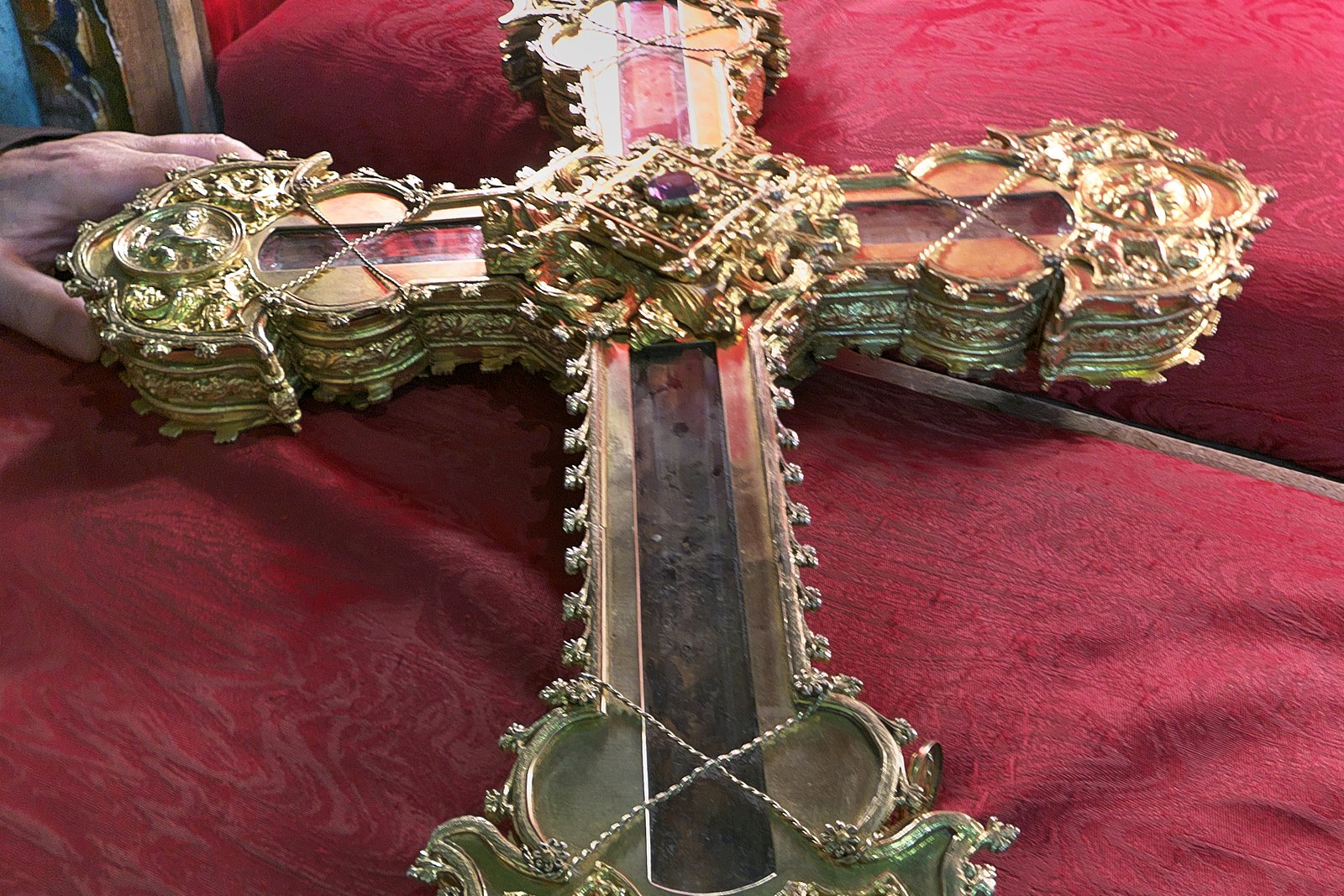
Of all the Holy Nail relics venerated today, none is tied to a more theatrical annual ceremony than the one kept in Milan Cathedral, the Duomo. Known as the Santo Chiodo, this nail is preserved inside a small case, inside a tabernacle, set roughly 45 meters above the main altar in the vault of the apse — far too high to reach by any ordinary ladder or scaffold. Once a year, on the Saturday closest to September 14 (the Feast of the Exaltation of the Holy Cross, the same feast connected to Helena's discovery of the True Cross), the Archbishop of Milan is raised to the tabernacle aboard an elaborate lift known as the Nivola — "cloud" in the old Milanese dialect — decorated with painted canvas clouds and angels to resemble a cloud bearing him upward. He retrieves the relic and brings it down to the altar, where it remains on public display for roughly forty hours before being returned to its resting place. The ceremony in its current form dates to the 16th century, encouraged by Saint Charles Borromeo, the reforming Archbishop of Milan during the Counter-Reformation, who also introduced a solemn procession carrying the relic through the city's streets.
Other claimed nails: the Iron Crown, Trier, Siena, Rome
Milan's is far from the only Holy Nail relic venerated in Europe. A short distance away, in Monza Cathedral, the Iron Crown of Lombardy — the crown used for centuries to coronate kings and emperors of northern Italy, including, at various points, Charlemagne and Napoleon — is said by long tradition to contain, worked into its narrow inner band, a nail of the Crucifixion, which is part of why it carries the name "iron" crown despite being made primarily of gold. Trier, in Germany, and Siena, in Tuscany, both maintain their own venerated Holy Nail relics with centuries of local devotional history behind them. In Rome, the Basilica of Santa Croce in Gerusalemme — already the resting place of relics of the True Cross and the Crown of Thorns — displays what is venerated as one of the Crucifixion nails in its own relic chapel, and Santa Maria Maggiore has long been associated with devotion to a nail relic as well, reflecting the broader pattern, familiar from the True Cross itself, by which relics of the Passion accumulated in Rome's major basilicas as the city became the Western Church's principal center.
Multiple nails, one tradition: what the Church actually says
Laid side by side, these relics obviously cannot all be the literal, single nail of any one crucifixion event — a tension the Church has never tried to resolve by declaring one relic authentic and dismissing the rest. As with the True Cross and the Spear of Longinus, which faces the identical problem of several rival relics making the same claim, the Church's actual theology of relics doesn't require that kind of adjudication. The Catechism of the Catholic Church lists "the veneration of relics" among the Church's encouraged forms of popular piety (no. 1674), and the underlying principle, affirmed by the Second Council of Nicaea in 787 AD, is that honor shown to a relic "passes to the prototype" it represents — the historical reality of Christ's Passion — rather than requiring certainty that a specific scrap of iron in a specific tabernacle is the exact nail that pierced his flesh.
That distinction is what allows Milan, Trier, Siena, and Rome to each honor a nail without any of them needing to disprove the others. Whether or not forensic science could ever settle which, if any, of these relics touched Golgotha, the devotion surrounding all of them points toward the same historical and theological reality: an ordinary Roman execution, carried out with the same crude iron nails archaeologists have since recovered from an anonymous man's heel bone outside Jerusalem, became for Christians the instrument of a death they believe changed everything that followed it. The bent nail in Yehohanan's ossuary and the gleaming, venerated relic lifted on a painted cloud above Milan's altar are, in that sense, witnesses to the very same thing — one to the brutal historical fact of crucifixion, the other to the faith that found, in that fact, something worth keeping close for two thousand years.
Trivia
How many nails does tradition say were used to crucify Christ?
Where is the Holy Nail venerated in Milan?
Does the Iron Crown of Lombardy really contain a Holy Nail?
What is the Givat ha-Mivtar discovery, and what does it prove about crucifixion?
What does the Catholic Church teach about relics like the Holy Nails?
Related Reading