The Agnus Dei: The Pope's Wax Lamb of God Medallion

A small wax lamb with an outsized reputation
The Agnus Dei takes its name from the Latin words for "Lamb of God," the same phrase sung at Mass just before Communion. In sacramental form, it is a disc of wax — round or oval, usually small enough to fit in a palm — stamped with the image of a lamb, almost always shown carrying a small cross or flag. The reverse commonly carries a second image: a saint, or the name and coat of arms of the pope who had it made. Catholics have historically worn these discs on a cord around the neck, inside small cloth pouches, or kept them as objects of devotion in the home. The Catholic Encyclopedia classifies the Agnus Dei among the Church's "Sacramentals" — in the same category as holy water and blessed palms — meaning it is a blessed sign the Church offers to dispose the faithful toward grace, not an object with power of its own apart from the faith of the person using it, a distinction the Catechism spells out in its treatment of sacramentals (nos. 1667-1670).
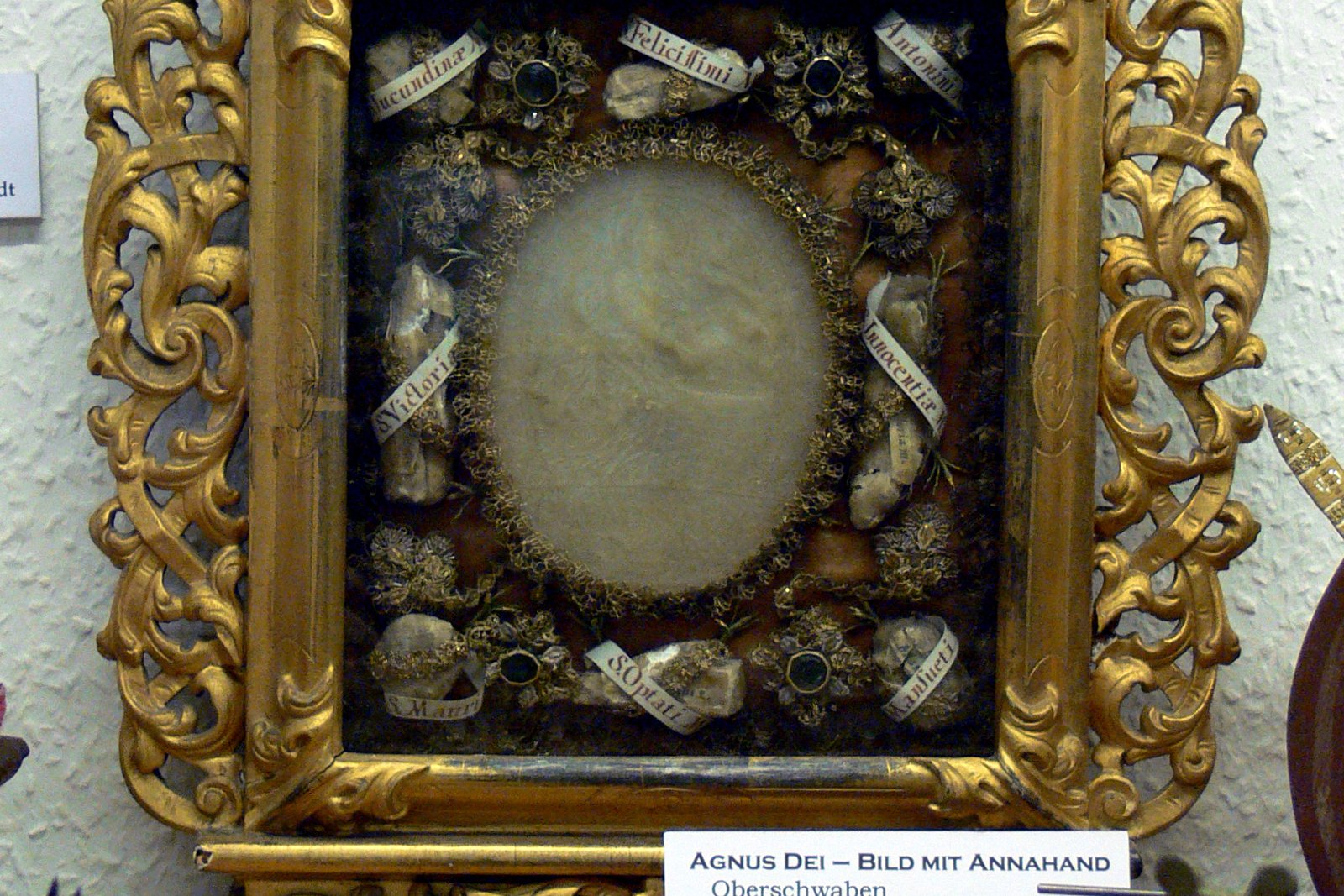
Andreas Praefcke, Agnus-Dei-Bild mit Annahand, Oberschwaben, c. 1740, Museum für Klosterkultur, Weingarten (on loan from the House of Waldburg-Wolfegg). Public domain, via Wikimedia Commons.
Origins lost somewhere before the ninth century
Historians admit they cannot pin down exactly when or how the Agnus Dei began. The Catholic Encyclopedia is candid that "recent authorities lay stress upon the lack of evidence for their existence before the ninth century," even while noting hints that push the custom earlier. One such clue comes from the sixth-century writer Ennodius, who around the year 510 described fragments of the Paschal candle being used as protection against storms and crop blight — a practice the Encyclopedia suggests may be the root from which the fully formed Agnus Dei later grew, once that same candle wax began to be shaped and stamped with the lamb image rather than simply broken into fragments.
By the time a text called the "Ordo Romanus" — a ninth-century liturgical handbook describing how Roman church ceremonies were actually performed — was compiled, the custom is already described as an established practice: the archdeacon of Rome made the discs early on Holy Saturday morning from clean wax mixed with chrism (perfumed oil blessed for sacred use), then distributed them to the people the following Saturday, a day traditionally called Sabbato in Albis. Some scholars have floated an earlier origin still, tracing a mention of wax being blessed under Pope Zosimus in 418, though the Encyclopedia itself treats that identification as uncertain, more likely referring to the Paschal candle itself than to a separate Agnus Dei. What is clear is that the earliest surviving physical specimen anyone can point to with confidence dates only to the time of Pope Gregory XI, around 1370 — a reminder of how much of this history survives only in written description, not in objects that lasted the centuries.
A gift fit for emperors — and a target for reformers
Once the custom took hold in Rome, Agnus Deis began traveling well beyond the city, carried as formal gifts between popes and heads of state. One of the better-documented examples is a verse letter that accompanied an Agnus Dei sent by Pope Urban V to the Byzantine emperor John Palaiologos in 1366 — evidence that by the fourteenth century the sacramental had become not just a devotional object for ordinary pilgrims but a diplomatic gesture carrying real symbolic weight between the papacy and distant rulers.
That same prominence made the Agnus Dei a target once the Reformation reshaped England's religious landscape. Under Queen Elizabeth I, Agnus Deis were named specifically in penal legislation among the "popish trumperies" whose importation into England was banned outright — a sign of just how closely the object had come to be identified with Catholic identity and papal authority, for better or worse depending on which side of the religious divide one stood.
The blessing: a ceremony tied to the rhythm of a pontificate
What sets the Agnus Dei apart from almost every other sacramental still blessed today is how rarely it has been performed in its full, traditional form. According to the Catholic Encyclopedia's account, "the great consecration of Agnus Deis took place only in the first year of each pontificate and every seventh year afterwards" — the Encyclopedia describes this as the rule "still followed" when the article was written in 1907, though the ceremony has grown markedly less frequent since.
The mechanics of the ritual, as the Encyclopedia describes it from a later period than the ninth-century archdeacon's original practice, moved the physical preparation off the pope's own hands: the wax discs were "prepared beforehand by certain monks, and without the use of chrism." Only on the Wednesday of Easter week were the finished discs brought before the pope, who then dipped them into a vessel of water mixed with chrism and balsam while reciting the formal prayers of consecration. The distribution that followed, on the Saturday after Easter, was itself a small ceremony of its own: after the "Agnus Dei" chant of the Mass, the pope placed a packet of the blessed discs into the upturned mitre (ceremonial headdress) of each cardinal and bishop who came forward to receive them — a vivid, specific detail of papal liturgical custom that few other sacramentals carry with them.
What the wax was believed to mean, and the Church's own caution
The symbolism attached to the Agnus Dei draws a direct line back through the Paschal candle to the Exodus account of the first Passover: as the blood of the sacrificial lamb once marked Israelite households for protection from the destroying angel (Exodus 12), the wax of the Agnus Dei — itself drawn from the candle that represents Christ's own flesh in the Easter liturgy — was blessed with prayers asking protection from storm, pestilence, fire, flood, and the particular dangers once attached to childbirth, according to the historical blessing formulas the Catholic Encyclopedia records.
It is worth pausing here on a distinction the Church has insisted on consistently, in connection with this sacramental and others like it: a sacramental's power works through the faith and disposition of the person using it, never automatically or independent of that faith. The Catechism is direct about where that line gets crossed into superstition, stating plainly that "to attribute the efficacy of prayers or of sacramental signs to their mere external performance, apart from the interior dispositions that they demand, is to fall into superstition" (CCC 2111). Popular piety across the centuries did not always observe that line as carefully as the Church's own theology insisted on: the Encyclopedia itself notes that "miraculous effects have been believed to follow the use of these objects of piety," including specific claims that fires were extinguished and floods stayed by an Agnus Dei's presence — folk beliefs the Church has permitted to circulate as popular devotion without ever formally endorsing them as guaranteed outcomes. The Church took the opposite problem just as seriously: papal bulls repeatedly prohibited the manufacture of counterfeit Agnus Deis, along with painting or otherwise ornamenting genuine ones, treating tampering with the blessed object as a real abuse to be corrected rather than a harmless embellishment.
A separate, grayer category existed alongside the true Agnus Dei: discs described as "Paste de' SS. Martiri," made from wax mixed with dust believed to come from the bones of early Christian martyrs. The Encyclopedia notes these needed no special papal consecration at all and were treated instead as relics in their own right — a reminder that "Agnus Dei" eventually came to cover more than one kind of sacred object sharing the same basic wax-disc form.
Why the Miraculous Medal and Saint Benedict Medal eclipsed it
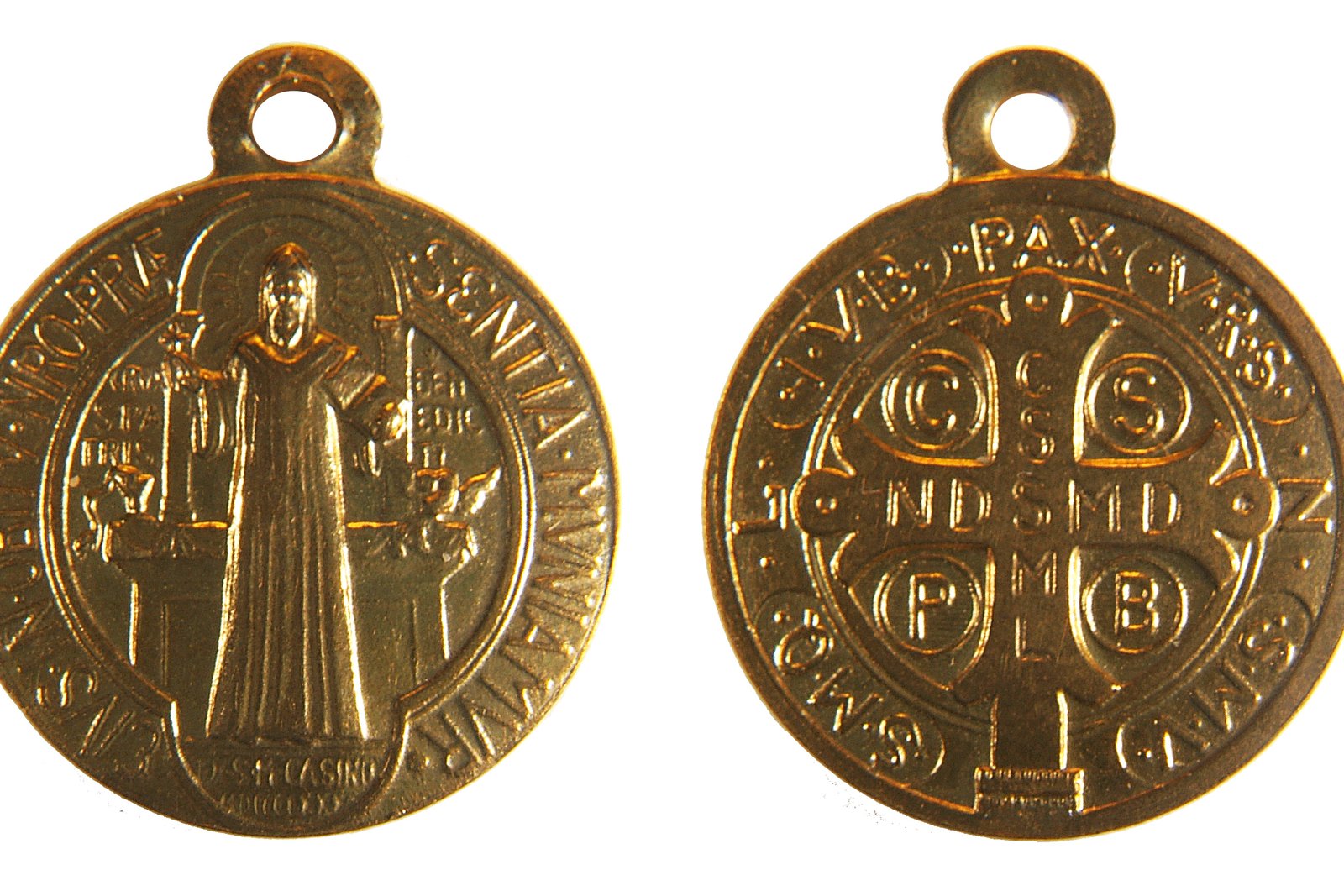
Anyone shopping for a Catholic sacramental today is far more likely to come across a Miraculous Medal or a Saint Benedict Medal than an Agnus Dei, and the reasons are mostly practical rather than theological. Both of those later sacramentals are made of durable stamped metal that any priest can bless on an ordinary day, and both can be produced in enormous quantities without waiting on a fixed liturgical calendar tied to a single pope's own schedule. The Agnus Dei, by contrast, depends on fragile wax and a ceremony the Catholic Encyclopedia itself describes as tied to "the first year of each pontificate and every seventh year afterwards" — a rhythm that, by its very design, could not keep pace with ordinary demand even in centuries when the devotion was at its height.
That rarity has not erased the Agnus Dei from Catholic life so much as moved it into a different register: museum collections like the Museum für Klosterkultur in Weingarten, Germany, preserve surviving examples such as the elaborately mounted eighteenth-century relief shown above, antique dealers occasionally offer genuine older specimens, and historically minded Catholics and scholars continue to study the ceremony's surviving texts. It remains, in the Catholic Encyclopedia's own account, one of the oldest sacramental objects the Church still formally recognizes — a small disc of wax carrying nearly a millennium and a half of papal history inside it, even if relatively few Catholics today have ever held one in their hands.
Trivia
What is an Agnus Dei medallion made of?
How often does the Pope bless Agnus Dei medallions?
What did people believe the Agnus Dei protected against?
Is the Agnus Dei the same thing as the Miraculous Medal or the Saint Benedict Medal?
Why don't Catholics see Agnus Dei medallions very often today?
Related Reading