The Saint Benedict Medal: History, Symbols, and Meaning

A cross that has outlived its own explanation
Nobody can say with certainty when the first medal bearing Saint Benedict's image was struck. What is documented is this: at some point, Benedictine communities began circling the cross on these medals with rows of capital letters, and for a long stretch of history, the meaning of those letters was simply forgotten by most of the people wearing them. According to the Catholic Encyclopedia and the Benedictine Confederation's own account, the puzzle wasn't solved until 1647, when a manuscript dated 1415 turned up at the Abbey of Metten in Bavaria, laying out exactly what the initials stood for: a short Latin prayer of exorcism against Satan. The medal, it turned out, had been carrying a spoken rite in abbreviated form the whole time, understood only by whoever still held the key.
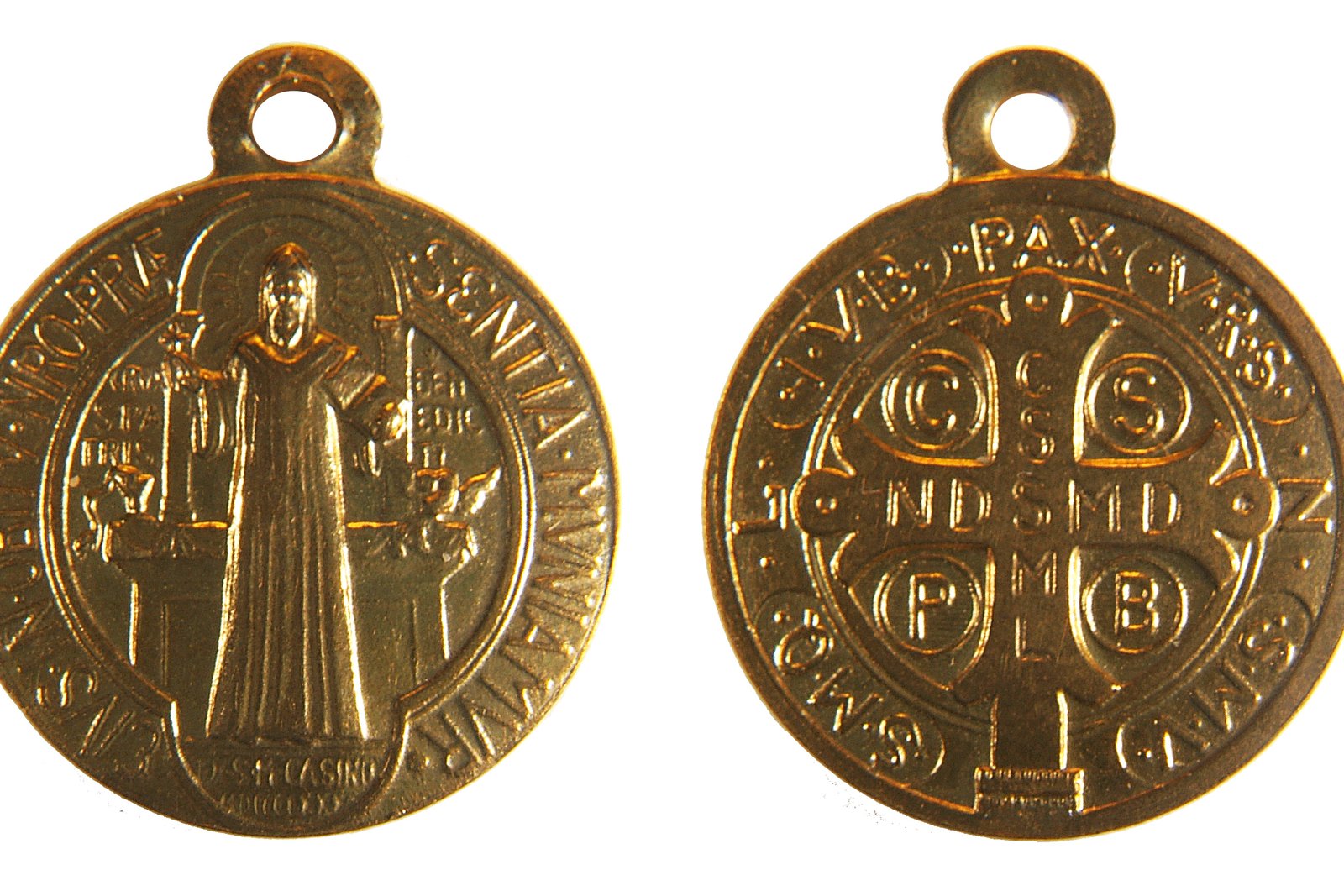
Saint Benedict Medal (Jubilee design), photograph by Gec00, 2011. CC0 1.0 Universal Public Domain Dedication, via Wikimedia Commons.
That key traces back to the man himself. Saint Benedict of Nursia, who tradition places in Italy in the sixth century, is remembered as the father of Western monasticism — the author of the Rule of Saint Benedict, the guide for communal monastic life that shaped Benedictine, and later many other, religious orders across Europe. He founded the abbey of Monte Cassino, south of Rome, where he lived out his final years and where, according to the account of Pope Gregory the Great's Dialogues, he died standing in prayer, supported by his brother monks. Monte Cassino has remained tied to his memory ever since, and it is that same monastery that today holds the exclusive right to strike the medal that bears his name.
The 1880 design that became the standard
The medal most people picture when they hear "Saint Benedict medal" is not the original form the devotion took, but a specific 19th-century redesign. In 1880, to mark the 1400th anniversary of Benedict's birth, the monks of Monte Cassino commissioned a new medal gathering together every element that had accumulated around the devotion over the centuries — the image of Benedict, the cross, the Latin inscriptions, the exorcism letters — into one standardized design. The artwork was produced at Beuron Archabbey in Germany at the request of Monte Cassino's prior, Boniface Krug, and the result became known as the Jubilee Medal. It proved so popular that, per the Benedictine Confederation's own history of the medal, it has outstripped every earlier version ever struck in Benedict's honor, and it is the design still produced and sold today.
What the front of the medal shows
On the obverse, Benedict stands holding a cross raised in his right hand and his Rule for Monasteries in his left. Beside him, on pedestals to either side, appear two smaller scenes drawn from stories told in Gregory the Great's Dialogues: a cup, shattered by the sign of the cross Benedict made over it after a jealous rival tried to poison him, and a raven, carrying off a loaf of poisoned bread sent to him by the same means. Above these images run the Latin words Crux s. Patris Benedicti — "The Cross of our Holy Father Benedict." Around the rim, encircling the whole figure, is a petition: Eius in obitu nostro praesentia muniamur — "May we be strengthened by his presence in the hour of our death," a line reflecting the Benedictine tradition of honoring Benedict as a patron of a peaceful death, tied directly to the account of how he himself died in prayer.
What the back actually spells out
The reverse is where the medal's reputation as a protective object against evil comes from most directly. A cross dominates the design, and on its arms run the initial letters of a short rhymed prayer: Crux Sacra Sit Mihi Lux, Nunquam Draco Sit Mihi Dux — "May the holy cross be my light; may the dragon never be my guide" — abbreviated as C S S M L on one arm and N D S M D on the other. In the four angles formed by the cross sit the letters C S P B, again for Crux Sancti Patris Benedicti. Above the cross is the single word Pax — "Peace," a motto long associated with Benedictine communities.
Around the outer rim of the reverse runs the longer, more pointed inscription: Vade Retro Satana, Nunquam Suade Mihi Vana, Sunt Mala Quae Libas, Ipse Venena Bibas — "Begone, Satan, never tempt me with your vanities; what you offer me is evil; drink the poison yourself." This is the Vade Retro Satana formula, the exorcism prayer whose initials — V R S N S M V, S M Q L I V B — are the very letters that puzzled the medal's owners for centuries before that 1415 manuscript explained them. It is a direct, almost combative line, and it is the clearest reason the medal has long been associated with protection against temptation and evil influence.
Sacramental, not charm
Because of that exorcism language, it's worth being precise about how the Church actually understands an object like this. A sacramental — the Church's term for a blessed object such as a medal, rosary, or holy water, distinct from a sacrament itself — is meant to dispose a person toward grace through faith and devotion, not to act automatically like a magic talisman. The Catechism of the Catholic Church addresses this directly: it warns that attributing a magical efficacy to sacramental signs "apart from the interior dispositions that they demand" is itself a form of superstition (CCC 2111). The Benedictine Confederation's own published explanation of the medal makes the identical point in plain language, stating outright that any use of religious articles "as if they were mere charms or had some magic power" runs against the Christian understanding of how such objects work. Worn with faith, the medal is a reminder and a prayer in miniature; worn as a lucky charm, it isn't functioning as the Church intends it.
A small object, still everywhere
Today the medal appears far beyond monastery gift shops — worked into rosaries, set at the center of crucifixes, pinned to lapels, or simply carried in a pocket or kept in a car. Some Catholics, following a tradition Benedictine sources describe, place the medal in the foundation of a new house or building as a blessing on the home itself. None of this requires any special or elaborate ritual; the devotion has always been simple by design; which is likely part of why, nearly a century and a half after that 1880 Jubilee redesign, it remains one of the most recognizable and most requested sacramentals connected to any single saint.
Trivia
What do the letters on the back of the Saint Benedict medal mean?
What does C S P B stand for on the Saint Benedict medal?
When was the Saint Benedict medal designed, and is it the original design?
Is wearing a Saint Benedict medal considered magic or superstition by the Catholic Church?
Who has the right to strike the official Saint Benedict medal?
Related Reading