The History of the Rosary as an Object: From Knotted Cords to Strings of Beads

Counting prayers before there was a rosary
The object now so familiar — a loop of beads divided into tens, ending in a crucifix — did not arrive fully formed. It grew out of a much older, much blunter human problem: how do you keep track of a prayer repeated hundreds of times a day without losing count?
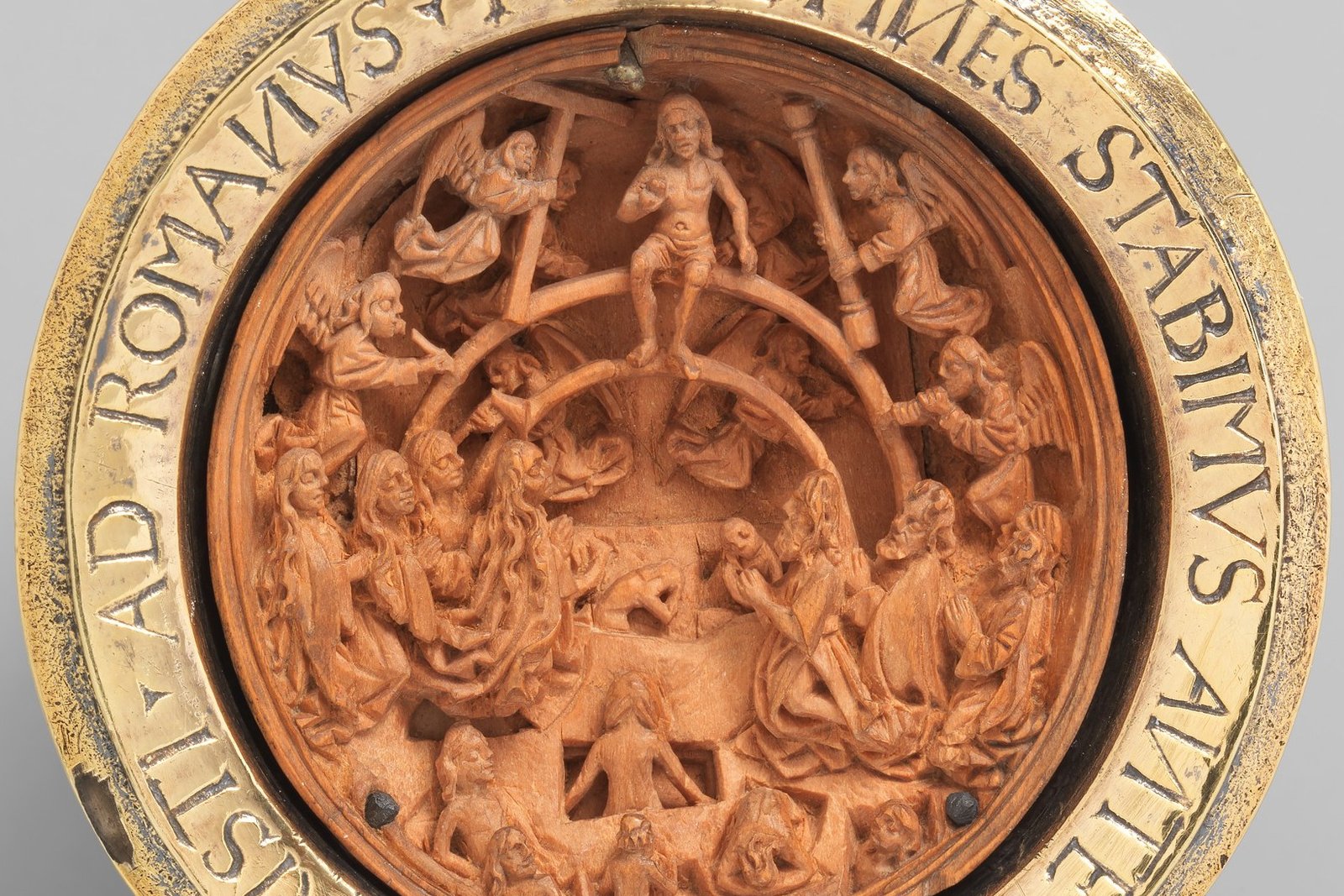
Unknown, Flemish, Rosary Bead, early 16th century, Metropolitan Museum of Art. CC0, via Wikimedia Commons.
The Catholic Encyclopedia's own historical survey traces prayer-counting devices back to the earliest Christian ascetics. In the fourth century, a hermit known as Paul the Hermit reportedly gathered three hundred pebbles each morning and discarded one for every prayer completed, according to the ancient account preserved by Palladius. Other desert ascetics are recorded using similar methods — a cribbage-board-like device with holes was found buried beside a fourth-century Christian ascetic named Thaias in Egypt, generally understood as another prayer-counting tool. In the Greek monastic world, a knotted cord called the kombologion or komboschoinion served the same purpose, used to count genuflexions and signs of the cross — a tradition still alive among Orthodox and Eastern Catholic monks today, sometimes called a "prayer rope" or, in Russian usage, a chotki.
From "paternosters" to a recognized craft
By the eleventh and twelfth centuries, something more durable than pebbles had taken hold in the West: strings of beads threaded from pebbles, berries, or discs of bone. The Catholic Encyclopedia cites the English Countess Godiva of Coventry, who around 1075 left a monastery "the circlet of precious stones which she had threaded on a cord in order that by fingering them one after another she might count her prayers exactly" — one of the earliest concrete records of the practice in Western Europe. Similar strings of beads were discovered in the tomb of Saint Rosalia, who died around 1160.
These objects were known across medieval Europe — and in some languages still are — as "paternosters," since they were used chiefly to count repetitions of the Lord's Prayer (the Hail Mary did not come into general devotional use until the mid-twelfth century, making it essentially certain that Godiva's beads were not counting Aves). The craft of making them became substantial enough to organize into formal guilds: by 1268, records examined by the Catholic Encyclopedia show four separate guilds of paternôtriers (bead-makers) operating in Paris alone, and London's own Paternoster Row, near St. Paul's Cathedral, preserves the memory of the street where English bead-makers once clustered their workshops.
The Dominic legend, and what historians actually found
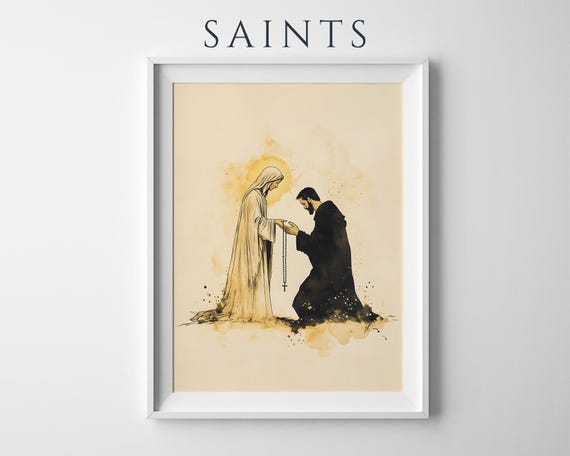
No part of the rosary's story is more persistent — or more carefully dismantled by the Church's own scholarship — than the claim that Saint Dominic received the rosary directly from the Virgin Mary as a weapon against the Albigensian heresy in the early thirteenth century. Successive popes repeated this claim in official documents for centuries, and it remains part of popular devotional memory.
But the Catholic Encyclopedia's detailed review of the historical evidence found the claim essentially unsupported. None of the eight or nine earliest biographies of Dominic mention the rosary at all. The witnesses who testified at his canonization process said nothing about it. Two and a half centuries of Dominican manuscripts, sermons, chronicles, and convent records are, in the Encyclopedia's own words, met with "absolute silence" on the subject — even the frescoes and tomb sculptures commemorating Dominic's life show no trace of it. Tracing the claim backward, the Bollandist scholars who investigated it found that it converged on one specific source: the preaching of a Dominican friar named Alan de Rupe around 1470-1475, roughly 250 years after Dominic's death. Several of the documents later used to support an earlier origin — including a supposed 1221 will and alleged eyewitness memoirs — were subsequently shown by scholars to be forgeries or misreadings of other texts.
What the evidence does support is more modest and, in its own way, more interesting: the beads for counting prayers and the practice of reciting 150 Hail Marys ("Our Lady's Psalter") both predate Dominic's lifetime, while the practice most central to the rosary as we know it today — meditating on specific mysteries while reciting each decade — only emerged roughly two centuries after Dominic's death, credited by the Encyclopedia's sources to a Carthusian monk named Dominic the Prussian (1382-1461). The rosary's explosive growth in popularity from the late fifteenth century onward is real and well documented; its invention by one saint in one moment is not. Most scholars, and increasingly the Church's own reference works, now favor this gradual, collective development over the single-origin legend — without denying that the Dominican order's later, genuine devotion to spreading the practice did more than any other single factor to carry it worldwide. (For how the prayer itself is actually recited today, and what each bead and mystery represents, see How to Pray the Rosary and The Meaning of the Catholic Rosary Beads.)
Materials: from carved boxwood to a soldier's scavenged wire
Once the string-of-beads form settled into something recognizable, its materials tracked the wealth and circumstance of whoever carried it. Surviving rosary beads from the fifteenth and sixteenth centuries, like the intricately carved Flemish boxwood bead held today at New York's Metropolitan Museum of Art, show the kind of miniature craftsmanship wealthy patrons could commission — scenes carved in relief at a scale smaller than a thumbnail. Noble households and religious foundations across the same period are recorded owning rosaries strung with coral, amber, silver, and precious stones, objects as much displays of status as instruments of devotion.
At the other end of the scale, ordinary parish rosaries were strung from whatever was cheap, durable, and locally available: olive wood (especially popular from the Holy Land), plain wooden discs, bone, or simple glass. This gap between luxury and ordinary craftsmanship persisted for centuries and remains visible today in the range of rosaries sold for everyday devotional use versus those made as fine jewelry or heirloom pieces.
War reshaped the object again in the twentieth century. According to the Imperial War Museum's own survey of First World War trench art, soldiers facing shortages — or simply wanting something made with their own hands — improvised rosaries from braided cord, scavenged wire, or metal fragments found in the field. Separately, chaplains and Catholic relief organizations distributed large numbers of simple, durable metal or chain-link rosaries to soldiers at the front; contrary to a persistent modern myth, these were not paid for or issued by any government, but came from church and charitable donations. Many of these military rosaries survive today in museum and private collections, valued less for their materials than for what they carried their owners through.
Blessed versus unblessed: when beads become a sacramental
Not every rosary sold in a shop is, in the Church's own technical sense, a devotional object yet. An unblessed rosary is simply beads and a cord — well made or poorly made, but spiritually inert until a priest, or someone given the faculty to do so, blesses it. The Catechism of the Catholic Church (nos. 1667-1670) describes sacramentals as "sacred signs" instituted by the Church that "prepare men to receive the fruit of the sacraments and sanctify different circumstances of life" — language that applies directly to the rosary once blessed. The blessing does not alter the physical object in any way; it changes how the Church understands its use, and many Catholics seek a second or subsequent blessing for a rosary carried through a pilgrimage, received at a shrine, or passed down through a family.
Objects that outlived their owners
Some rosaries have become historical artifacts in their own right, tied permanently to a particular person or moment rather than to general devotional use — the rosary found or reported in connection with a saint's own life becomes, in Catholic practice, something closer to a relic than an ordinary sacramental, carrying the specific weight of having belonged to someone the Church holds up as holy. The broader pattern recurs across Catholic history: an object that began as a simple counting tool for an individual's private prayer ends up preserved, displayed, or venerated precisely because of whose hands once held it.
That arc — from anonymous pebbles in a desert hermit's pouch to a named, carved, catalogued artifact in a museum case — is really the whole history of the rosary as an object in miniature. The prayer it was built to count has stayed remarkably stable across sixteen centuries. The thing doing the counting has been remade again and again, in wood, bone, glass, silver, and scavenged wire, by whoever needed to keep track of how many times they had asked for help.
Trivia
Did Saint Dominic really invent the rosary?
What came before the string-of-beads rosary?
What's the difference between a blessed and an unblessed rosary?
What were trench rosaries made of during the First World War?
Why are rosary beads sometimes called a 'chaplet'?
Related Reading