Arma Christi: The Instruments of the Passion in Medieval Art

A body made of objects, not a scene
Most medieval images of the crucifixion show a narrative moment — Christ on the cross, Mary and John standing below, perhaps the two thieves on either side. Arma Christi images do something stranger. They typically show Christ alone, usually upright or seated, his wounds visible, his body marked by suffering but often his eyes open, meeting the viewer's gaze directly. This particular pose — neither fully dead nor depicted mid-crucifixion — became known in art history as the "Man of Sorrows" (a phrase borrowed from Isaiah 53:3, "a man of suffering"), and it's the figure most often surrounded by the Arma Christi.
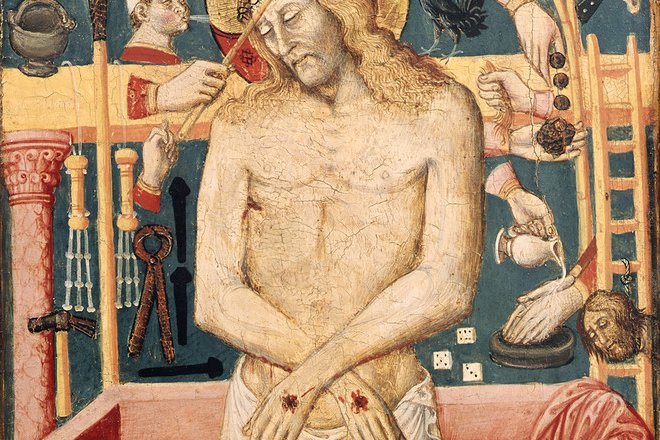
Unknown Umbrian artist, Christ as the Man of Sorrows Surrounded by the Arma Christi (late 15th century), Wallraf-Richartz-Museum, Cologne. Public domain, via Wikimedia Commons.
Around that figure, artists scattered the physical evidence of everything that had been done to him: the crown of thorns pressed onto his head, the nails that pierced his hands and feet, the lance that opened his side, the sponge soaked in vinegar offered to his lips, the dice the soldiers rolled for his seamless robe, the rooster that crowed as Peter denied knowing him three times, the thirty coins Judas took for his betrayal. None of these objects appears together in any single verse of the Gospels — the dice and the rooster belong to entirely separate moments in the Passion narrative, hours apart, told by different evangelists. The Arma Christi doesn't follow the Gospels' sequence at all. It compresses the whole story into one still frame, trading chronology for simultaneity, so that everything that happened to Christ during his final hours could be taken in at a glance — or, more precisely, meditated on slowly, one object at a time.
Where the motif came from
The individual pieces of this iconography have deep roots. The cross itself had already been established as a Christian symbol of victory — the crux invicta, or "unconquered cross" — as early as the 4th century, long before anyone thought to surround it with the other instruments. According to Wikipedia's overview of the tradition (cross-checked against the broader scholarly consensus it cites), the earliest known grouping of several Passion instruments together, rather than the cross standing alone, appears in the Utrecht Psalter, a Carolingian manuscript from around 830 AD — making the basic idea nearly a thousand years older than its most famous artistic flowering.
That flowering came in the Late Middle Ages, roughly the 13th through 15th centuries, when devotional interest in Christ's physical suffering intensified dramatically across Western Europe. The compositional type became common in manuscript illumination, in carved wooden misericords (the small ledges tucked beneath the hinged seats of church choir stalls, often carved with surprisingly playful or grim imagery, meant to give standing clergy brief relief during long services), and in panel paintings commissioned for side altars and private devotion — precisely the kind of small, intimate image meant for one person's prayer rather than a whole congregation's liturgy. A Middle English poem simply titled "Arma Christi," composed before the close of the 14th century, survives in some fifteen manuscript copies, several of them unrolled as long devotional scrolls meant to be displayed in church as a visual aid for public prayer. According to these manuscripts, gazing on the accompanying pictures of the instruments carried the promise of a specific indulgence — a popular medieval belief about time remitted from purgatory, tied to the act of devout viewing itself, though it's worth being careful here: that's a claim from medieval popular literature and devotional practice, not a formal doctrine of the Church, and the Church's own later theology of indulgences (see the Catechism, nos. 1471-1479) developed along considerably more careful lines than some of this popular literature suggests.
A grouping, not a single relic
It's worth being precise about what the Arma Christi actually is, because the name can mislead. This is not a relic in the sense that a fragment of the True Cross or the Holy Lance preserved at a particular shrine is a relic — a physical object with a claimed chain of custody back to the first century. The Arma Christi is an artistic and devotional motif: a way of composing an image, not a physical artifact anyone could touch or venerate directly. Several of the individual objects it depicts do correspond to relics venerated in specific churches — splinters of the True Cross kept at Santa Croce in Gerusalemme in Rome, the lance traditions preserved at St. Peter's Basilica and at Etchmiadzin in Armenia, the Veil of Veronica associated with St. Peter's — but the grouped image itself was never an object of pilgrimage. No church ever claimed to possess "the Arma Christi" the way one might claim to possess a nail from the crucifixion. It existed purely as a compositional device, repeated across thousands of manuscripts, panels, and carvings, to give the devout a single, memorizable image containing the entire Passion.
That distinction matters for anyone approaching this topic after reading about individual Passion relics elsewhere — a reader coming from an article on the True Cross or the Holy Lance might reasonably wonder whether the Arma Christi is some larger reliquary collecting all of them in one place. It isn't. It's closer to a medieval mnemonic device, a way of organizing meditation on the Passion into discrete, visualizable steps — which is exactly the function the Stations of the Cross would later formalize into its own distinct, more narrative sequence of fourteen moments, as the USCCB's own description of that devotion makes clear.
Theology behind the "weapons" framing
The Latin word arma — weapons or arms, in the heraldic sense — carries a deliberate irony. The objects it names were instruments of torture and humiliation: whips, nails, a crown meant to mock rather than honor. Calling them Christ's own "weapons" reflects a specific theological reading of the Passion that had deep patristic roots long before the Middle Ages formalized it in art — the idea that Christ's apparent defeat on Golgotha was, in traditional Christian understanding, the very means of his victory over sin, death, and Satan. The instruments used against him become, in this reading, paradoxically his own armament: the tools by which (in the language the tradition favored) he "conquered" rather than simply died. This framing sits alongside, without displacing, the Gospels' own more sober and historical account of the events themselves — Matthew, Mark, Luke, and John each narrate the arrest, trial, scourging, and crucifixion as real historical suffering, and the Church has always held both things together: the literal reality of Christ's pain, and the theological meaning later tradition and art drew out of it.
From panel paintings to the Stations of the Cross
The grouped Arma Christi composition faded as a dominant art form after the Renaissance, giving way to other ways of depicting the Passion. But the devotional instinct behind it never disappeared — it simply found a new, more narrative structure in the Stations of the Cross, the sequence of fourteen (traditionally) meditative stops tracing Christ's final journey from condemnation to burial, still prayed today in Catholic parishes worldwide, especially during Lent. Where the Arma Christi offered a single, compressed image containing every instrument at once, the Stations spread the same essential content — the physical and emotional stages of the Passion — into a walkable, step-by-step sequence. The underlying impulse is identical: take an event too vast and theologically dense to absorb all at once, and break it into discrete, contemplatable pieces.
Individual pieces of the old Arma Christi vocabulary also live on independently, far outside their original grouped-image context. The cross, the crown of thorns, and the nails remain some of the most recognizable symbols in all of Christian art and devotional jewelry — a visual language so familiar today that most people who encounter a crucifix or a thorn-crown pendant have no idea they're looking at objects that once stood, quite literally, side by side in a single medieval panel painting, arranged around the wounded body of Christ as a complete, memorizable map of everything his Passion had cost.
Trivia
What does the term 'Arma Christi' mean?
What objects are typically shown in an Arma Christi image?
Is Arma Christi the same thing as a relic of the True Cross or the Holy Lance?
Did looking at an Arma Christi image actually grant an indulgence in the Middle Ages?
Is the Arma Christi tradition still used in Catholic art today?
Related Reading