The Black Nazarene of Manila

A statue that outran its own paperwork
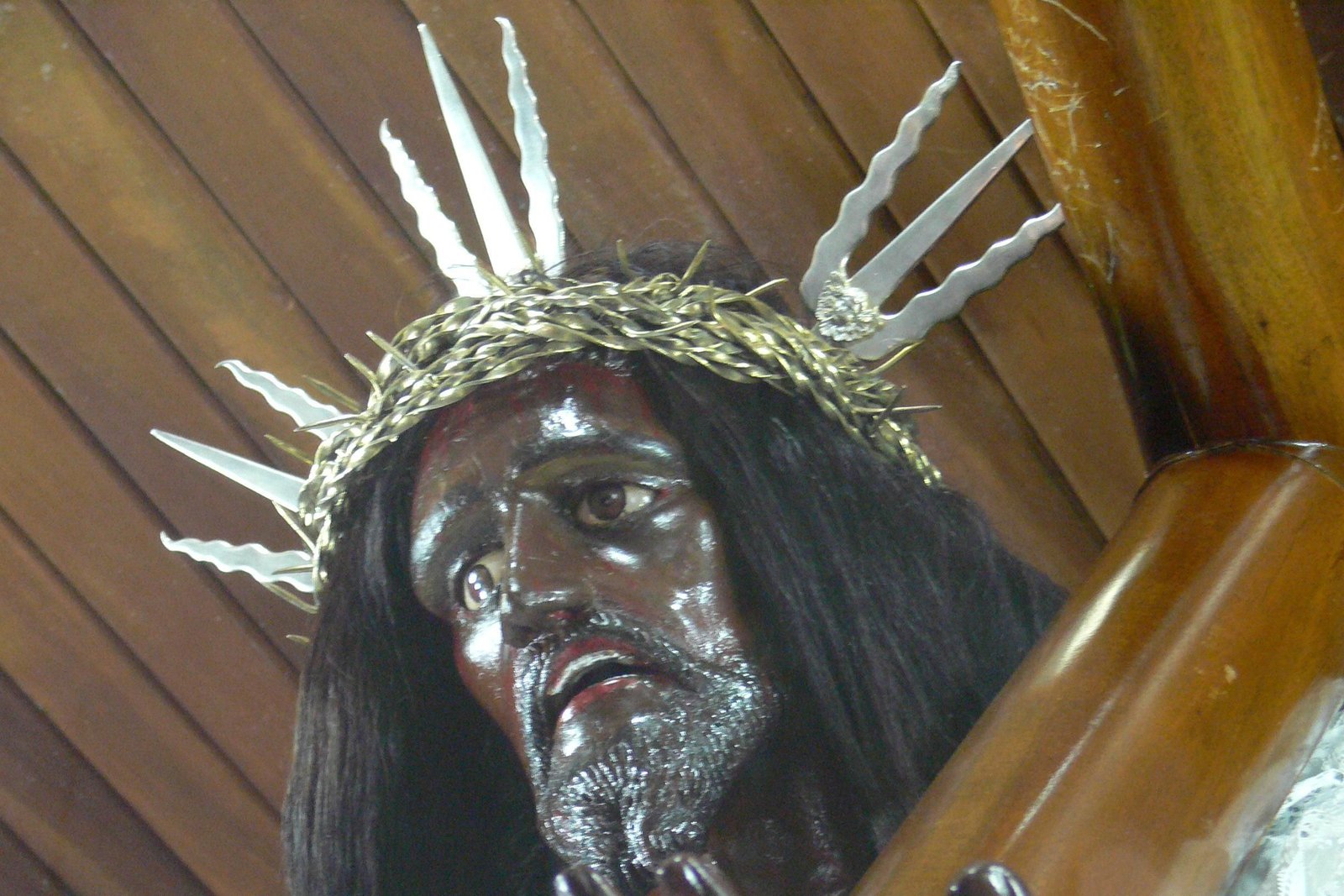
Few venerated images anywhere in the Catholic world draw crowds on the scale of the Black Nazarene, and few come with a history quite this hard to pin down. The statue at the center of the devotion — a life-sized, dark-wood carving of Jesus Christ bent forward under the weight of the cross he carries, dressed in maroon and gold, barefoot like the devotees who follow him — is enshrined at the Minor Basilica and National Shrine of Jesus Nazareno, better known simply as Quiapo Church, in the heart of Manila. According to the devotion's own Wikipedia-documented history, no one can say with certainty who carved it, exactly when it reached the Philippines, or precisely when it was moved to the church where it now stands. What is certain is the scale of what it has become: a national feast day, a procession numbered among the largest annual religious gatherings on Earth, and a figure Filipino Catholics have turned to for four centuries.
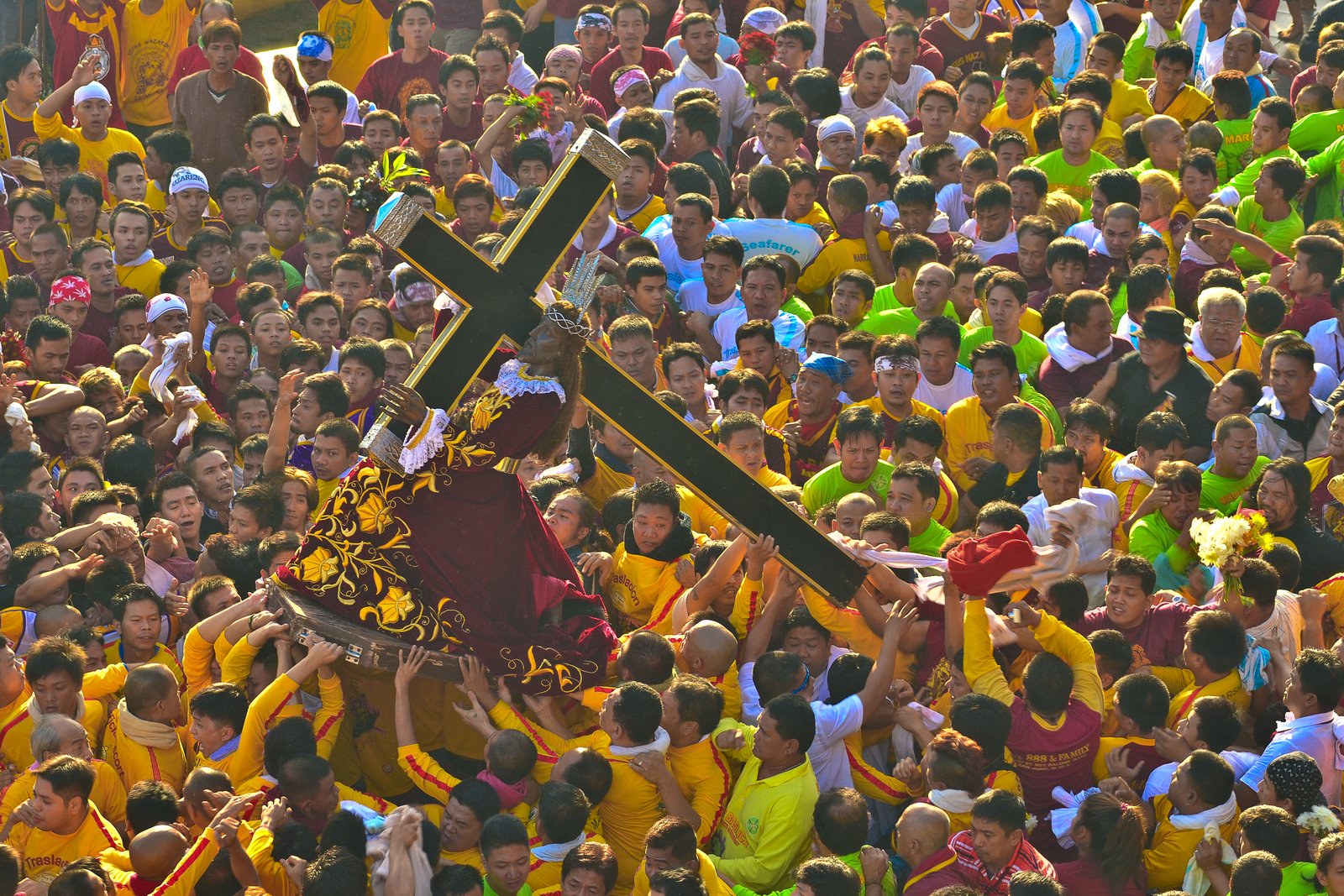
Jsinglador, Feast of Black Nazarene, Quiapo, Manila, photograph, 2012. CC BY-SA 3.0, via Wikimedia Commons.
From Acapulco to Luneta
The statue's documented origin lies not in the Philippines but across the Pacific, in New Spain. It was carved by an anonymous Mexican sculptor and transported to Manila aboard one of the Spanish galleons that, for two and a half centuries, carried goods, settlers, and devotional images between Acapulco and the Philippines along the Manila-Acapulco trade route. Beyond that, the record thins out quickly. The Augustinian Recollect friars, the religious order credited with bringing the image into Filipino devotional life, stated that the Nazareno was not actually among the sacred images they carried with them when they themselves arrived in the islands in 1606 — which rules out that specific date as the image's arrival, even though it has often been cited as such. The only firm anchor historians have is indirect: Pope Innocent X authorized the formation of a confraternity dedicated to "Nuestro Padre Jesús Nazareno" in 1650, which means the devotion, and presumably the statue itself, was already established in Manila by then.
The image was first enshrined in the Church of San Juan Bautista, an Augustinian Recollect church in the Bagumbayan district near what is now Manila's Luneta park. From there it was moved to the Church of San Nicolás de Tolentino inside the walled city of Intramuros, where it stood at the high altar for generations — until, under the archbishopric of Basílio Sáncho de Santa Justa y Rufina (1767-1787), a copy of the image was ordered transferred to Quiapo Church, reportedly to give ordinary devotees easier access to it and to keep Intramuros, a restricted Spanish colonial enclave, more secure from outside crowds. Popular tradition dates that transfer to January 9, 1787, and that date became the basis for the modern feast — but, as with the statue's arrival, no surviving historical document actually confirms either the year or the day.
Why "black"
The question people ask most about the statue is also the one with the least settled answer. The most widely repeated legend holds that the image was originally a lighter color and was charred dark by a fire aboard the galleon that carried it from Mexico — a dramatic, almost providential origin story for the name "Black Nazarene." A more sober counter-explanation comes from Monsignor Sabino Vengco, a Filipino Catholic theologian and church historian, who argued after his own research in Mexico that the statue was never charred at all: he identified the wood as mesquite, a material he found was commonly used by sculptors working in that region and period, and noted that mesquite carvings are simply dark throughout, not burned. He pointed to other dark-complexioned Mexican Christ images of similar style and material, such as the Señor de Chalma, as comparable examples. A third, less dramatic factor sometimes cited is simply centuries of soot accumulated from votive candles burned in front of the image by generations of devotees. The Catholic Church has never formally adjudicated which explanation is correct, and it's worth being direct about that: the "charred by fire" story is best described as cherished legend rather than documented fact, however often it gets repeated as settled history.
In October 2024, the Archdiocese of Manila under Cardinal Jose Advincula made a notable move away from the name altogether, officially redesignating the church and the image as "Jesús Nazareno" rather than "Black Nazarene" — a decision explained as an effort to center devotion on Christ's holy name rather than on "a color or attribute." The older name remains in overwhelming popular use.
The image is not one single object
One detail that often surprises newcomers to the devotion is that there is no single, complete original statue in the way many venerated images are a single continuous object. Over the centuries the original image was damaged and its surviving pieces distributed between two composite figures that both carry the name. The Venerado, enshrined above the high altar, combines a 1980s replica body with the original head and right foot. The Vicário, the image actually carried in procession, retains the original body and torso but wears a replica head carved in the 1980s after the rector feared the aging original might be damaged during the rigors of the annual procession. Other original fragments — the original hands and left foot — are kept separately and used only for private blessings of the sick and dying, not displayed publicly. The composite nature of the image hasn't diminished devotion to it in the slightest; if anything, each surviving original fragment is treated with its own intense reverence.
The Traslación: one of the largest gatherings on Earth
The annual centerpiece of the devotion is the Traslación, held every January 9 and named for the historic transfer the procession is meant to commemorate. Devotees — overwhelmingly dressed in the maroon and yellow associated with the image, many walking the entire route barefoot as an act of penance echoing Christ's own walk to Golgotha — pull the statue's wheeled carriage, the ándas, through the streets of Manila by long ropes, with hundreds of marshals called the Hijos del Nazareno forming an honor guard around it. The scale involved is difficult to overstate: authorities estimated roughly 6.5 million participants in the 2024 procession and over 8 million in 2025, among the largest annual religious gatherings anywhere in the world. The route and duration vary considerably year to year depending on crowd density, weather, and mechanical problems with the carriage itself — the fastest Traslación on record, in 2007, took about nine hours; several years in the 2010s took roughly 20 to 22 hours; and the 2026 procession became the longest ever recorded, lasting more than 30 hours after ropes repeatedly snapped and the crowd's sheer density slowed progress to a crawl.
That scale comes with real, documented risk, and it deserves to be stated plainly rather than glossed over. The jostling, heat, and crush of a crowd in the millions produces injuries every single year, treated on-site by the Philippine Red Cross and city health teams: more than 800 people were treated for injuries in the 2018 Traslación alone, and several hundred more in subsequent years, with deaths also reported in multiple recent processions from causes including trampling, cardiac events, and heat exhaustion. Philippine authorities and Quiapo Church organizers have made repeated safety changes in response — shortening or altering the route, redesigning the ándas with reinforced wheels and barriers, and in 2024 and 2026 building the carriage with tempered glass enclosures and, eventually, motorized assistance — precisely because the devotion's intensity has made crowd safety an ongoing, unresolved challenge rather than a solved one.
Touch, cloth, and popular piety
Central to how devotees relate to the image is the belief that physical contact with it — touching the statue directly, or wiping a handkerchief or small towel against it, a practice especially concentrated around the rope nearest the image's right shoulder, called the Kanang Balikat — can bring healing or other favors. This custom has a long pedigree in Catholic popular devotion generally, echoing the ancient practice of touching cloth to relics or to the tombs of saints in the hope that the cloth itself would carry some of that sanctity outward, a practice with roots going back to how early Christians treated the tombs of the apostles. It's important to be precise about what kind of claim this is, though: this is popular piety, a form of devotion the Church tolerates and, within reason, encourages as an expression of faith, but it is not defined Catholic doctrine. The Church has never taught that touching the statue guarantees a cure, and no healing associated with the Black Nazarene has gone through the kind of formal medical and theological investigation the Church requires before recognizing something as a verified miracle. What the devotion does represent, unambiguously, is a profoundly sincere expression of faith carried by millions of ordinary people, year after year, often at real physical cost to themselves.
A symbol larger than the statue itself
Four centuries after an anonymous sculptor in Mexico finished carving it, the Black Nazarene has become something that exceeds any single explanation of its origin or its color. It is, for many Filipino Catholics, inseparable from national and cultural identity itself — a devotion that crosses economic class, draws overseas Filipino workers home or to Filipino community processions abroad, and turns a single January day into the country's largest annual expression of lived faith. Whatever the honest, unresolved uncertainties in its documented history — the missing arrival date, the disputed cause of its color, the composite nature of the image itself — the devotion surrounding it has never needed those gaps filled in to sustain four hundred years of continuous, growing veneration.
Trivia
What is the Black Nazarene?
Where did the statue come from?
Why is the statue black?
What is the Traslación?
Does touching the statue actually heal people?
Related Reading