The Black Christ of Portobelo

A statue the harbor itself seems to have produced
The Church of San Felipe sits a short walk from Portobelo's waterfront, in a town whose entire reason for existing, historically, was the harbor outside its door — this was one of the Spanish empire's great Caribbean transshipment ports, where silver mined in Peru was loaded onto galleons bound for Spain, and where, for that same reason, Spanish traders brought enslaved Africans ashore by the thousands over more than two centuries. It is fitting, in a way neither the Church nor historians have ever fully resolved, that the town's most venerated object is a statue nobody can say with certainty where it actually came from.
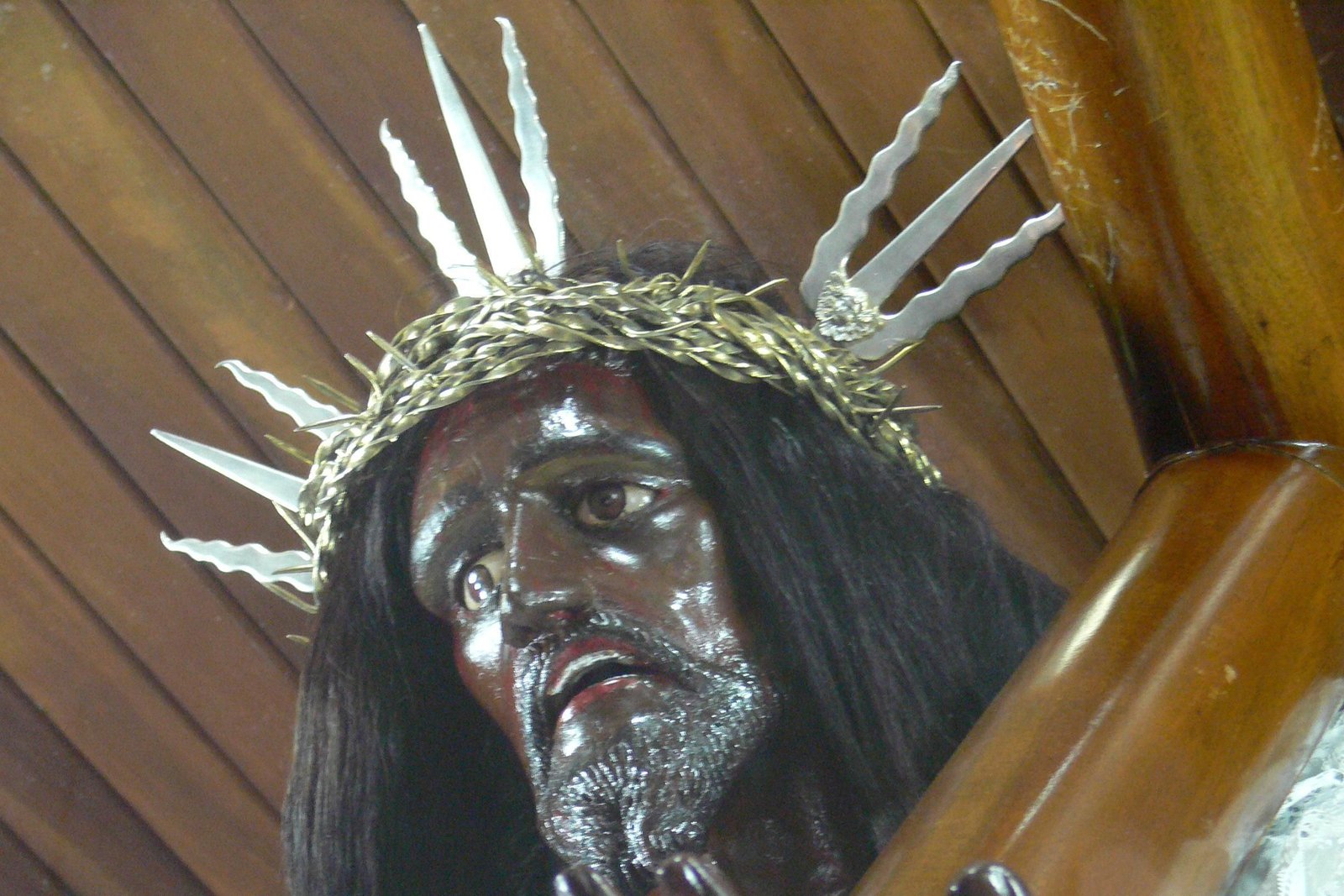
Nat Edwards, El Cristo Negro, Iglesia de San Felipe, Portobelo, Panama, photograph. Public domain, via Wikimedia Commons.
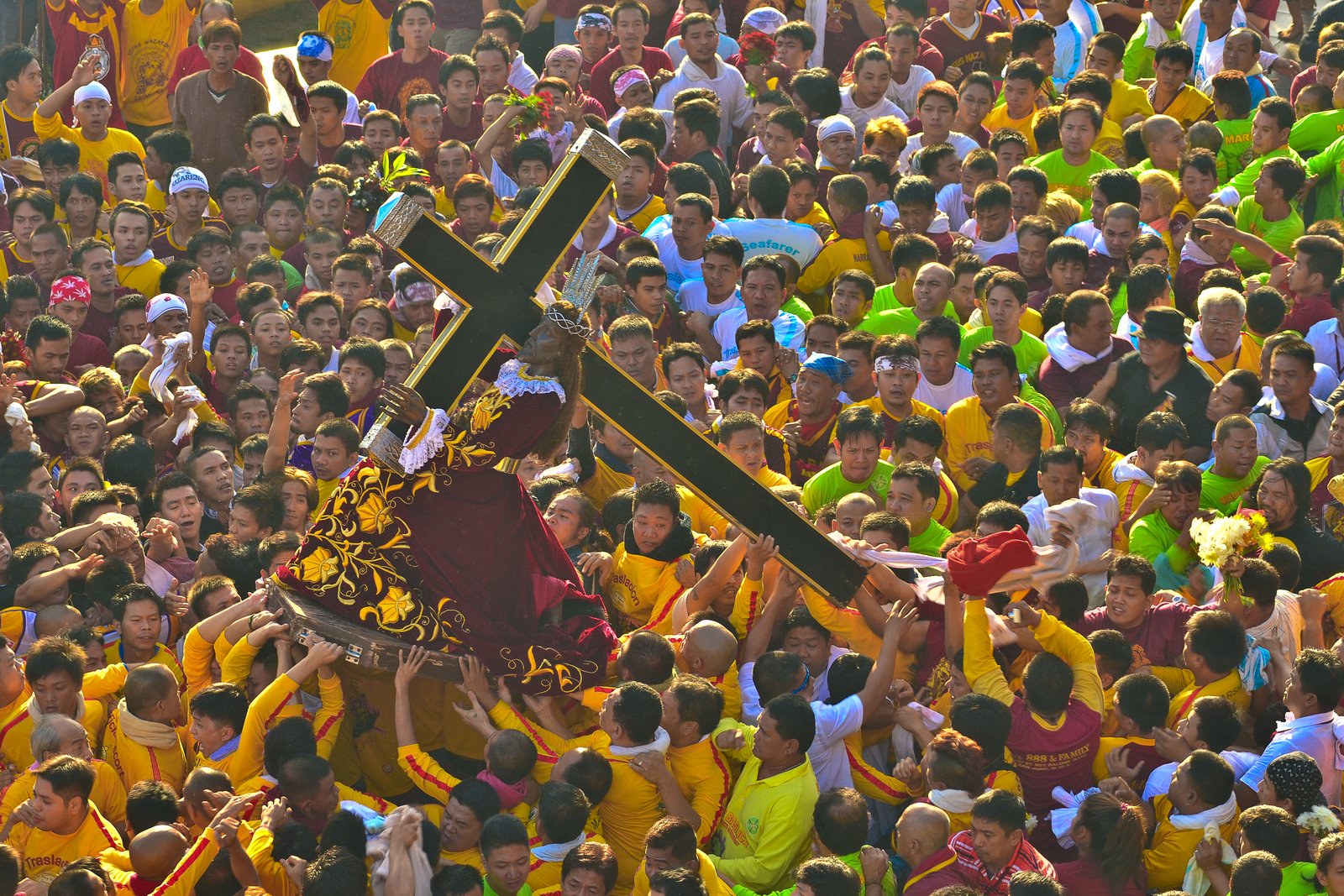
The image itself is unmistakable: a life-sized, dark wooden figure of Christ bent under the weight of the cross he carries, crowned with thorns, his expression carved with visible emotional strain rather than serene composure. According to Wikipedia's account of the statue, it is carved from cocobolo, a dense, naturally dark-brown tropical hardwood — which matters, because it rules out one common assumption people make on first seeing the statue, that its color comes from fire damage or centuries of candle soot, the explanation often given for a very similar image, the Black Nazarene of Manila. In Portobelo's case, by contrast, the wood itself was simply carved dark from the start.
Competing legends, no settled record
Ask how the statue arrived in Portobelo and you will get several different answers, often from the same source within a single paragraph — and that inconsistency is itself the honest historical picture, not a gap to be smoothed over. One widely told version holds that the image washed ashore in a crate, recovered from the water by local fishermen and carried to a small church before the present Church of San Felipe existed to house it. A second, frequently repeated legend describes a ship, bound from Spain or Colombia to deliver the statue elsewhere in the New World, that found itself unable to leave Portobelo's harbor — turned back again and again by sudden storms despite otherwise calm conditions, according to Wikipedia's summary of the story. Only once the crew, reading the pattern as a providential sign, threw the crate containing the statue overboard did the ship finally sail on without incident.
A third account, considerably less dramatic, simply dates the statue's carving to 1814, the same year construction finished on the Church of San Felipe itself — which would make it a commissioned image rather than a mysterious arrival at all. Historians researching the statue have not been able to adjudicate definitively among these stories; what can be said is only that the carving's style is consistent with Spanish and broader Latin American colonial-era religious woodworking, and that popular tradition has settled on 1658 as the year of its arrival, though even that date rests on tradition rather than a surviving document. None of this uncertainty has slowed the devotion down in the slightest — if anything, a statue whose own arrival reads like an act of providence has only deepened the sense among the faithful that it was placed there for a reason.
A symbol that carries more than one kind of weight
What makes the Black Christ of Portobelo distinct from other venerated dark-wood images of Christ carrying the cross is how deeply its devotion has become intertwined with Afro-Panamanian identity specifically. Portobelo and the surrounding Colón region have been shaped, across nearly five centuries, by multiple waves of African and Afro-Caribbean presence — enslaved Africans brought by Spanish colonists beginning in the early 1500s to move goods across the isthmus, and, centuries later, formerly enslaved Caribbean laborers who arrived to build the Panama Railroad and then the Panama Canal, many of whom settled permanently in the Colón region once that work was done. By the early twentieth century, Afro-Caribbean residents made up the majority population there, and Portobelo in particular became a center of Afro-Panamanian cultural life.
Against that backdrop, the Festival del Cristo Negro carries a meaning for many participants that runs alongside, not in place of, its Catholic devotional core. Theologian S. Kyle Johnson, writing in an essay for The Conversation cited by Smithsonian Magazine, describes the festival as functioning for many Afro-Panamanians as "a form of protest against Spanish colonialism, which brought with it slavery and racism" — a way of claiming a central Christian image as their own, in a Church whose colonial-era leadership, as Johnson and other scholars note, too often tolerated or justified slavery rather than opposing it. It's worth being precise about what this claim is and isn't: this is a layer of cultural and historical meaning that devotees themselves bring to the festival, documented by scholars studying the devotion, not an interpretation the Catholic Church has officially taught or incorporated into its own liturgy for the feast. Some writers on the subject also note points of devotional overlap between the festival and broader Afro-Caribbean religious traditions in the region, a connection worth noting honestly, without overstating it as something the Church itself endorses or recognizes as doctrine.
October 21, and a cholera story nobody can fully verify
The festival's date is itself wrapped in a piece of pious tradition that deserves the same honest treatment as the statue's origin story. A commonly repeated account ties October 21 to the town being spared from a severe epidemic — most often described as cholera, though other versions of the story name a more generic plague or smallpox, and the sources disagree on the exact year as well, with some pointing to 1821. In the telling, as the disease spread through the wider region, residents who prayed before the Black Christ saw the outbreak pass Portobelo by, and the date was fixed afterward as an annual day of thanksgiving. No single verified historical record confirms this chain of events, and given how much the details shift between versions, it is best understood plainly as devotional tradition rather than settled history — the kind of story a community tells about why it gathers, which doesn't require documentary proof to carry real meaning for the people who tell it.
The procession and the robe
Whatever its disputed origins, the modern festival itself is extensively documented, and its scale is considerable: reporting from the Associated Press and Smithsonian Magazine puts attendance at the 2022 and 2024 festivals somewhere between 60,000 and 200,000 visitors to a town of around 5,000 permanent residents. Pilgrims arrive from across Panama in the days beforehand, many on foot — some walking more than 50 miles from Panama City itself, enduring rain and difficult terrain along the way. A number of devotees cover the final approach to the church crawling or advancing on their knees, a visible act of penance and petition that has become one of the festival's most recognizable images, captured in photographs of the day every year.
The statue itself is central to this physical devotion in a very literal way: throughout the year it is dressed in robes that devotees donate, often anonymously, and once a robe has been worn it is retired rather than reused — a tradition that has produced a dedicated museum, the Museo del Cristo Negro, housed in a former 17th-century hospital building behind the Church of San Felipe, which by 2010 already held some sixty retired robes. For the October 21 festival specifically, the statue wears a new robe, traditionally in red or wine-colored fabric, distinct from the purple worn during Holy Week; some of these robes are simple cloth, others elaborately embroidered with gold thread, each one a devotee's individual expression of faith and penance. After an evening Mass, the statue is carried out of the church and through Portobelo's streets in a procession that draws the bulk of the day's crowd, before being returned to its place near midnight, where, as with the Black Nazarene's own January procession in Manila, the physical effort and crowding involved are an accepted part of what the devotion asks of the people who take part in it.
A devotion that keeps its own questions open
Four centuries on from whatever its actual arrival looked like, the Black Christ of Portobelo has become something larger than any one explanation of its past. It is a devotional object whose unresolved history — the competing legends, the uncertain date, even the disputed reason for its October festival — has not weakened the faith built around it in the slightest. If anything, the gaps themselves have left room for successive generations of the faithful, from colonial-era sailors to the Afro-Panamanian pilgrims who walk to Portobelo every October today, to find their own reasons for making that long, difficult, often literally knee-worn journey to stand before it.
Trivia
What is the Black Christ of Portobelo?
How did the statue end up in Portobelo?
Why is the statue's color significant to its devotees?
What happens during the October 21 festival?
Is the October 21 date tied to a true historical event?
Related Reading