The Pallium: The Pope's Wool Band and What It Means

A strip of wool with an outsized reputation
Among all the vestments and regalia that mark rank within the Catholic Church, few are as visually modest and as symbolically loaded as the pallium. It isn't gold, isn't jeweled, and isn't especially large — just a narrow circular band of white wool, worn around the neck with two short pendants hanging down the front and back, marked with a small number of dark silk crosses. And yet its use is so tightly restricted, and so laden with meaning about a bishop's relationship to Rome, that receiving one marks one of the defining moments in a new archbishop's ministry.
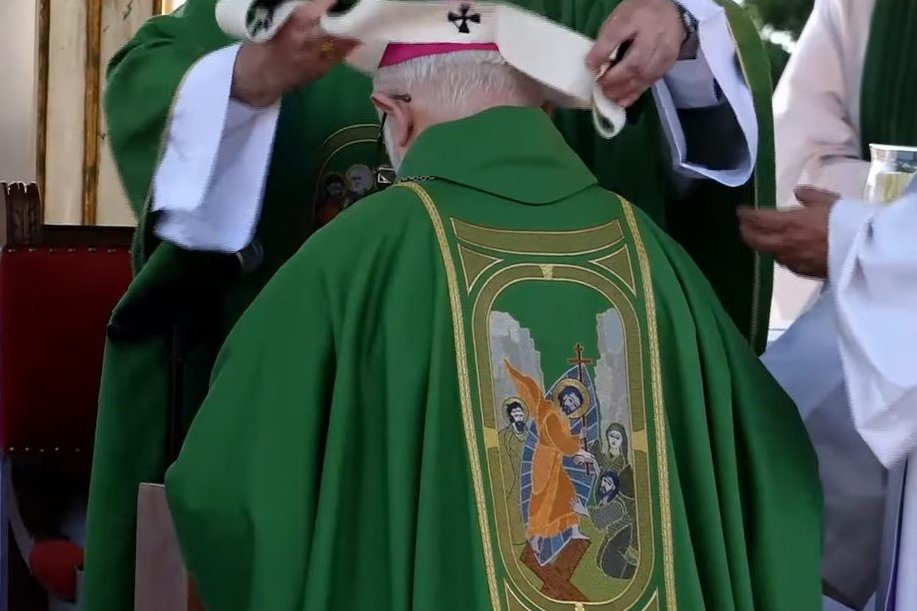
Romanuspontifex, Imposition of the archiepiscopal pallium to Celestino Aós (2020). Via Wikimedia Commons, CC BY-SA 2.0.
Roman roots, not strictly Christian ones
The pallium's history reaches back further than most people assume, and doesn't begin as a specifically Christian invention at all. Historians generally trace its origins to elements of Roman imperial and consular dress from late antiquity — the last centuries of the Roman Empire, when various officials wore bands or scarves of cloth as marks of rank. Christian tradition adapted the form for its own purposes, and by at least the 6th century, clear documentary evidence shows the pallium functioning as a liturgical vestment with a settled symbolic meaning, worn first and most distinctively by the pope himself before its use was extended, by papal grant, to other senior bishops.
Over the following centuries, that extension solidified into the pattern still followed today: the pallium became reserved for metropolitan archbishops, the archbishops who preside over an ecclesiastical province made up of several dioceses, rather than for bishops generally. Receiving the pallium came to mark, specifically, an archbishop's communion with the See of Rome and his sharing, within his own province, in a portion of the pope's own pastoral authority — not merely a promotion in rank, but a formal bond to the universal Church's visible center of unity.
Why lambs, and why Saint Agnes
The pallium's material carries its own small piece of tradition, built on a coincidence of language rather than any direct connection to its namesake saint. Each year on January 21, the Feast of Saint Agnes, two lambs are ceremonially blessed at the Basilica of Sant'Agnese fuori le Mura — "Saint Agnes Outside the Walls" — one of Rome's ancient basilicas built over the site associated with her burial. Their wool is later shorn, woven, and set aside, destined to become the material from which that year's new pallia are made.
The connection to Agnes rests on wordplay: her name sounds remarkably like the Latin word agnus, meaning "lamb," which made the pairing of her feast day with a ceremony involving literal lambs an appealing, almost poetic fit for medieval minds attuned to this kind of symbolic resonance. Agnes's actual name, though, has nothing to do with sheep at all — it derives from the Greek word hagnē, meaning "pure" or "chaste," a meaning entirely in keeping with her veneration as a young virgin martyr of the early Church. The lamb connection is a later linguistic coincidence that stuck, not an etymological fact, and it's worth being plain about that distinction even while describing a custom that has endured for centuries regardless.
Kept near Peter's tomb before it travels
Once woven, the new pallia traditionally spend time in one of the most symbolically significant locations available anywhere in the Catholic world: a niche near the tomb of Saint Peter, beneath the high altar of St. Peter's Basilica. Leaving the pallia there before their conferral is a deliberate, physical way of tying each new archbishop's authority back to Peter himself, whom Catholic teaching holds as the first among the apostles and the rock on which, in Christ's words, the Church would be built (Matthew 16:18). The pope blesses the pallia, and that act of blessing, carried out in proximity to Peter's own resting place, has long been understood as binding each new metropolitan's ministry to that same apostolic foundation.
A change Pope Francis made in 2015
For centuries, the culmination of this process was a personal ceremony in Rome: newly appointed metropolitan archbishops from around the world would travel to St. Peter's Basilica on June 29, the Feast of Saints Peter and Paul, to receive the pallium directly from the pope's own hands. In 2015, Pope Francis altered that practice. The pope still blesses the year's pallia in Rome on the feast day as before, but new archbishops no longer necessarily travel to Rome to receive them personally from him. Instead, the pallium is sent to and conferred on each archbishop within his own home diocese, typically by the apostolic nuncio — the pope's official representative in that country — in a ceremony held locally rather than in St. Peter's Basilica itself.
The change was framed by the Holy See at the time as an emphasis on the local, pastoral character of an archbishop's bond with his own people, rather than a diminishment of the bond to Rome that the pallium has always represented. It was nonetheless a real and noted departure from a practice that had held, essentially unchanged in its broad outline, for a very long time — a reminder that even the most tradition-bound vestments in the Church's life remain subject to the judgment of the pope currently wearing one.
A small vestment, a real distinction
Unlike many other items of ecclesiastical dress that have become largely decorative over the centuries, the pallium's restricted use has never loosened. Only the pope and metropolitan archbishops may wear it, and even an archbishop entitled to one may only wear it within his own ecclesiastical province — not as a general mark of rank he carries wherever he travels. That narrowness is exactly the point. A vestment nearly anyone could wear would communicate very little; one reserved this tightly, woven each year from wool blessed in a specific Roman basilica and laid briefly near the tomb of the apostle the Catholic Church regards as its first bishop, still manages to say a great deal with very little fabric at all.
Trivia
What is the pallium and what does it symbolize?
How old is the pallium as a vestment?
Why is the pallium's wool connected to Saint Agnes?
Where are new pallia kept before they're given to archbishops?
Did Pope Francis change how the pallium is given to new archbishops?
Who is allowed to wear a pallium today?
Related Reading