The Original Painting of Our Lady Undoer of Knots

A painting nobody outside Bavaria had reason to know
Walk into St. Peter am Perlach — the Perlach Church, named for the medieval watchtower that still stands beside it in the middle of Augsburg's old town — and you'll find a painting that, for most of its existence, drew almost no attention beyond the parish itself. It's a sizable Baroque canvas, oil on poplar wood, a little over six feet tall, painted around 1700 by a local artist named Johann Georg Melchior Schmidtner. Augsburg at the time was a prosperous Bavarian city with no shortage of church art, and this particular piece — a devotional image known in German as a Gnadenbild, literally a "grace image," commissioned for private veneration rather than civic spectacle — simply took its place among many others.
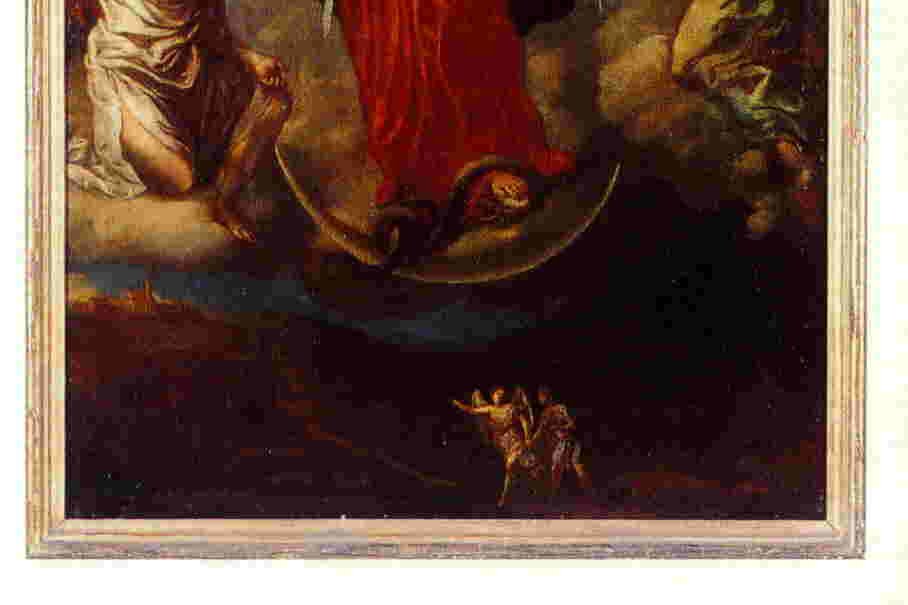
Johann Georg Melchior Schmidtner, Mary, Untier of Knots, c. 1700, St. Peter am Perlach, Augsburg, Germany. Public domain, via Wikimedia Commons.
What makes the painting unusual isn't its size or its technique. It's the composition. Mary stands on a crescent moon, crowned by a ring of stars, with the Holy Spirit hovering above her in the form of a dove — the familiar visual language the Church uses for the Immaculate Conception and for the "woman clothed with the sun" of Revelation 12. Angels surround her. But instead of the usual folded hands or outstretched arms, she's busy with something specific and almost domestic: untying a long white ribbon, working a series of knots loose one at a time, while her foot presses down on the head of a knotted serpent beneath her. Below the main scene, a smaller pair of figures — usually read as the Archangel Raphael guiding the young Tobias from the Book of Tobit — travels along a path, a quiet echo of divine guidance offered to someone in distress.
The thanksgiving story — and what historians actually know
The painting is traditionally said to have been commissioned by Hieronymus Ambrosius Langenmantel, a canon of the Augsburg monastery and a doctor of canon law, around 1700. The story attached to it concerns his grandparents: Wolfgang Langenmantel and his wife, Sophia Rentz, whose marriage was reportedly on the verge of collapse in the early 17th century. According to the tradition, Wolfgang sought help from a Jesuit priest named Jakob Rem in nearby Ingolstadt, who prayed before an image of Mary and declared, in the words later attributed to him, "In this religious act, I raise the bonds of matrimony, to untie all knots and smoothen them." The separation, the story goes, never happened — and decades later, their grandson commissioned this painting in thanksgiving, giving Mary the specific title of "Untier of Knots."
It's a moving story, and it's worth being honest about what kind of claim it actually is. Researchers have not found contemporary evidence tying the painting's commission to that particular family episode, and the German historian Dr. Leo Hintermayr has traced the specific narrative — as it's told today, with its named grandparents and its exact wording from Fr. Rem — to sources no older than the second half of the 20th century. That doesn't mean the core devotional idea is a modern invention; venerating Mary as one who "unties" spiritual and relational difficulty has much older roots. It does mean the charming family-rescue anecdote attached to this specific painting should be read as a pious tradition that grew up around the image over time, not as a documented 1700s event.
An idea far older than the painting
The theological concept behind the image long predates Schmidtner's canvas by more than fifteen centuries. It traces back to St. Irenaeus of Lyons, a second-century bishop and one of the earliest Church Fathers to write systematically about Mary's role in salvation. In his work Against the Heresies, Irenaeus drew a direct parallel between Eve and Mary: where Eve's disobedience had, in a sense, "bound" humanity through disbelief, Mary's obedient "yes" at the Annunciation loosened that same bind. The Catechism of the Catholic Church (paragraph 494) still quotes the Church Fathers on exactly this point: "The knot of Eve's disobedience was untied by Mary's obedience: what the virgin Eve bound through her disbelief, Mary loosened by her faith." Schmidtner's painting gives that centuries-old theological image — knots loosened through Mary's faithful cooperation with God — a literal, visual form: an actual ribbon, actually being untied, one knot at a time.
From a Bavarian parish to the chapel of a future pope
For roughly 250 years, that's where the story mostly stayed — a respected but regional devotional image, known in Augsburg, largely unknown everywhere else. The turn came through a young Argentine Jesuit named Jorge Mario Bergoglio, who spent part of the 1980s pursuing theological studies in Germany. The popular version of the story has long held that Bergoglio saw the actual painting in Augsburg and brought a copy home. Pope Francis himself corrected that account directly: in a 2017 interview with the German newsweekly Die Zeit, he said he had never been to Augsburg at all. What actually happened, by his own telling, was smaller and more personal — a German nun he'd met sent him a Christmas card showing the image, and something about it stayed with him.
Back in Argentina, Bergoglio had copies of the image made and distributed, including to the poor neighborhoods of Buenos Aires, where he later said people were struck by the idea of Mary as someone who actively works through the tangled, specific problems of ordinary life — debt, illness, strained marriages, unemployment — rather than a distant, idealized figure. He commissioned a German exchange student, Barbara Klimmeck, to document the Augsburg original in careful detail so a faithful copy could be painted in Buenos Aires by the artist Ana de Betta Berti. That copy was enshrined at the Church of San José del Talar in Buenos Aires on December 8, 1996, where to this day thousands of pilgrims gather on the eighth of each month to pray before it.
A regional devotion goes global
Devotion to Mary, Untier of Knots, spread through Argentina and then into Brazil over the following years, becoming — as one Brazilian religious-studies researcher described it to The Guardian — something close to a popular "religious craze," particularly among people facing small, specific, frustrating problems rather than life-and-death crises. The first chapel formally dedicated to the title was completed in Styria, Austria, in 1989, offered as a prayer following the Chernobyl nuclear disaster.
But the real turning point was 2013. When Cardinal Bergoglio was elected Pope Francis, the devotion he'd quietly carried with him for three decades went with him onto the world stage. He had already had the image engraved on a chalice he gave to Pope Benedict XVI years earlier; another chalice bearing the same image was later presented to Francis himself by the Argentine people. Suddenly a painting that had spent two and a half centuries known mainly to one Bavarian parish was reproduced on prayer cards, rosaries, and devotional art across five continents — a striking case of a minor regional image becoming genuinely global, not through any grand institutional campaign, but because one man happened to carry a small reproduction of it in his wallet, and later in his heart, all the way to the papacy. The original itself never moved an inch. It's still in Augsburg, in the same church, quietly doing — in paint — what the devotion asks of Mary in prayer: working, patiently and without fanfare, at knots that seem impossible to untie alone.
Trivia
Where is the original painting of Mary, Untier of Knots kept today?
Who painted the original Our Lady Undoer of Knots, and when?
What does the painting actually show?
Is the story about a saved marriage historically confirmed?
Did Pope Francis actually see the original painting in Augsburg?
Related Reading