Saint Agnes of Rome


A child born into a dangerous time to be Christian
Agnes was born around 291 to noble Christian parents in Rome, at a moment when practicing that faith openly carried genuine risk. The Diocletianic persecution, one of the most severe periods of official hostility toward Christians in the empire's history, fell squarely within her short lifetime — meaning the ordinary devotion of her upbringing existed under a threat that most children her age would never have had to reckon with directly.
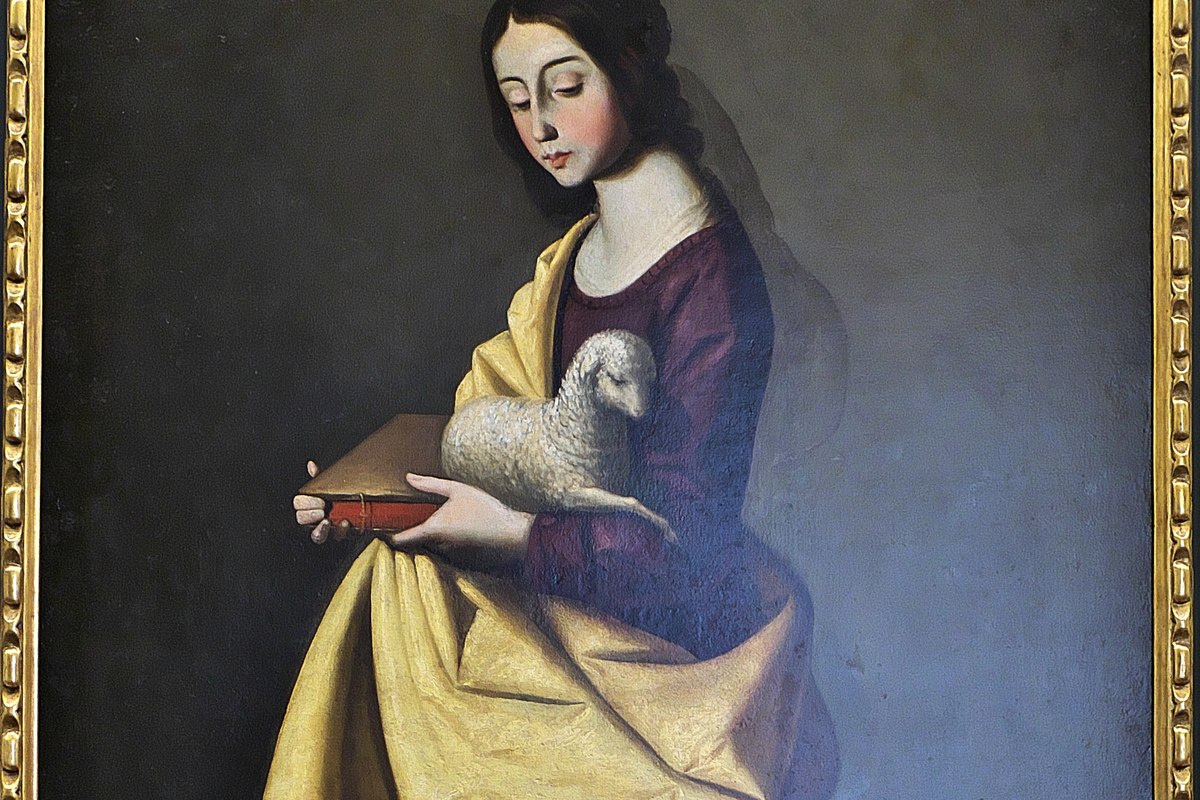
Circle of Francisco de Zurbarán, "Santa Inés," c. 1650, Museo de Bellas Artes de Sevilla — CC BY-SA 4.0.
The persecution under Diocletian, beginning in 303, specifically targeted Christian gathering places, Scriptures, and clergy across the empire, and periodically escalated into direct demands that ordinary citizens publicly sacrifice to the Roman gods or face punishment. Rome itself, as the empire's capital, saw some of the harshest enforcement, and Christian families of any social standing — including prominent, noble households like the one Agnes was born into — were not shielded from suspicion simply by their status. If anything, a highly visible noble family's public refusal to comply carried a particular weight, since it undercut the assumption that Christianity was merely a marginal superstition confined to the poor and powerless.
Rejected suitors and a punishment meant to humiliate
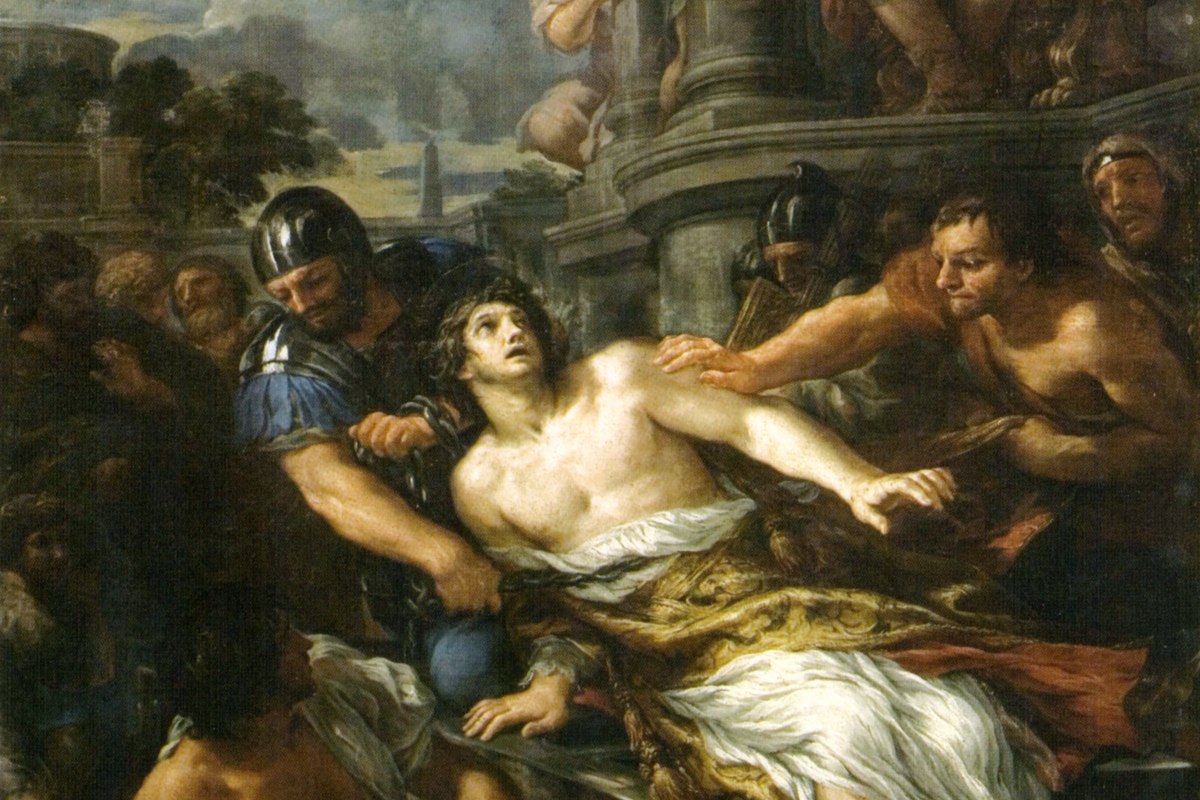
According to tradition, Agnes attracted high-ranking suitors who were refused because of her resolute commitment to religious purity — and rather than accept the rejection, they are said to have retaliated by exposing her Christian faith to the authorities. What followed was designed as much to shame her as to punish her: she was reportedly dragged naked through the streets of Rome to a brothel, a punishment aimed squarely at the same purity for which she had turned her suitors down in the first place.
The earliest surviving accounts of Agnes's martyrdom, written by figures like Saint Ambrose and the poet Prudentius within a few generations of her death, already treat her as a celebrated example of youthful courage, though the precise details of her ordeal vary somewhat between sources — a common feature of early hagiography, where the core fact of martyrdom is treated as solidly attested while surrounding narrative details reflect the storytelling conventions of the era more than documented history. What all the early accounts agree on is the basic shape of the story: a very young girl, socially vulnerable despite her noble birth, subjected to public humiliation specifically calibrated to attack the virtue she had staked her defiance on, and remaining unmoved by it.
A death sentence that resisted its own methods
Tried and condemned, Agnes faced an execution that, according to tradition, didn't go as planned at first — an attempt to burn her at the stake reportedly failed before she was finally put to death by beheading on January 21, 304. She was twelve or thirteen years old. Whatever the precise historical details, the account that survives insists on a young girl who did not waver even as one method of killing her after another was attempted.
Agnes is honored today alongside a small group of virgin martyrs of the early Church — young women, several of them, like her, executed as teenagers during the same waves of Roman persecution, for the same basic refusal to abandon either their faith or their commitment to chastity. Her name appears in the Roman Canon, the oldest and most solemn Eucharistic Prayer used at Mass, placing her among a small, select group of early martyrs whose names have been recited at the altar continuously for well over a thousand years — a level of liturgical prominence given to only a handful of saints from this period of the Church's history.
A name that predicted its own ending
Agnes's name carries a double meaning that later devotion read as almost prophetic: it evokes "chaste" in Greek and "lamb" — agnus — in Latin, and both senses point directly toward the manner of her death as a virgin martyr. That symbolism has outlived the centuries in a very literal way: to this day, on the feast of Saint Agnes, two lambs are brought from the Trappist abbey of Tre Fontane in Rome to be blessed by the pope, a small, continuing ritual tribute to a girl whose name seemed, in hindsight, built for exactly the story that followed it.
The wool from those two blessed lambs isn't merely symbolic decoration — it's spun and woven, later in the year, by the Benedictine nuns of the Roman convent of Santa Cecilia in Trastevere into the pallium, a narrow woolen band worn by the pope and conferred on archbishops around the world as a sign of their union with Rome. It's a striking detail connecting a twelve-year-old girl martyred in the early 4th century directly to a piece of liturgical vestment still worn by senior Church leaders today. Agnes's basilica in Rome, Sant'Agnese fuori le Mura, built over the site of her burial along the Via Nomentana, remains a pilgrimage destination, and her cult spread widely enough in the early centuries of the Church that she's counted, alongside figures like Saint Lucy of Syracuse, among the best-known virgin martyrs of the persecuted early Church — young women whose youth, rather than diminishing the significance of their witness, has always been central to why their stories were remembered and retold.
Trivia
How old was Agnes when she was martyred?
Why did Agnes's suitors turn against her?
What happened to Agnes before her execution?
Why is Agnes depicted with a lamb?
Related Reading