Fra Angelico as a Painter

A painter working at the hinge of two traditions
Fra Angelico's career, spanning roughly the 1420s through his death in 1455, places him at a genuinely pivotal point in Florentine painting — trained within the gold-ground, Gothic altarpiece tradition still dominant when he began, yet working alongside, and absorbing techniques from, the generation of Florentine artists then actively inventing Renaissance pictorial space: Filippo Brunelleschi's mathematical theory of linear perspective and Masaccio's application of it to fresco painting. For a full account of his life and religious formation as a Dominican friar, see Blessed Fra Angelico; this article focuses specifically on what made him distinctive as a working painter — his materials, his workshop, and the technical choices behind his most significant commissions.
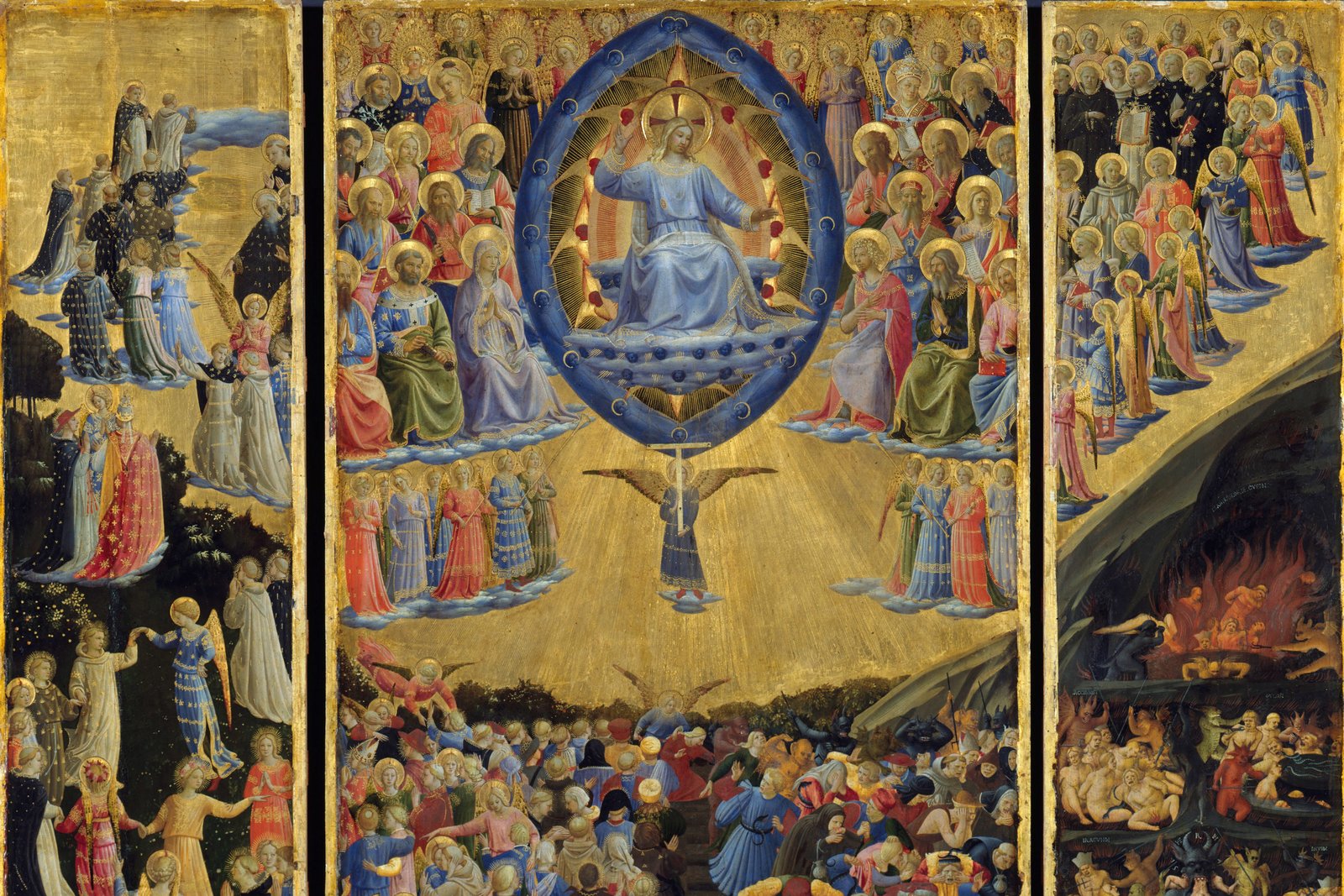
Fra Angelico, "The Last Judgment," c. 1435-1440, Museo di San Marco, Florence — public domain.
Tempera panels and true fresco, handled differently
Fra Angelico worked confidently in two quite different technical modes, each suited to a different kind of commission. His altarpieces were typically executed in egg tempera on wood panel — pigment ground and mixed with egg yolk, applied in careful, controlled layers that dry quickly and produce a luminous, matte-yet-jewel-like surface quality, especially suited to the brilliant blues, reds, and gold leaf detailing common in his devotional panels. Tempera demands a disciplined, methodical working process, since the paint dries almost immediately and doesn't allow the kind of slow blending later oil painting would make possible — every passage of modeling has to be built up through fine, deliberate hatching rather than wet-on-wet mixing.
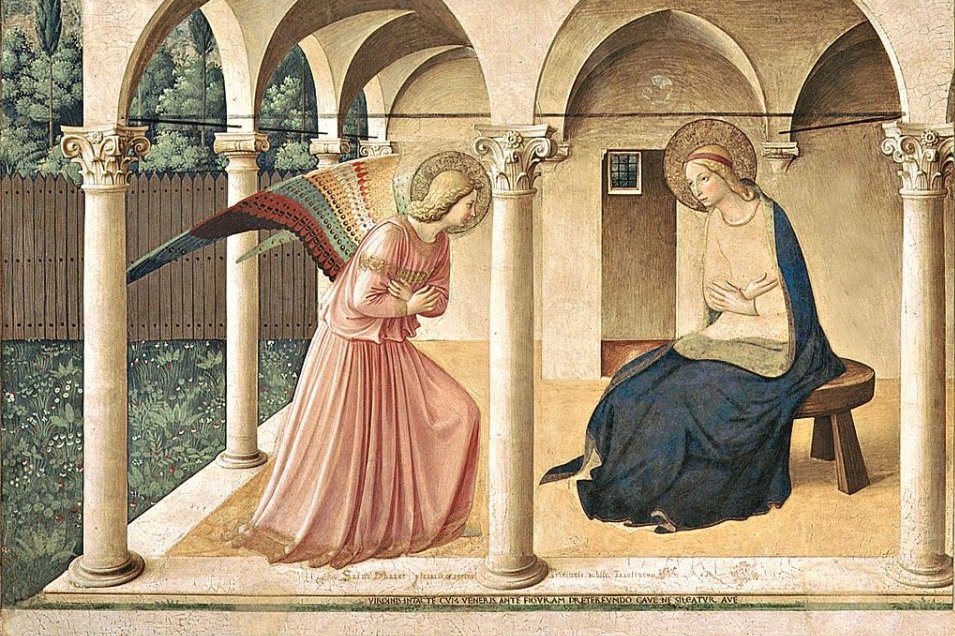
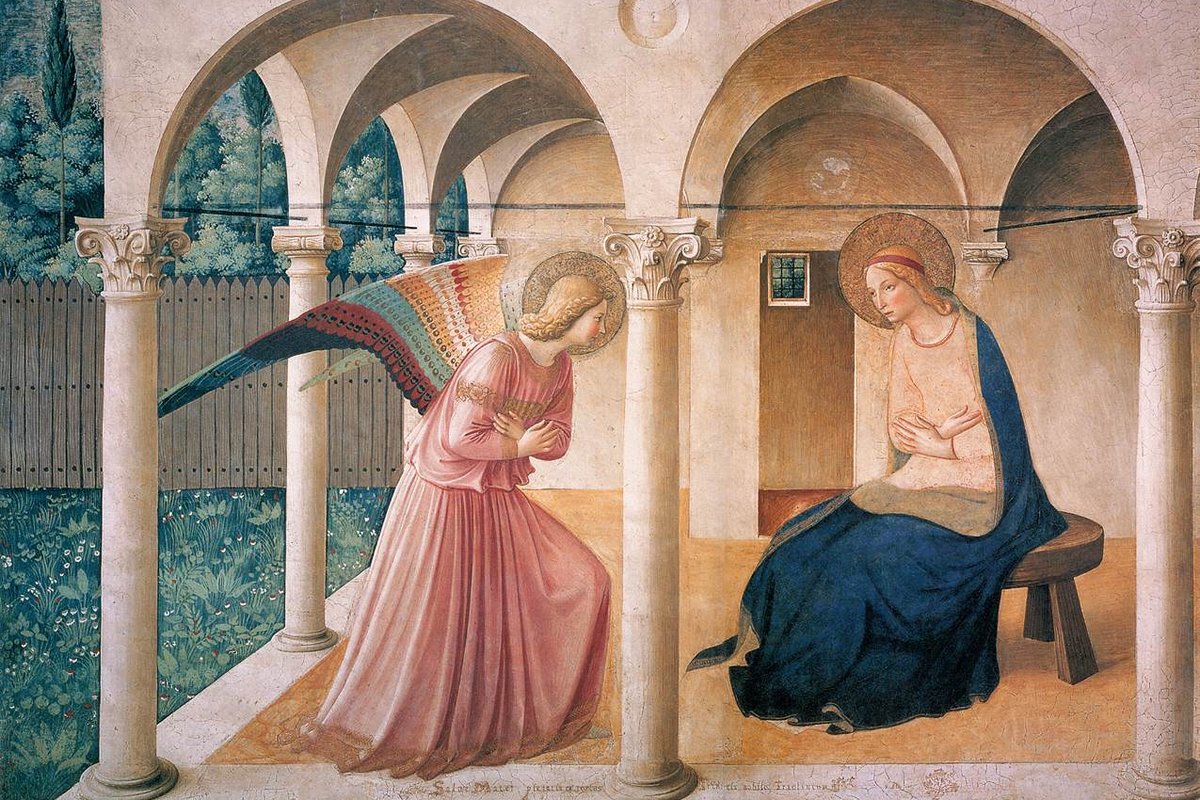
For his large-scale wall commissions, above all the fresco cycle at the Convent of San Marco, Fra Angelico worked in true fresco (buon fresco), applying pigment directly onto a thin layer of wet plaster so the color bonds permanently with the wall as it dries — a technique that permits no correction once the plaster has set and requires an artist to plan each day's work, called a giornata, with real precision, since only as much wet plaster can be prepared as the painter can complete before it dries. The technical discipline fresco demands — decisive brushwork, no room for hesitation — suited Fra Angelico's compositional clarity well, and it's part of why his San Marco frescoes retain such crispness even after nearly six centuries.
The San Marco Altarpiece and a new kind of composition
Among Fra Angelico's panel paintings, the high altarpiece he produced for San Marco itself, completed in the early 1440s, holds particular significance in art history. Earlier fifteenth-century altarpieces frequently took the form of polyptychs — several separate panels, each framed individually, typically showing the Virgin and Child in the central panel with individual saints isolated in their own side panels, each in their own space with no interaction between them.
The San Marco Altarpiece instead presents the Virgin and Child enthroned together with a group of saints — including Dominican founders and physician-saints associated with the Medici family, who funded the convent's rebuilding — standing together within a single, unified, architecturally coherent space, as though gathered for a shared conversation. This compositional format later became known as sacra conversazione, "holy conversation," and Fra Angelico's San Marco version is counted among its earliest fully realized examples, a format that would go on to dominate Italian altarpiece design for the rest of the century and beyond, developed further by painters including Giovanni Bellini in Venice decades later.
A workshop that trained the next generation
Fra Angelico's output, especially in his later, most productive decades working between Florence and Rome, was large enough that art historians are confident he relied on a functioning workshop of assistants to help execute major commissions under his direction and design — standard practice for any successful painter of the period handling this volume of work. Zanobi Strozzi is documented as a close associate whose own independent panel paintings show clear direct training under Fra Angelico. More significantly, the young Benozzo Gozzoli is generally understood to have worked in Fra Angelico's shop, most likely assisting on the Vatican's Niccoline Chapel frescoes in Rome, before going on to a substantial independent career of his own, most famously the richly decorated Procession of the Magi fresco cycle in the Medici-Riccardi Palace chapel in Florence — a work that carries clear traces of Fra Angelico's compositional influence even as it develops a far more ornate, courtly visual language.
The Last Judgment: discipline and unexpected joy
The fresco used as this article's hero image, Fra Angelico's Last Judgment, painted for the church of Santa Maria degli Angeli around 1435-1440, shows the technical range underlying his reputation for quiet devotional restraint. The composition follows a traditional structure — Christ enthroned in judgment at the top, an open row of graves along the bottom edge, the saved gathered to one side and the damned to the other — but Fra Angelico's treatment of the blessed departs from the more static, orderly rows typical of earlier versions of the subject. On the left, the redeemed link hands and move together in a joyful circular dance across a flowering meadow, angels interspersed among them, a composition of real motion and rhythm rarely attempted with such warmth in earlier fourteenth-century treatments of the same subject.
That contrast — theological gravity on one side of the composition, genuine visual delight on the other — captures something distinctive about Fra Angelico's approach across his whole career: technical precision and doctrinal seriousness combined, without contradiction, with an evident capacity for warmth, color, and even joy that set his work apart from some of his more severe contemporaries.
A technical legacy alongside a spiritual one
Fra Angelico's combination of Gothic luminosity with the era's new spatial science gave later Florentine painters, including his own workshop assistants and painters who studied his altarpieces after his death, a working model for how devotional clarity and Renaissance naturalism could coexist rather than compete — a technical bridge as significant, in its own way, as the personal holiness for which the Church would later beatify him. His paintings remain, alongside his biography, part of why the Church eventually named him patron of Catholic artists: a recognition of craft and devotion as genuinely inseparable in his particular case.
Trivia
What painting techniques did Fra Angelico use?
How did Fra Angelico's workshop operate?
What is the San Marco Altarpiece and why is it considered innovative?
Did Fra Angelico use linear perspective in his paintings?
How is this article different from the Saints Store biography of Fra Angelico?
Related Reading