Botticelli's Mystic Nativity

A painting from a city in crisis
Sandro Botticelli painted The Mystic Nativity in 1500, in a Florence that had spent the preceding several years convulsed by religious and political upheaval. The Medici family, longtime rulers of the city, had been expelled in 1494, and the following years were dominated by the fiery apocalyptic preaching of the Dominican friar Girolamo Savonarola, who denounced the corruption of the clergy and civic elite, predicted imminent divine punishment, and briefly turned Florence into a strict theocratic republic before being excommunicated, arrested, and executed by burning in 1498. Botticelli, who had been a celebrated painter of mythological and courtly subjects for the Medici and other wealthy patrons earlier in his career, is recorded by contemporaries as having become deeply affected by Savonarola's preaching, and some art historians even connect a supposed late-career burning of his own earlier secular paintings to that influence, though the extent of this personal transformation remains debated among scholars.
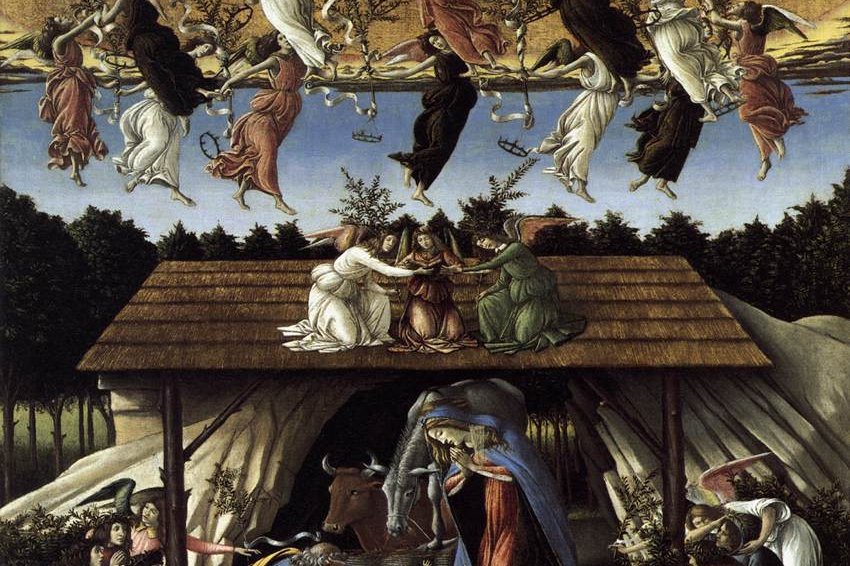
Sandro Botticelli, "The Mystic Nativity," 1500, The National Gallery, London — public domain.
The Mystic Nativity, completed at the turn of the new century, reflects that charged atmosphere directly. It is the only surviving painting Botticelli signed, and rather than a simple signature, he wrote a lengthy Greek inscription across the top of the canvas — an unusual, almost defiant act of self-identification paired with a specific, urgent prophetic message.
Reading the inscription
The inscription, roughly translated, states that Botticelli painted the work "at the conclusion of the year 1500, in the troubles of Italy," during a period he identifies with the "second woe" of the Book of Revelation and "the loosing of the devil for three and a half years" — before Satan would be "bound" again, as depicted in the painting itself, and a period of peace would follow. This language draws directly on apocalyptic imagery from the Book of Revelation, particularly the eleventh and twelfth chapters, which describe cycles of tribulation, angelic warfare, and the eventual binding of Satan for a period of time. Botticelli's choice to attach such explicitly end-times language to a traditional Nativity scene — the birth of Christ, ordinarily depicted as a moment of quiet joy — signals that he intended the painting as something considerably more urgent than conventional devotional imagery: a visual argument that Christ's birth and the troubles of his own era in Florence were bound together in a single unfolding prophetic timeline.
An unusual composition built on hierarchy, not perspective
Visually, the painting departs sharply from the naturalistic single-point perspective that had become standard in Florentine painting by 1500, including in works by Botticelli's own contemporaries. Figures are sized according to their spiritual rank rather than their position in space: the Holy Family at the center, sheltered beneath a rocky outcropping, is rendered noticeably larger than the angels, shepherds, and magi surrounding them, an older pictorial convention called hierarchical scale that had mostly given way to more naturalistic spatial systems decades earlier. Above the stable, a ring of twelve dancing angels circles beneath a golden, star-filled sky, holding olive branches and scrolls inscribed with texts of peace and glory. At the very bottom edge of the canvas, small devils flee into cracks and crevices in the earth, several being speared or trampled by angels — a literal, miniature enactment of the binding of Satan described in Botticelli's own inscription.
This deliberate archaism and symbolic density set the painting apart from the more naturalistic, geometrically organized Marian imagery being produced by contemporaries like Raphael, whose Sistine Madonna, painted about a decade later, favors a calmer, more idealized approach to a related Marian subject, without the layered apocalyptic urgency running through Botticelli's composition.
A private devotional object, not a public commission
Unlike many of the large-scale altarpieces discussed elsewhere in this series, the Mystic Nativity was likely painted as a smaller, private devotional work rather than a public church commission — its intimate scale and highly personal, coded inscription both suggest it was intended for a specific individual or small circle of viewers who would have understood its prophetic references, rather than for a general congregation. Its exact original patron and location are not documented, adding to the sense that it functioned as something closer to a personal spiritual statement by Botticelli himself during a period of intense religious anxiety in his own life and city.
From Florence to London
The painting's ownership history before the nineteenth century is not fully documented, but it eventually passed through private British collections before being acquired by the National Gallery in London in 1878, where it remains today. Its combination of traditional Nativity iconography with explicit, dated apocalyptic prophecy makes it one of the most extensively analyzed and debated paintings in the museum's collection, still generating new scholarly interpretations of exactly what Botticelli believed was about to happen in the "troubles of Italy" he described.
Trivia
What does the Greek inscription at the top of the Mystic Nativity say?
Why does the painting include small devils fleeing at the bottom edge?
Is the Mystic Nativity connected to the friar Savonarola?
What is unusual about the scale of the figures in the painting?
Where is the Mystic Nativity displayed today?
Related Reading