The Angel Appearing to Manoah

An angel speaks to the wife first
The account of Samson's birth, tucked into the middle of the Book of Judges, opens not with his father but with his unnamed mother. "An angel of the Lord appeared to the woman and said to her: Though you are barren and have had no children, you will conceive and bear a son" (Judges 13:3, NABRE). Barrenness in the ancient world carried a weight of grief and social stigma modern readers can underestimate, and this pattern — an angel announcing an unexpected, long-awaited birth to a barren or aged woman — recurs across Scripture, from Sarah at Mamre to Elizabeth centuries later in the Gospel of Luke.
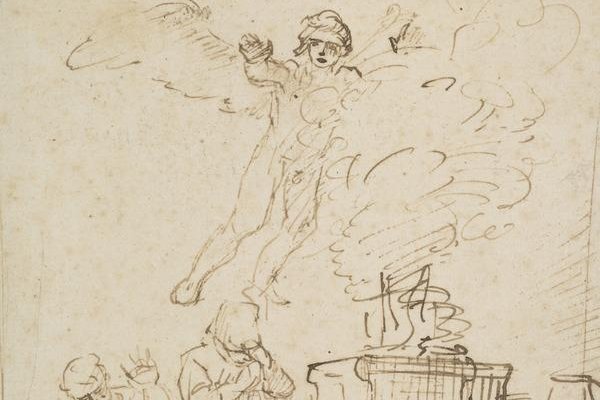
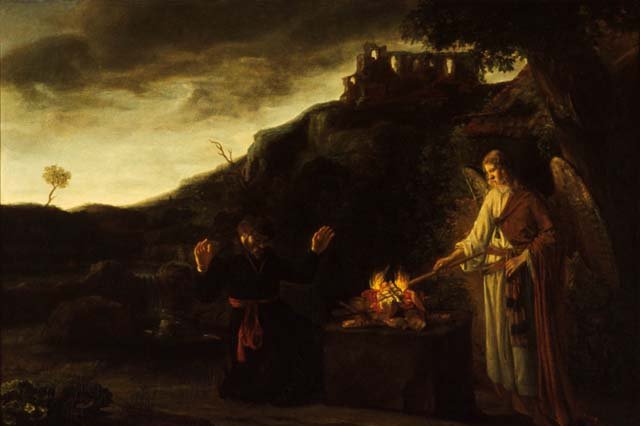
Rembrandt van Rijn, "The Sacrifice of Manoah," c. 1641 — public domain.
Along with the announcement comes a set of strict conditions: the mother is told to "drink no wine or beer and to eat nothing unclean" throughout the pregnancy, "for the boy is to be a nazirite for God from the womb" (Judges 13:4-5, NABRE) — a status of special consecration marked, among other things, by never cutting his hair. This child, the angel says, "will begin to save Israel from the power of the Philistines" (Judges 13:5). The boy is Samson, whose extraordinary strength and turbulent life fill the following chapters of Judges.
"The appearance of an angel of God, fearsome indeed"
Manoah's wife goes and tells her husband what happened, describing the visitor in terms that reveal she did not immediately grasp his full nature: "A man of God came to me; he had the appearance of an angel of God, fearsome indeed. I did not ask him where he came from, nor did he tell me his name" (Judges 13:6, NABRE). It's a striking admission — she recognized something unusual and even frightening about him, yet described him first in ordinary human terms, "a man of God," a phrase used elsewhere in the Old Testament for prophets and holy men rather than angels specifically.
Manoah prays that the "man of God" might return and instruct them both directly, and his prayer is answered — but pointedly, the angel appears again to the wife alone while she is out in the field, and she has to run and fetch her husband (Judges 13:8-11). This detail, easy to pass over, has drawn the attention of commentators: throughout the episode, the angel consistently addresses the woman first and treats her as the primary recipient of the message, with Manoah arriving second and, in some ways, understanding last.
A name too wondrous to give
When Manoah finally does speak with the visitor, he asks the same question countless people have asked strangers who spoke with authority: what is your name? The answer he receives is a refusal wrapped in mystery: "The angel of the Lord answered him: Why do you ask my name? It is wondrous" (Judges 13:18, NABRE). The Hebrew word translated "wondrous" here (peli) is closely related to the language used elsewhere in the Old Testament for God's own incomprehensible, awe-inspiring nature — a strong hint, though not an explicit statement, of just who Manoah has actually been speaking with.
Not fully understanding this, Manoah prepares a young goat along with a grain offering and presents it as a sacrifice on a rock, the same kind of gesture Gideon made to his own angelic visitor in an earlier chapter of Judges. What happens next settles the question of the visitor's identity beyond doubt: "as the flame rose to the heavens from the altar, the angel of the Lord ascended in the flame of the altar. When Manoah and his wife saw this, they fell on their faces to the ground; but the angel of the Lord was seen no more by Manoah and his wife" (Judges 13:20-21, NABRE).
"We will certainly die, for we have seen God"
The realization hits Manoah with force. "Then Manoah, realizing that it was the angel of the Lord, said to his wife, 'We will certainly die, for we have seen God'" (Judges 13:21-22). This reaction — terror at having glimpsed the divine directly — echoes the same fear Gideon expressed after his own angelic encounter, and reflects a belief threaded throughout the Old Testament that unmediated contact with God was mortally dangerous to sinful human beings.
It's Manoah's wife who offers the calmer, more logical reassurance: if the Lord had meant to kill them, she reasons, he would not have accepted their burnt offering, nor shown them all these things, nor told them what he had just told them (Judges 13:23). Her practical faith closes the episode on a note of quiet trust rather than lingering dread, and the chapter moves directly into the birth and naming of Samson, "and the Lord blessed him" as he grew (Judges 13:24).
A pattern shared with Gideon
Readers of the Book of Judges will notice how closely this episode mirrors the earlier story of Gideon and the Angel of the Lord: both men encounter a visitor they don't initially recognize as angelic, both offer a sacrifice as a form of confirmation, and in both cases fire consumes the offering and the angel departs in a way that retroactively reveals his identity. Judges seems to be establishing a deliberate pattern across its central chapters — that Israel's deliverers, whether the reluctant farmer Gideon or the not-yet-born Samson, are called into being through angelic visits that combine awe, mystery, and a refusal to be fully explained or named.
In art and tradition
"The Sacrifice of Manoah" became a recurring subject for Dutch seventeenth-century painters, who were drawn to its dramatic contrast of an ordinary domestic altar scene interrupted by a figure literally ascending into flame and smoke. Rembrandt's treatment of the subject — painted more than once across his career — emphasizes the couple's physical prostration, faces turned away or shielded, capturing the same instinctive terror the biblical text describes rather than a serene or triumphant departure.
The episode also holds a quieter significance within the broader story of Samson: it establishes, before he is even born, that his life and extraordinary strength were understood by his own parents as a direct gift bound up with sacred obligation — a frame that makes his later, very human failures within the same book all the more tragic by contrast.
Trivia
Who was Manoah, and why did an angel appear to his household?
What instructions did the angel give about the child before he was even born?
Why didn't Manoah's wife know at first that her visitor was an angel?
How did Manoah finally realize he had been speaking with an angel of the Lord?
Why did the angel refuse to tell Manoah his name?
Related Reading