Balaam's Donkey and the Angel Only She Could See

A prophet hired to curse a nation
The Book of Numbers sets up this episode with real narrative tension. Balak, king of Moab, terrified by the vast Israelite population now camped near his territory on their way to the Promised Land, sends for Balaam, a prophet or diviner known well beyond Israel's own borders for the effectiveness of his blessings and curses. Balak's request is direct: come curse this people for me, so that I may be able to defeat them.
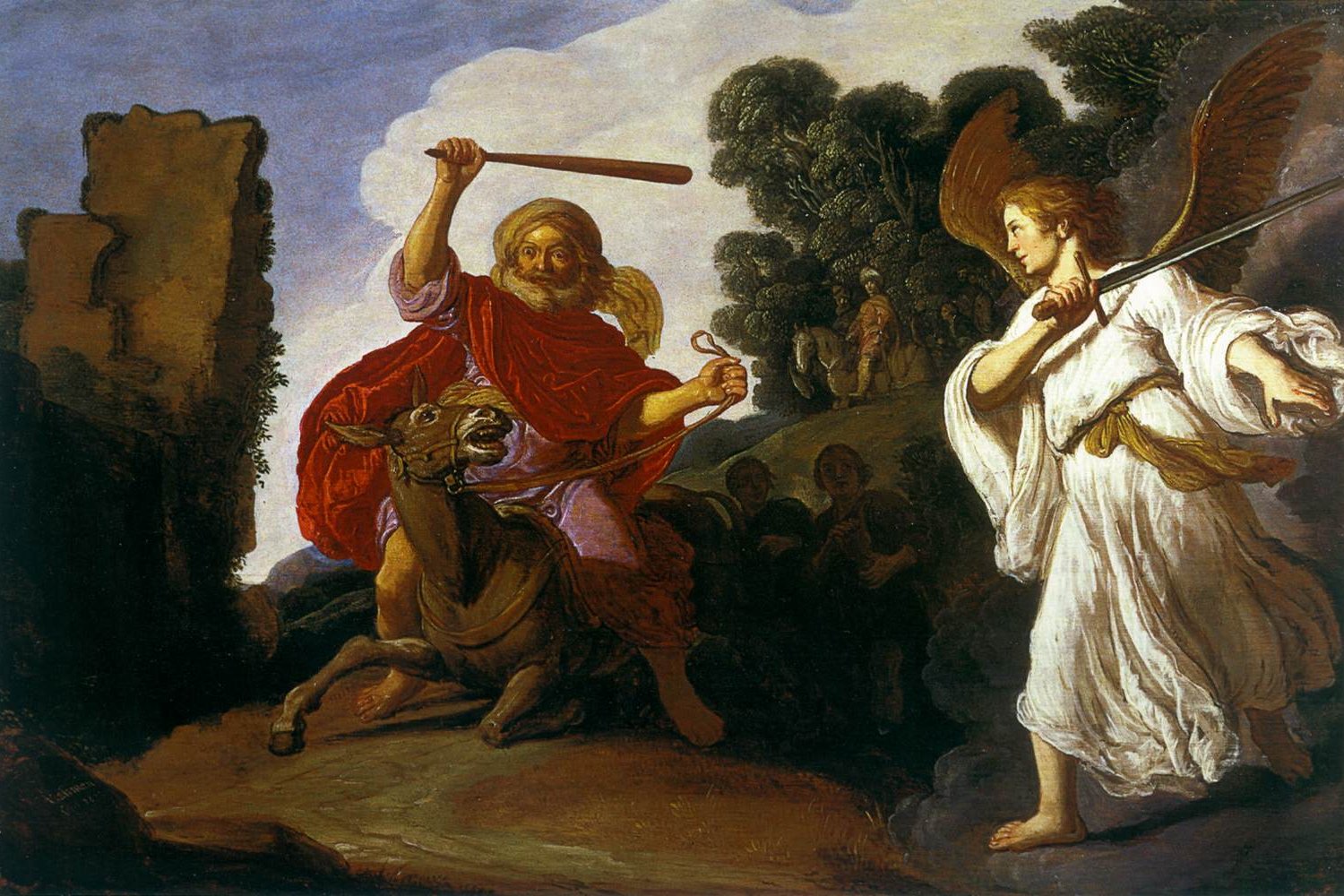
Pieter Lastman, Balaam and His Ass, 1622, Israel Museum, Jerusalem — public domain.
God initially tells Balaam not to go, and Balaam refuses Balak's first envoys on that basis. But when Balak sends a second, more prestigious delegation with an even greater reward offered, God tells Balaam he may go after all — with one crucial condition: he is to say only what God tells him to say, nothing more. It's against this backdrop of divine permission paired with strict limitation that Balaam sets out the next morning, riding his donkey down the road toward Moab.
Three refusals, three beatings
What follows is one of the most unusual scenes in the entire Old Testament, delivered with a kind of dry, almost comic precision that makes its underlying seriousness land even harder. "God's anger flared up at him for going, and the angel of the Lord took up a position on the road as his adversary. As Balaam was riding along on his donkey... the donkey saw the angel of the Lord standing in the road with sword drawn. The donkey turned off the road and went into the field, and Balaam beat the donkey to bring her back on the road" (Numbers 22:22-23, NABRE).
The pattern repeats, each time in a tighter space. The angel next positions itself "in a narrow lane between vineyards with a stone wall on each side" (Numbers 22:24, NABRE); the donkey, seeing it again, presses against the wall, crushing Balaam's foot, and he beats her a second time. Finally, in a passage too narrow for the donkey to turn aside at all, she simply lies down beneath Balaam — and "Balaam's anger flared up and he beat the donkey with his stick" (Numbers 22:27, NABRE). At every stage, the reader already knows exactly why the donkey keeps refusing; Balaam, blind to the angel standing directly in front of him, does not.
The donkey speaks
What happens next is unique in all of Scripture: "Then the Lord opened the mouth of the donkey, and she asked Balaam, 'What have I done to you that you beat me these three times?'" (Numbers 22:28, NABRE). Balaam, remarkably, answers her without apparent surprise at a talking animal — a detail commentators have long noted as part of the passage's deliberately strange, almost dreamlike tone — snapping back that he would kill her on the spot if he had a sword handy. The donkey presses her case further, appealing to their long history together: "Am I not your donkey, on which you have always ridden until now? Have I been in the habit of treating you this way before?" (Numbers 22:30, NABRE). Balaam, forced to admit she hasn't, concedes the point.
Only then does the scene resolve: "Then the Lord opened Balaam's eyes, so that he saw the angel of the Lord standing on the road with sword drawn; and he knelt and bowed down to the ground" (Numbers 22:31, NABRE). Everything the donkey had been reacting to for the entire journey is suddenly, finally visible to Balaam as well.
A rebuke, and an unexpected debt owed to a donkey
The angel's words to Balaam once he can finally see are pointed. The angel states plainly that it has come to oppose Balaam because his journey, in the angel's judgment, has been reckless — and adds a detail that reframes the entire preceding scene: had the donkey not turned aside each of the three times, the angel would have killed Balaam and let the donkey live. The animal Balaam struck three times in frustration, in other words, had in fact been the one repeatedly saving his life. Balaam, chastened, offers to turn back if the journey displeases God, but the angel instead tells him to continue — repeating the same condition given at the start: speak only what God commands.
Why the donkey story matters within the larger narrative
The episode sets up the chapters that follow, in which Balaam, standing before Balak and expected to curse Israel, instead delivers a series of unmistakable blessings over the Israelite camp instead — unable, despite Balak's mounting frustration, to speak anything but what God places in his mouth. Read together, the donkey's three refusals and Balaam's repeated blessings form a single consistent message running through the whole narrative: that no hired curse, and no failure of a prophet's own perception, could override God's protection over Israel.
There's also something quietly humbling built into the story's very structure — a prophet renowned for spiritual insight is, for most of the episode, less perceptive than the animal he's riding. It's a detail Scripture doesn't shy away from, and it has given the story lasting resonance well beyond its immediate narrative role: a reminder that divine action isn't always visible to those who might expect to see it most clearly, and that resistance mistaken for stubbornness can sometimes be exactly the opposite.
Trivia
Who was Balaam and why was he traveling this road?
What did the donkey see that Balaam couldn't?
What happened when the donkey spoke to Balaam?
What did the angel say to Balaam once he could finally see it?
What is the broader significance of the Balaam story in the Book of Numbers?
Related Reading