The Angels at Sodom

A city gate, and a warning received differently
The two angels who leave Abraham's tent at Mamre in Genesis 18 arrive at Sodom in the evening of the very same day. Lot, Abraham's nephew, is sitting at the city gate — in the ancient world, a place associated with civic business and standing, suggesting Lot had achieved some status within the city since settling there. He rises to greet the strangers, bows to the ground, and urges them to lodge at his house rather than spend the night exposed in the open square (Genesis 19:1-2). It's an echo, almost word for word in structure, of Abraham's own hospitality to the same visitors the day before — a deliberate narrative parallel that invites the reader to compare uncle and nephew.
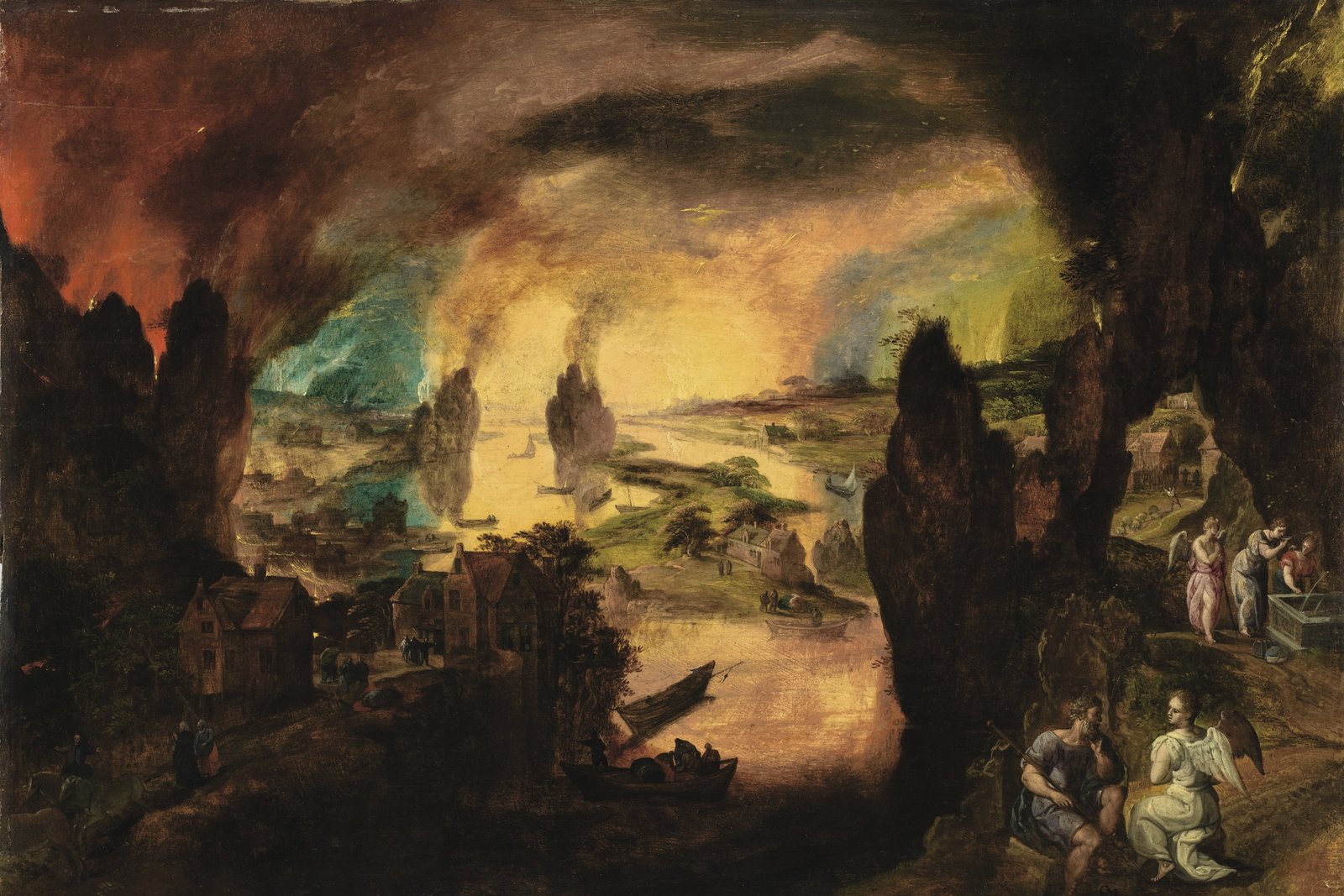
Gillis Mostaert, "Lot and His Daughters Guided by Angels, the Destruction of Sodom and Gomorrah Beyond," 1593 — public domain.
The angels initially decline, saying they will spend the night in the square, but Lot insists, and they relent. He prepares a meal, bakes unleavened bread, and the household settles in for the evening — until "the townsmen of Sodom, both young and old—all the people to the last man—surrounded the house" (Genesis 19:4, NABRE), demanding Lot bring out his guests so they could assault them. Lot's response — offering his own daughters to the mob instead, a proposal Scripture records without endorsing and one that later readers have found deeply troubling — reflects the extreme, and to modern readers deeply uncomfortable, weight ancient Near Eastern hospitality codes placed on protecting a guest under one's roof at nearly any cost. The angels themselves end the standoff by striking the men at the entrance "with such a blinding light that they were utterly unable to find the doorway" (Genesis 19:11, NABRE).
Reluctant to leave
What follows is one of the most psychologically honest rescue scenes in the Old Testament. The angels reveal their full purpose: Sodom is about to be destroyed, and Lot must gather his family and flee. Lot goes to his sons-in-law-to-be — men betrothed to his daughters — to warn them — "Come on, leave this place... the Lord is about to destroy the city" — but "his sons-in-law thought he was joking" (Genesis 19:14, NABRE), and they refuse to leave.
As dawn breaks, the angels press Lot to hurry, but he hesitates — Scripture does not disguise or excuse this delay. It is only "because of the Lord's compassion for him" that "As dawn was breaking, the angels urged Lot on, saying, “Come on! Take your wife with you and your two daughters who are here, or you will be swept away in the punishment of the city.” When he hesitated, the men, because of the Lord’s compassion for him, seized his hand and the hands of his wife and his two daughters and led them to safety outside the city." (Genesis 19:15-16, NABRE). The rescue, in other words, happens despite Lot's own reluctance, not because he seized it eagerly — a detail commentators have long read as a sober picture of how attached people can remain to a doomed way of life even once warned plainly of its end.
Once outside, the angels issue the instruction that becomes the episode's most famous and fatal detail: "Flee for your life! Do not look back or stop anywhere on the Plain. Flee to the hills at once, or you will be swept away" (Genesis 19:17). Lot, still bargaining even in flight, asks to be allowed to escape instead to a small nearby town called Zoar rather than the more distant hills, and is granted the concession.
Fire from heaven, and a look back
"Then the Lord rained down sulfur upon Sodom and Gomorrah, fire from the Lord out of heaven. He overthrew those cities and the whole Plain, together with the inhabitants of the cities and the produce of the soil" (Genesis 19:24-25, NABRE). The destruction is total and described in language that later biblical writers — from the prophets to the Gospels — return to repeatedly as the paradigm case of divine judgment falling on a city given over to violence and abuse of strangers.
It's in the middle of this destruction that the story delivers its final, chilling detail: "Lot's wife looked back, and she was turned into a pillar of salt" (Genesis 19:26). She is never named in the text. Jesus himself later invokes her as a warning against clinging to what must be left behind: "Remember the wife of Lot" (Luke 17:32).
What Sodom's sin actually was
Popular usage has narrowed "the sin of Sodom" almost entirely to the assault the townsmen attempted against Lot's guests, and that scene is undeniably central to how Genesis itself frames the city's judgment. But readers of the whole of Scripture should know that later biblical writers describe Sodom's guilt more broadly. The prophet Ezekiel, writing centuries later, states plainly: "Now look at the guilt of your sister Sodom: she and her daughters were proud, sated with food, complacent in prosperity. They did not give any help to the poor and needy" (Ezekiel 16:49, NABRE). Catholic biblical scholarship has generally read Sodom's condemnation as encompassing this fuller pattern of arrogance, excess, and cruelty toward the vulnerable, of which the assault on the angelic visitors was the final, decisive act rather than the sole cause.
In art and memory
Painters of the Flemish and Dutch schools were especially drawn to the dramatic contrast this story offers — a burning city receding in the distance while, in the foreground, small human figures hurry away under angelic guidance. Gillis Mostaert's late-sixteenth-century treatment places Lot's family being physically led by the angels in the near foreground, with Sodom already consumed by flame on the horizon behind them, visually reinforcing the urgency Genesis describes in the angels' repeated warnings not to look back.
The episode remains, alongside Noah's flood, one of the two great Old Testament pictures of judgment survived only by grace extended to the unworthy and reluctant — a theme that runs, in different form, through the rescue of Peter from prison by an angel and other angelic interventions across both Testaments.
Trivia
Who were the two angels who came to Sodom?
How did Lot receive the angels, compared to the rest of Sodom?
Why did the angels have to physically drag Lot's family out of the city?
What happened to Lot's wife?
Is Sodom's destruction connected only to sexual sin, as popular usage often assumes?
Related Reading