Samson and Delilah: Strength, Betrayal, and a Final Prayer

A strength that was never really about muscle
Samson shows up in the book of Judges as Israel's strongest deliverer and, in nearly the same breath, its most reckless one. Before Delilah ever enters the story, he's already torn a lion apart with his bare hands, burned Philistine fields out of spite, and ripped an entire city gate off its posts and carried it, on his shoulders, to the top of a hill near Hebron just to prove he could walk out of an ambush unscathed (Judges 16:3). He's less a disciplined hero than a force of nature who happens to be on Israel's side.
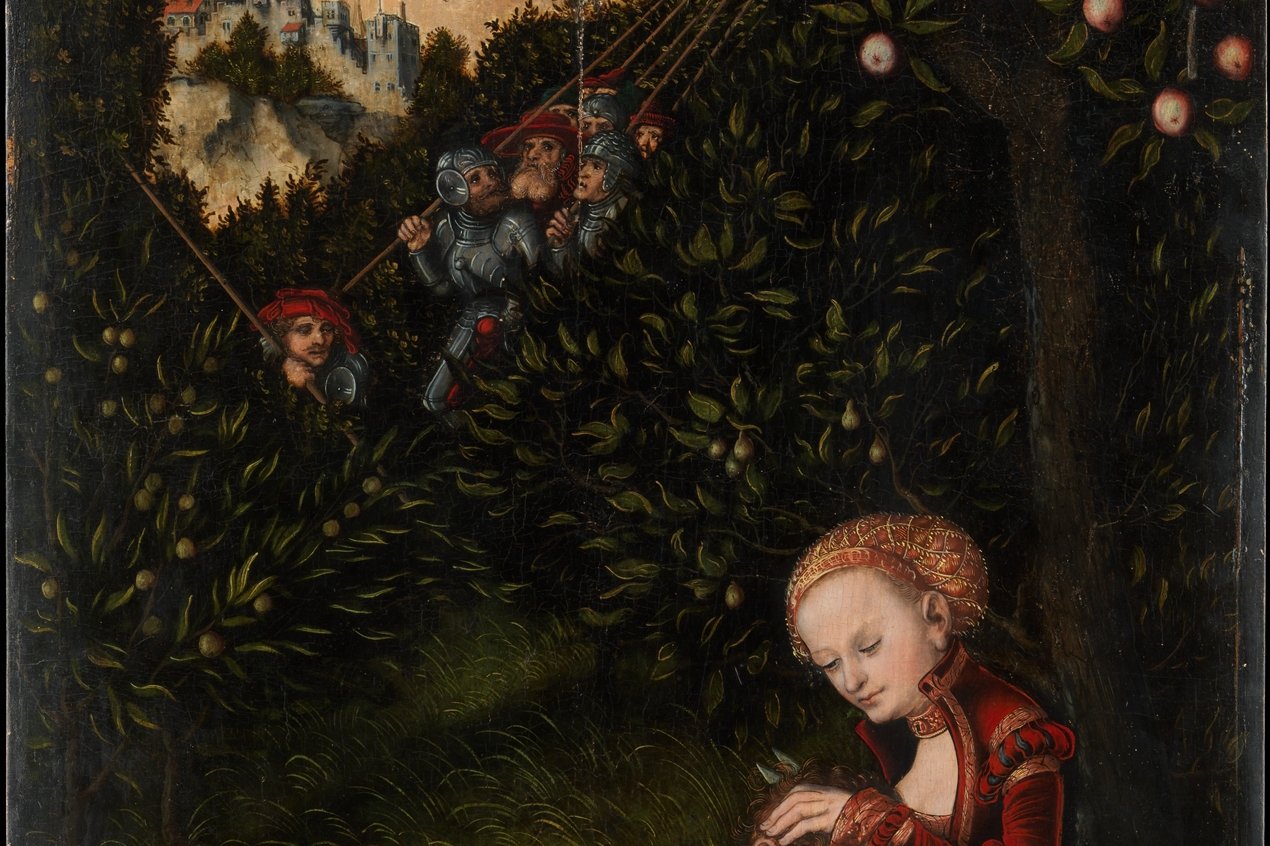
Lucas Cranach the Elder, Samson and Delilah, c. 1528-30. Public domain, The Metropolitan Museum of Art.
What the text keeps insisting on, though, is that none of this strength was Samson's own achievement. He was a nazirite — someone set apart for God under a vow described in the book of Numbers, part of which required never cutting one's hair. Samson had been consecrated this way from birth, his mother visited by an angel before he was even conceived (Judges 13). The uncut hair wasn't a superstition or a magic charm; it was a visible, physical sign of a covenant Samson had never actually chosen to keep with any consistency.
Delilah and the three lies
After the incident at Gaza's gate, Samson fell in love with a woman named Delilah, who lived in the Wadi Sorek. The Philistine lords saw an opportunity and came to her directly: find out the secret of his strength, and each of them would pay her eleven hundred pieces of silver (Judges 16:5).
What follows is one of the more uncomfortable rhythms in the Old Testament — not because it's subtle, but because it isn't. Delilah asks Samson outright how he could be bound and made helpless. He lies: fresh bowstrings. She ties him with fresh bowstrings while men wait in ambush, then wakes him shouting that the Philistines are upon him; he snaps the bowstrings like burnt thread. She asks again. He lies again: new ropes. Same result. A third time: weave the seven locks of his hair into a loom. Still nothing — he pulls the whole loom out of the wall waking up.
By any reasonable measure, three attempted betrayals should have ended the relationship. Instead, Judges 16:16 says Delilah "pressed him continually and pestered him till he was deathly weary of it," and on the fourth try, worn down, Samson finally told her everything: "No razor has touched my head, for I have been a nazirite for God from my mother's womb. If I am shaved, my strength will leave me, and I shall grow weaker and be like anyone else" (Judges 16:17).
The haircut that changed everything
This time Delilah knew she had the truth. She lulled Samson to sleep on her lap, called in someone to shave the seven locks of his hair, and Judges 16:19 states plainly: "He immediately became helpless, for his strength had left him." The next line is the harshest in the whole account — Samson woke thinking he could shake himself free as always, "he did not realize that the Lord had left him" (Judges 16:20). The strength had never been in the hair as an object; it was tied to a vow, and the vow had finally been broken all the way through.
The Philistines gouged out his eyes, chained him in bronze, and set him to grinding grain like an animal in a Gaza prison. It's a brutal, humiliating end for a man who had spent his whole life relying on raw power — except the text adds one quiet detail before moving on: his hair started growing back (Judges 16:22).
One last prayer
Some time later, the Philistine lords gathered for a sacrificial feast to their god Dagon, celebrating their capture of Samson, and in their triumph they had the blind, chained Samson brought out from prison "to amuse them" in front of thousands of onlookers (Judges 16:25-27). Positioned between the temple's two central support pillars, Samson asked the boy guiding his hand to let him lean against them.
Then he prayed — not for rescue, not for restored glory, but for one final act: "Lord God, remember me! Strengthen me only this once that I may avenge myself on the Philistines at one blow for my two eyes" (Judges 16:28). Bracing himself against both columns, he said, "Let me die with the Philistines!" and pushed. The temple collapsed on everyone inside, Samson included. Judges 16:30 notes the grim scale of it: "Those he killed by his dying were more than those he had killed during his lifetime."
Samson's story sits uneasily in scripture — he's honored in the Letter to the Hebrews among figures commended for their faith (Hebrews 11:32), yet his life is a catalogue of impulsiveness, broken vows, and self-inflicted disaster. Catholic tradition has never treated him as a moral exemplar in the way it treats the saints; rather, his story is read as an example of God working through deeply flawed human instruments, and as a sober warning about the cost of chipping away, promise by broken promise, at a commitment meant to last a lifetime.
Trivia
Why did Samson's strength depend on his hair?
How many times did Delilah try to trick Samson before he told her the truth?
Did the Philistines pay Delilah to betray Samson?
What happened to Samson after the Philistines captured him?
How did Samson die?
Related Reading