The Angel Freeing All the Apostles from Prison


A jealousy that had been building for a while
By the time Acts reaches its fifth chapter, the apostles aren't an obscure sect anymore. Luke describes a movement drawing real attention in Jerusalem: "many signs and wonders were done among the people at the hands of the apostles," gathering crowds so large and so certain of healing that "they even carried the sick out into the streets and laid them on cots and mats so that when Peter came by, at least his shadow might fall on one or another of them" (Acts 5:12,15, NABRE). People from towns outside the city were traveling in with their sick and afflicted, "and they were all cured" (Acts 5:16, NABRE).
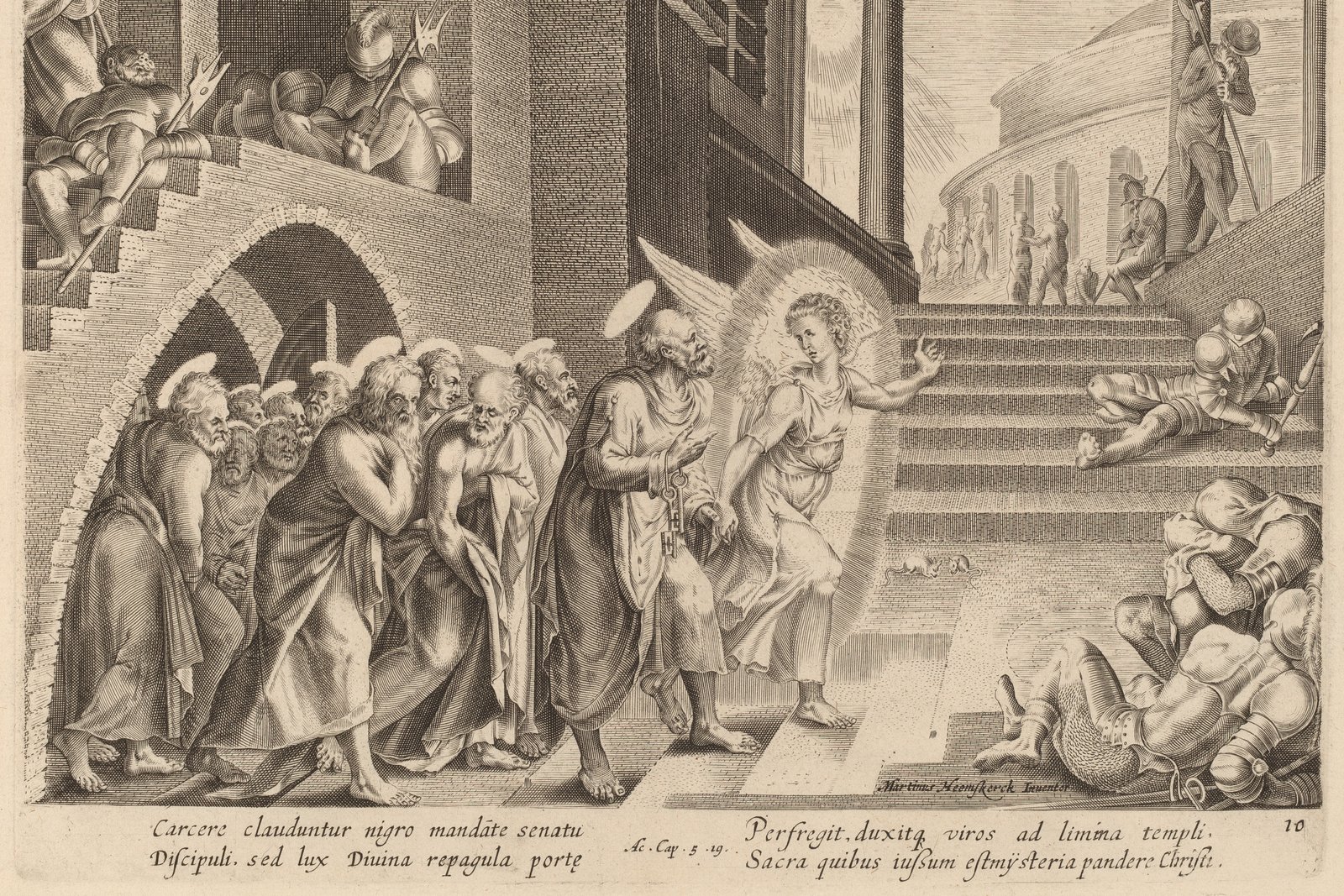
Philip Galle, after Maerten van Heemskerck, "The Apostles Delivered from Prison by an Angel," c. 1575, National Gallery of Art -- public domain (CC0).
That kind of visible, uncontrollable success is exactly what provokes the response that follows. "Then the high priest rose up and all his companions, that is, the party of the Sadducees, and, filled with jealousy, laid hands upon the apostles and put them in the public jail" (Acts 5:17-18, NABRE). This wasn't a quiet or informal detention — the public jail was the city's own official holding facility, and putting the apostles there as a group was a direct, institutional move by Jerusalem's religious establishment.
Freed in the dark, without a sound
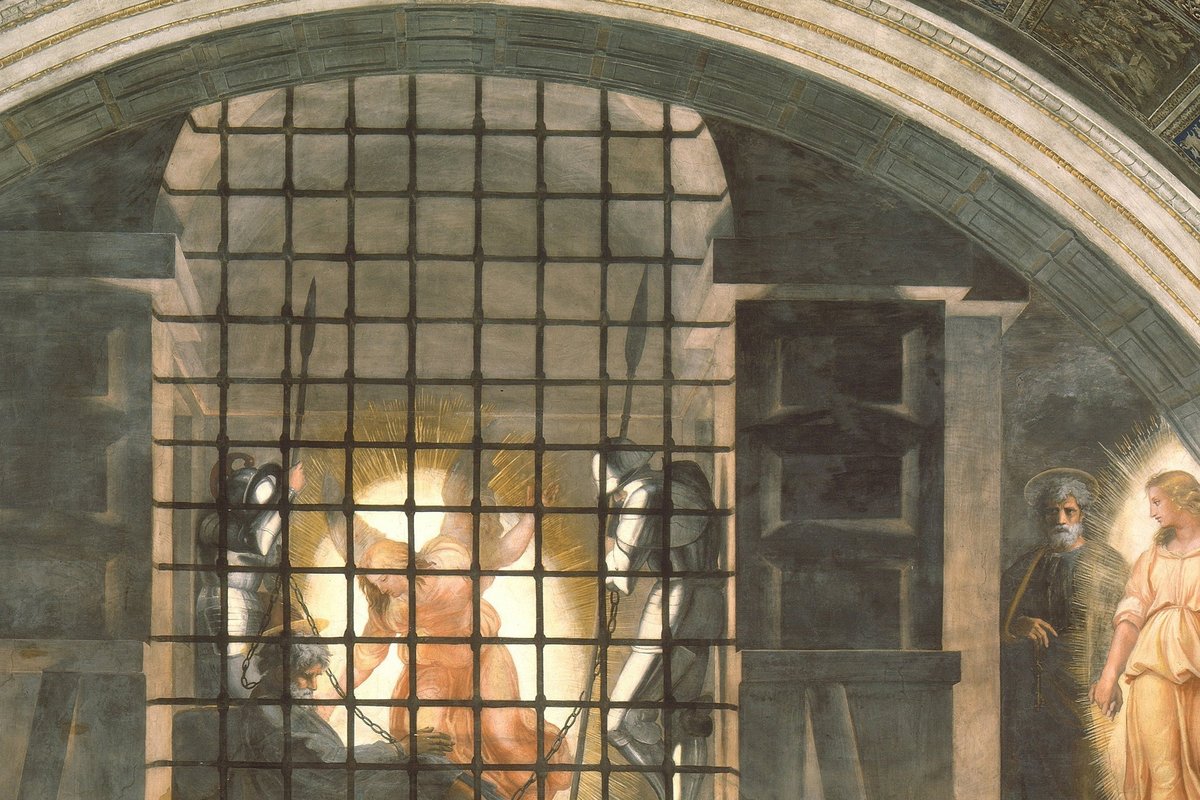
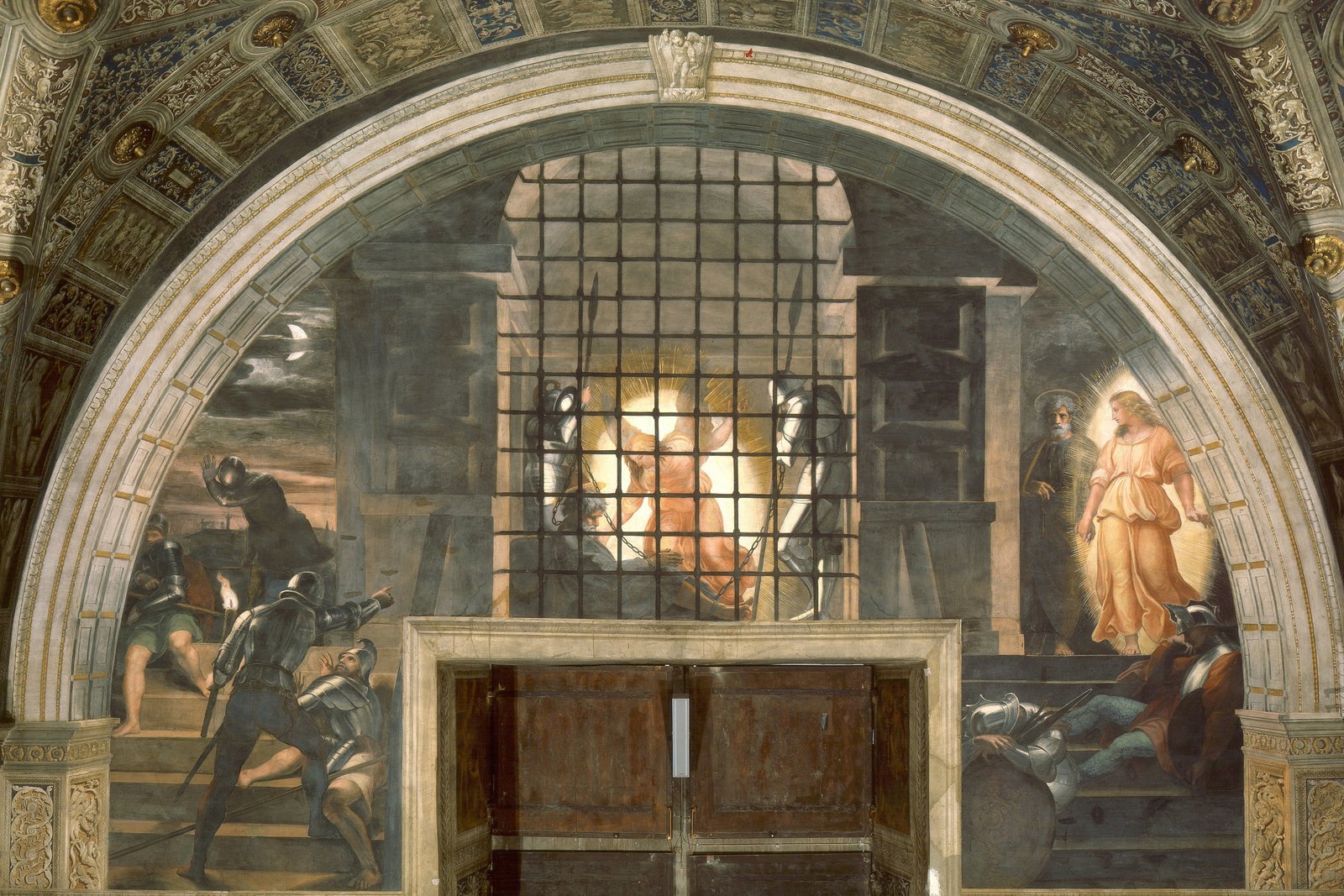
What happens overnight is described in a single, almost understated sentence: "during the night, the angel of the Lord opened the doors of the prison, led them out, and said, 'Go and take your place in the temple area, and tell the people everything about this life'" (Acts 5:19-20, NABRE). Luke doesn't pause to describe light, or fear, or any of the dramatic elements that mark some of Scripture's other angelic encounters — the action here is almost businesslike: doors opened, apostles led out, instructions given.
What makes the scene remarkable isn't how it's described, but what it implies happened outside the text's own attention. This was a guarded public jail, not an unwatched holding cell, and yet the release left no trace anyone could detect until it was already discovered. The instruction that follows the release is just as notable as the release itself: the angel doesn't tell the apostles to flee the city or go into hiding. He sends them directly back into the most public space in Jerusalem — the Temple courts — to keep doing exactly what had gotten them arrested in the first place.
Obedient anyway, at first light
And that's precisely what they do. "When they heard this, they went to the temple early in the morning and taught" (Acts 5:21, NABRE) — not waiting, not weighing the risk, simply following the instruction they'd been given in the dark hours before dawn.
Meanwhile, the Sanhedrin — the full Jewish ruling council — convenes exactly as planned, sends for the prisoners, and runs straight into a problem nobody anticipated. "The court officers who went did not find them in the prison, so they came back and reported, 'We found the jail securely locked and the guards stationed outside the doors, but when we opened them, we found no one inside'" (Acts 5:22-23, NABRE). Every physical safeguard had held — the locks, the doors, the sentries at their posts — and the prisoners were simply gone regardless. Luke notes the council's reaction plainly: "the captain of the temple guard and the chief priests were at a loss about them, as to what this would come to" (Acts 5:24, NABRE). It's one of the few moments in Acts where the religious authorities are described not as hostile or calculating, but genuinely baffled.
Found exactly where they said they'd be
The resolution comes almost immediately, and it's almost comic in how anticlimactic it is: "someone came in and reported to them, 'The men whom you put in prison are in the temple area and are teaching the people'" (Acts 5:25, NABRE). The apostles hadn't gone underground or fled the region — they were precisely where the angel had told them to be, doing precisely what they'd been arrested for doing the first time.
Brought before the council again, the apostles are reminded of the earlier order to stop teaching in Jesus's name, and accused of trying to "bring this man's blood upon us" (Acts 5:28, NABRE). Peter's reply on behalf of the group is one of the most quoted lines anywhere in Acts: "We must obey God rather than men" (Acts 5:29, NABRE) — a direct, plainly stated declaration of where their obedience finally rested, delivered to the very body that had just failed to keep them locked up.
A pattern Luke returns to deliberately
This isn't the only time in Acts that an angel opens a prison door on the apostles' behalf. Years later, in Acts 12, an angel frees Peter alone from King Herod Agrippa I's custody the night before a scheduled execution — a different arrest, a different ruler, a different set of circumstances, but the same underlying shape: locked prison, posted guards, an escape that leaves the guards themselves baffled. Luke, as the author of Acts, seems to return to this pattern on purpose, using it more than once to make the same point about the early Church's persecutions — that human authority, however carefully it locks its doors, keeps proving unable to actually contain what it's trying to stop. The Catechism of the Catholic Church teaches more broadly that "the whole life of the Church benefits from the mysterious and powerful help of angels" (CCC 334) — and this early episode, group escape and all, is one of the clearer examples Scripture offers of exactly what that help could look like in practice.
Trivia
Why were the apostles arrested in Acts 5?
How did the angel get the apostles out of a guarded prison?
What did the angel tell the apostles to do once they were free?
Is this the same story as Peter's later escape from prison in Acts 12?
What happened when the apostles were found teaching again?
Related Reading