The Two Angels Who Appeared at the Ascension

A departure witnessed, then interrupted
The Ascension marks one of the most significant transitions in the entire New Testament narrative — the moment Jesus, forty days after his Resurrection, gathers his disciples for a final time on the Mount of Olives near Jerusalem and is taken from their sight into heaven. Luke, who wrote both his Gospel and the Acts of the Apostles, describes it with characteristic economy: "When he had said this, as they were looking on, he was lifted up, and a cloud took him from their sight" (Acts 1:9, NABRE).
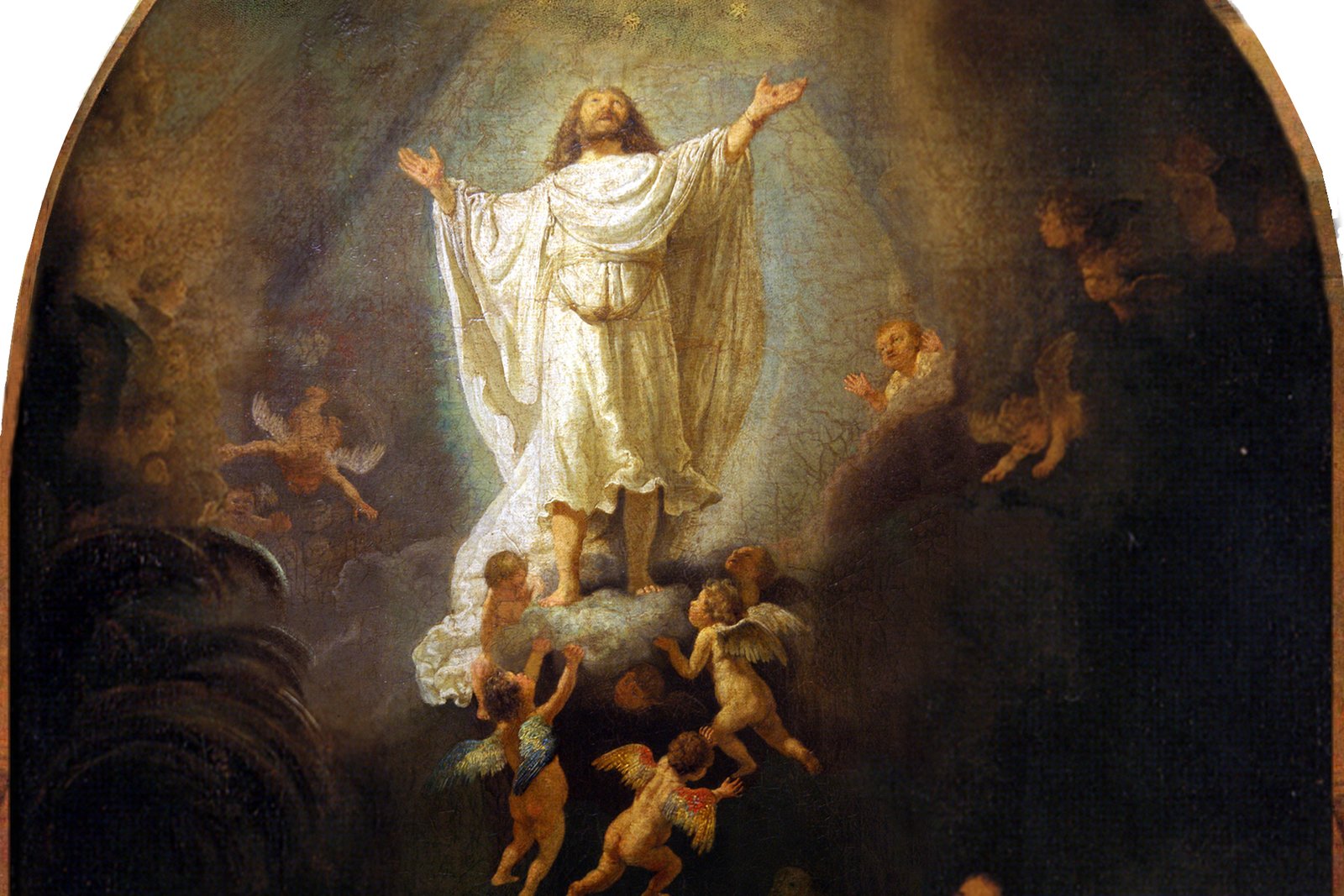
Rembrandt van Rijn, The Ascension of Christ, 1636, Alte Pinakothek, Munich — public domain.
It's what happens immediately afterward that gives the scene its full shape. The disciples, understandably, keep staring upward — reluctant, it seems, to look away from the space where Jesus had just disappeared. "While they were looking intently at the sky as he was going, suddenly two men dressed in white garments stood beside them" (Acts 1:10, NABRE). The text doesn't describe them arriving gradually or being noticed approaching; they are simply, suddenly, present.
A gentle question with a message inside it
The two figures don't linger in silence. Their words function as both a mild rebuke and a promise: "Men of Galilee, why are you standing there looking at the sky? This Jesus who has been taken up from you into heaven will return in the same way as you have seen him going into heaven" (Acts 1:11, NABRE). It's a brief statement, but it does considerable theological work in very few words — acknowledging that Jesus has genuinely departed, while immediately redirecting the disciples' focus away from that departure and toward an assured future return.
The gentle correction embedded in the question — essentially, "why are you still looking up, as though gazing will bring him back sooner?" — has often been read by commentators as a broader lesson about how faith is meant to function after this moment: not through passive waiting fixed on the sky, but through the active work the disciples are about to be sent to do, beginning just chapters later with the events of Pentecost.
Are they explicitly called angels?
Acts describes the two figures only as "men dressed in white garments," stopping short of using the word "angel" directly — a detail worth being precise about. But the description carries unmistakable echoes of other angelic appearances recorded in Luke's own writing. At the empty tomb, in Luke's Gospel, the women encounter "two men in dazzling garments" (Luke 24:4, NABRE) who deliver the news of the Resurrection — a scene explored more fully in the account of the angel at the empty tomb — and that passage's language closely mirrors the Ascension scene in Acts.
Given both the shared imagery across Luke's two-part work and the broader biblical pattern of angels appearing at pivotal moments in salvation history dressed in bright or white clothing, Christian tradition has consistently and almost universally understood these two figures at the Ascension as angels, even though the specific word is withheld in the text itself. It's a pattern of restrained, understated angelic description that appears elsewhere in Scripture as well — the messenger's function and appearance often speak clearly enough without the narrator needing to supply the label explicitly.
A promise that shapes Christian belief in the Second Coming
The angels' statement — that Jesus "will return in the same way as you have seen him going into heaven" — carries weight far beyond the immediate scene. Catholic tradition reads this brief promise as one of the clearest and earliest scriptural anchors for the doctrine of the Second Coming, the belief that Christ will return visibly and bodily at the end of time, a teaching articulated in the Nicene Creed recited at every Sunday Mass: "He will come again in glory to judge the living and the dead."
The specificity of the angels' phrase — "in the same way" — has traditionally been understood to mean that just as the Ascension was visible, bodily, and witnessed directly by the disciples rather than occurring in some purely spiritual or invisible sense, so too will Christ's return be a real, visible, and unmistakable event, not a hidden or merely symbolic occurrence.
Why this brief scene still matters
The Ascension account in Acts is short — just a handful of verses — but it accomplishes something structurally important within the wider New Testament narrative. It closes the period of Jesus's earthly, visible presence with the disciples and opens the era that Acts spends the rest of its pages describing: the Church's early life, guided now not by Jesus's direct physical presence but by the Holy Spirit, whom Jesus had promised would come. The two angels' appearance, brief as it is, marks that hinge point clearly — turning the disciples' eyes, and by extension the reader's, away from the sky where Jesus disappeared and toward the work, and the promised return, still to come.
Trivia
Where in the Bible does the account of angels at the Ascension appear?
What exactly happened right after Jesus ascended?
What did the two men in white say to the disciples?
Does the text explicitly call these two men angels?
What is the theological significance of the promise that Jesus will 'return in the same way'?
Related Reading