Peter's Release from Prison

A king who had already executed one apostle
Acts 12 opens with a blunt statement of the danger the earliest Christian community was facing: "About that time King Herod laid hands upon some members of the church to harm them. He had James, the brother of John, killed by the sword," (Acts 12:1-2). This James, one of the original Twelve, was the first of the apostles to be martyred, and his death establishes immediately how real the stakes are for what follows. Herod Agrippa I, seeing that the execution "and when he saw that this was pleasing to the Jews he proceeded to arrest Peter also. (It was [the] feast of Unleavened Bread.)" (Acts 12:3), timing the arrest during the feast of Unleavened Bread, with the intention "He intended to bring him before the people after Passover." (Acts 12:4) — a public trial almost certainly headed toward the same fate as James's.
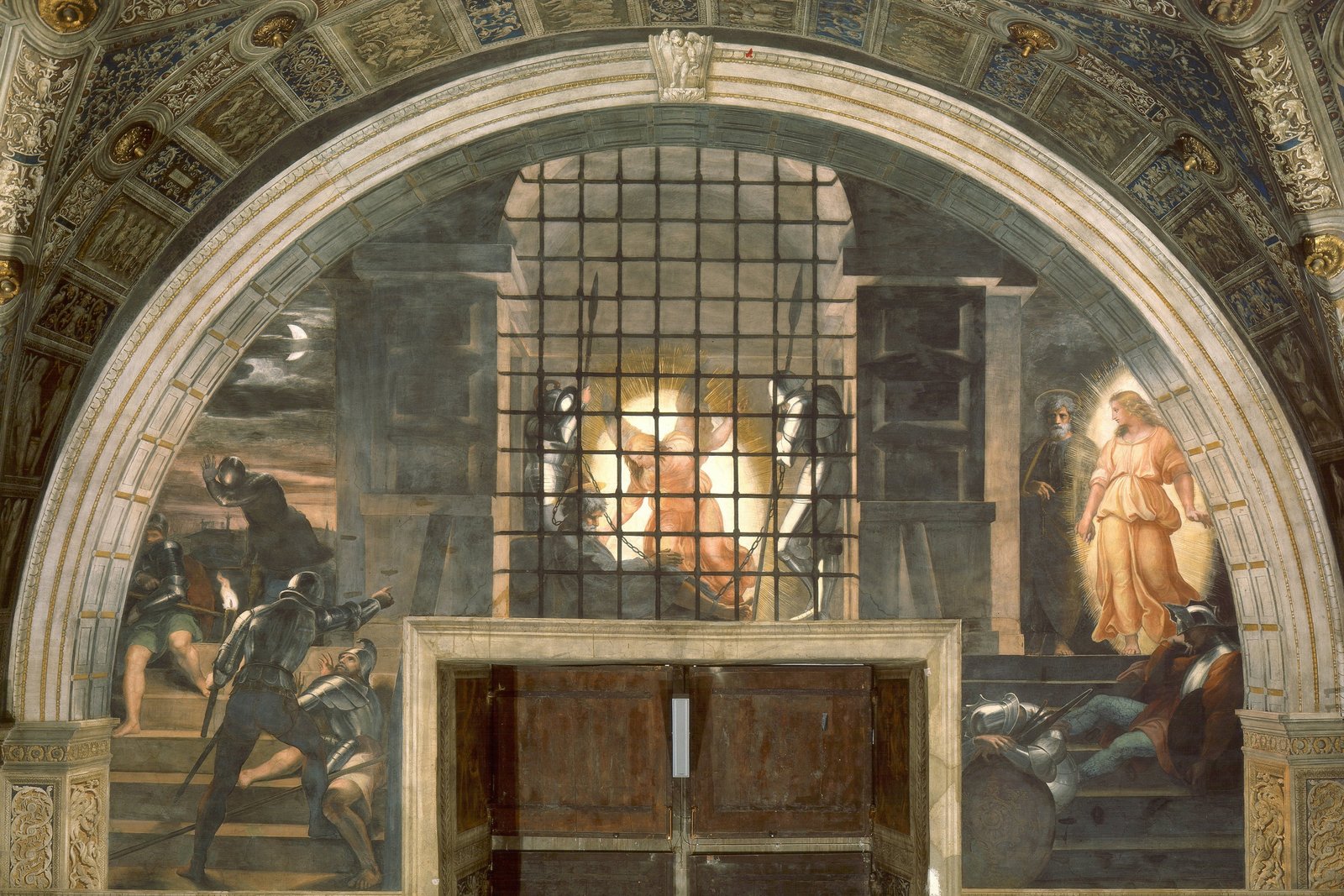
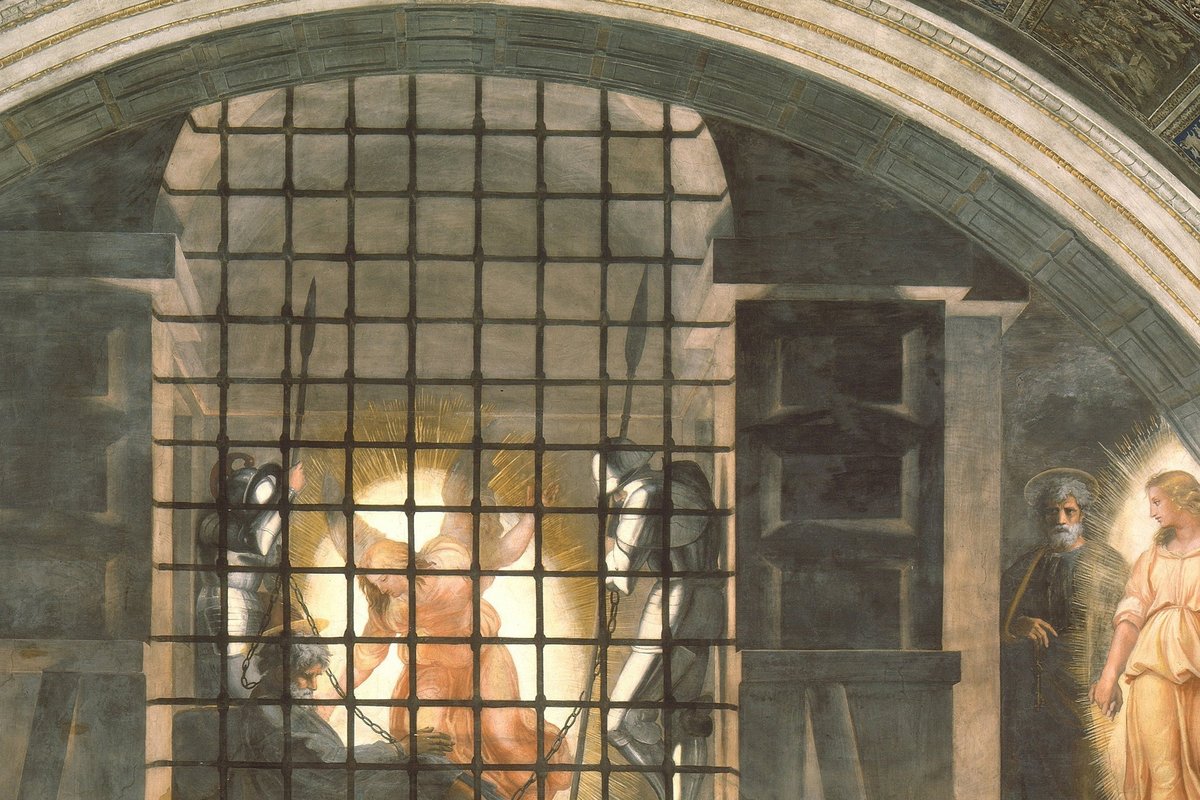
Raphael, "The Liberation of Saint Peter," 1514, Stanza di Eliodoro, Vatican Palace. Public domain.
Chained between two soldiers, watched at every door
The security around Peter's cell is described in deliberately overwhelming detail: "Peter thus was being kept in prison, but prayer by the church was fervently being made to God on his behalf" (Acts 12:5) — establishing both the danger and the community's response to it in the same breath. On what would have been the last night before his trial, "Peter, secured by double chains, was sleeping between two soldiers, while outside the door guards kept watch on the prison" (Acts 12:6). Acts lists at minimum four layers of guard — two chained soldiers immediately beside him, plus guards at the door, plus, as becomes clear moments later, additional posts beyond that — a level of security that makes what happens next all the more striking.
A light in the cell, and chains that simply fall away
"Suddenly the angel of the Lord stood by him and a light shone in the cell. He tapped Peter on the side and awakened him, saying, 'Get up quickly.' The chains fell from his wrists" (Acts 12:7). There's no drama or struggle described — the chains don't break, they simply fall, as effortlessly as the angel's instructions are given. The angel continues issuing calm, practical commands: "Put on your belt and your sandals, ... Put on your cloak and follow me" (Acts 12:8), and Peter, still disoriented, obeys each instruction in turn.
Walking past the guards without knowing it's real
What makes this escape especially striking is Peter's own state of mind throughout it: "he followed him out, not realizing that what was happening through the angel was real; he thought he was seeing a vision" (Acts 12:9). He walks straight past the layers of security that should have stopped him instantly: "They passed the first guard, then the second, and came to the iron gate leading out to the city, which opened for them by itself. They emerged and made their way down an alley, and suddenly the angel left him" (Acts 12:10). No alarm is raised, no guard reacts — the whole sequence unfolds as though Peter and the angel simply weren't there to be stopped.
"Now I know for certain"
It's only once he's alone that the reality of what just happened lands on him: "Then Peter recovered his senses and said, 'Now I know for certain that [the] Lord sent his angel and rescued me from the hand of Herod and from all that the Jewish people had been expecting'" (Acts 12:11). The vision he thought he was having turns out to have been entirely real — chains, guards, an iron gate, and an empty street standing between him and the trial that had been planned for him.
A knock at the door nobody believes
Peter makes his way to a house where the community had gathered to pray — very likely the same gathering interceding for him mentioned back in verse 5. What happens at the door is almost comic in its disbelief: "When he knocked on the gateway door, a maid named Rhoda came to answer it. She was so overjoyed when she recognized Peter's voice that, instead of opening the gate, she ran in and announced that Peter was standing at the gate" (Acts 12:13-14) — so excited she forgets to actually let him in. The response inside is flat rejection: "They told her, 'You are out of your mind,' but she insisted that it was so. But they kept saying, 'It is his angel'" (Acts 12:15) — the community that had been praying fervently for exactly this outcome still can't quite believe it's happened. "But Peter continued to knock, and when they opened it, they saw him and were astounded" (Acts 12:16).
Prayer, and an answer that outran expectation
This episode has long been read in Catholic tradition as a vivid illustration of intercessory prayer — the community's fervent, sustained prayer for Peter (Acts 12:5) bracketing the whole account, from the moment of his arrest to the moment of his unexpected arrival at their own door. What makes the ending land with particular force is the disbelief of the very people who had been praying: they asked for Peter's deliverance and then, when it happened exactly as prayed for, couldn't accept that it was real. It's a very human detail inside a miraculous story — for more of Peter's journey from fisherman to the leadership of the early Church, our guide to the life of Saint Peter, fisherman to pope traces the fuller arc.
Raphael's fresco in the Vatican itself
The image illustrating this article carries a particular resonance: Raphael painted "The Liberation of Saint Peter" around 1514 as part of the decoration of the Stanza di Eliodoro in the Vatican Palace — a fresco of Peter's escape from prison, commissioned for the private apartments of the pope, the office Catholic tradition holds descends from Peter himself. Raphael divides the scene into three simultaneous moments within one architectural frame: the angel waking Peter inside the cell, the two leading guards past the sleeping soldiers, and the angel departing outside the gate — an ambitious use of continuous narrative that turns the whole dramatic sequence of Acts 12 into a single, unified image.
Trivia
Why was Peter in prison when the angel appeared?
How closely was Peter guarded in prison?
What did the angel do to free Peter?
Did Peter realize right away that he was actually free?
How did the Christian community react when Peter showed up at their door?
Related Reading