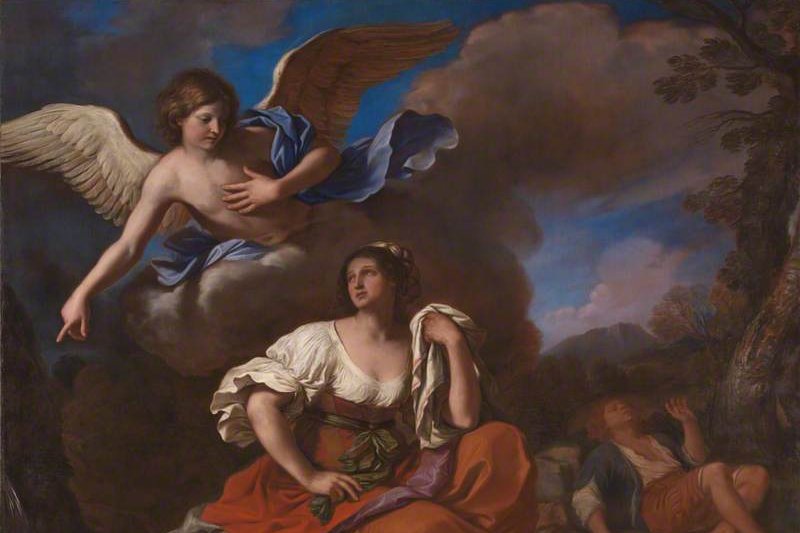
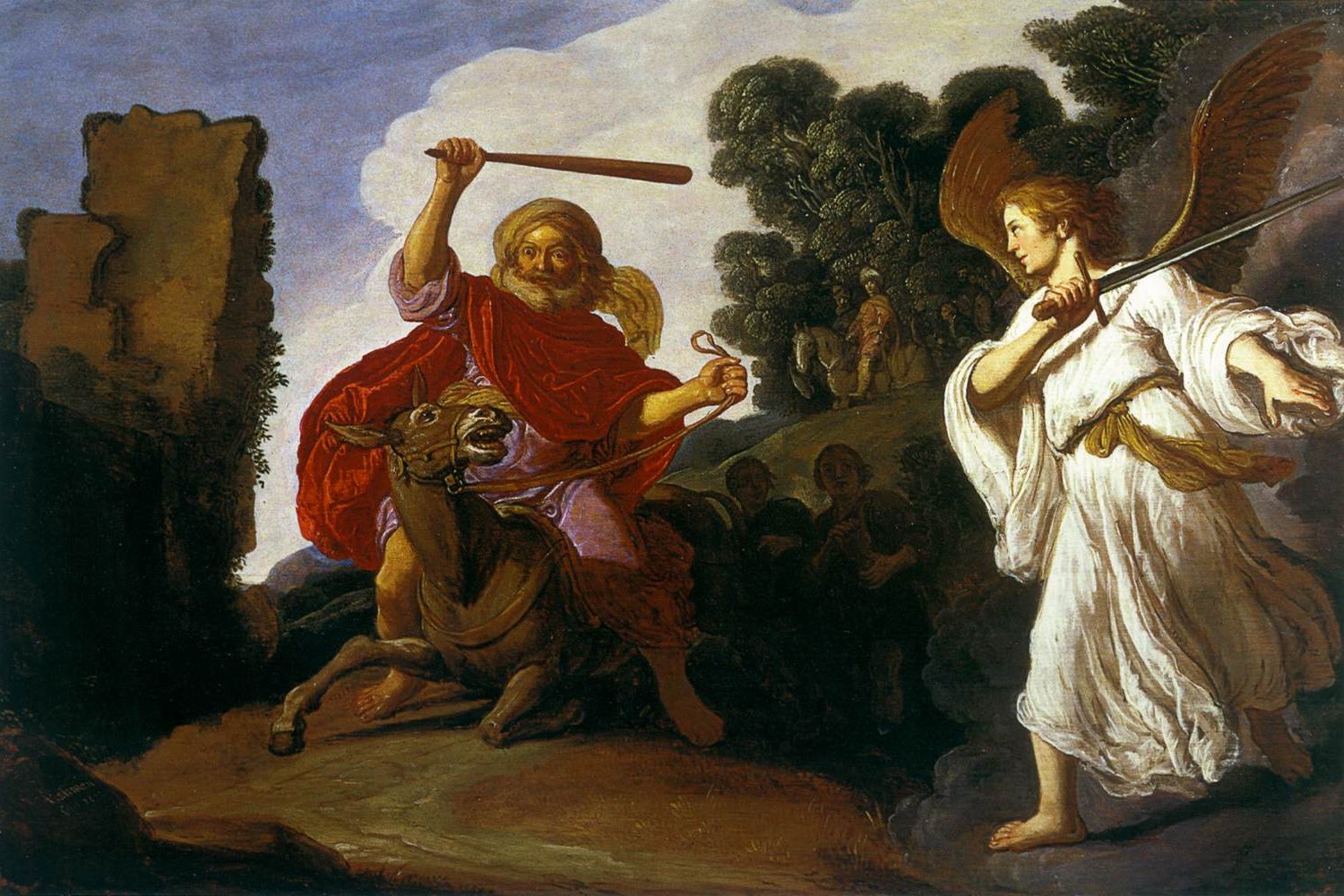
The Three Angels at Mamre

Hospitality in the heat of the day
Genesis frames the scene with an almost cinematic economy: "The Lord appeared to Abraham by the oak of Mamre, as he sat in the entrance of his tent, while the day was growing hot" (Genesis 18:1, NABRE). Abraham looks up and sees three men standing nearby — no fanfare, no announcement, just their sudden presence in a landscape empty enough that a stranger approaching would ordinarily be visible from a distance.
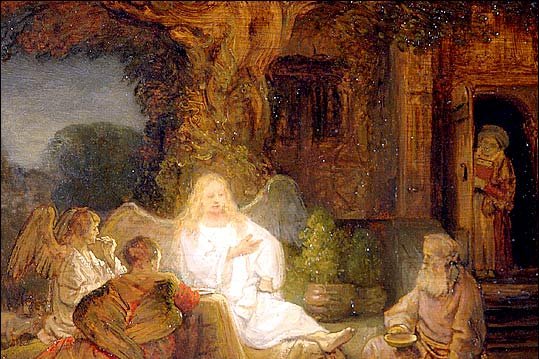
Rembrandt van Rijn, "Abraham Serving the Three Angels," 1646 — public domain.
His reaction is immediate and physical. He runs from the tent entrance to greet them, bows to the ground, and — addressing them in the singular, "Sir" — begs them not to pass by without accepting his hospitality (Genesis 18:2-3). What follows is a small masterpiece of ancient Near Eastern hospitality customs: water for washing dusty feet, rest in the shade, and a meal Abraham personally oversees Sarah in preparing — fine flour cakes, a tender calf, curds and milk. He stands by them under the tree while they eat, the picture of a host attending to guests whose true identity he does not yet fully grasp.
Three men, one Lord
What makes this passage theologically distinctive — and has occupied readers for two thousand years — is its grammar. The chapter opens by saying "the Lord appeared," yet Abraham sees three men, addresses them in the singular, and the ensuing dialogue moves between plural "they said" and singular "the Lord said" almost without warning (Genesis 18:9-10, 13). By the start of the next chapter, only two of the three continue on toward Sodom, now explicitly called "the two angels" (Genesis 19:1).
Scholars call this kind of scene a theophany — a visible, historical appearing of God's presence, distinct from an ordinary vision or an angel speaking purely on God's behalf. The text does not fully resolve who is who among the three, and Catholic tradition has generally been cautious not to over-specify what the original human author intended. What is clear from the narrative itself is that God's own presence and two attending angels are somehow both operative in this single visit — a mystery the text presents rather than explains.
The promise Sarah couldn't quite believe
The visitors ask after Sarah by name — itself notable, since they were never introduced to her — and are told she is in the tent. One of them then makes the promise that anchors the whole episode: "I will return to you about this time next year, and Sarah will then have a son" (Genesis 18:10, NABRE). Sarah is listening from just inside the tent entrance, unseen, or so she thinks.
Genesis specifies that "Abraham and Sarah were old, advanced in years... Sarah laughed to herself" (Genesis 18:11-12) — not a laugh of joy, but the reflexive incredulity of a woman who had spent decades watching that particular hope fail. When the visitor calls her out by name, asking why she laughed and doubted, she denies it out of fear. His reply is delivered without rebuke, simply as fact: "Is anything too marvelous for the Lord to do? At the appointed time, about this time next year, I will return to you, and Sarah will have a son" (Genesis 18:14). The promise is kept exactly on schedule the following year, and the son is named Isaac — Hebrew for "he laughs," a name that turns Sarah's disbelieving laugh into a permanent family joke on providence itself.
Continuing on to judgment
The chapter does not end with the promise. Abraham walks partway with the departing visitors, and it's here that the narrative shifts into one of the Bible's most striking scenes of intercession: Abraham bargains with the Lord over the fate of Sodom, asking whether the whole city might be spared for the sake of fifty righteous people inside it, then talking the number down in stages — forty-five, forty, thirty, twenty, finally ten (Genesis 18:23-32). It is a remarkable portrait of familiarity and boldness in prayer, made possible only because the encounter at Mamre had already established an intimacy between Abraham and his guest.
The two angels who continue on from Mamre arrive at Sodom that same evening, where the story of their reception by Lot — and the city's destruction — unfolds as its own dramatic sequel; read the fuller account in The Angels at Sodom.
Legacy in art and devotion
The Mamre visitation became one of the most painted Old Testament scenes in Western art, valued by artists for its intimate, domestic staging — a rare biblical moment where the divine sits down to share an ordinary meal. Rembrandt returned to the subject more than once, depicting Abraham in the act of serving rather than merely greeting, emphasizing the host's active humility rather than passive awe.
In the Eastern Christian tradition, the scene took on an additional layer of meaning: because three figures are present around Abraham's table while the text insists on a single Lord, icon painters — most famously Andrei Rublev in the fifteenth century — used the composition as a meditation on the Holy Trinity, seating three identical angelic figures around a table with a chalice at its center. It's worth being precise about what the Genesis text itself claims and what later theological reflection added to it: Genesis presents an angelic visitation and a theophany in its own right, and the Trinitarian reading, however beautiful and enduring in Christian art, is a development of later contemplation rather than a claim the original passage makes explicitly.
Either way, the episode at Mamre endures as Scripture's clearest picture of hospitality rewarded — a reminder, as the Letter to the Hebrews later puts it: "Do not neglect hospitality, for through it some have unknowingly entertained angels" (Hebrews 13:2, NABRE).
Trivia
Where did the three visitors appear to Abraham?
Were the three visitors angels, or was one of them God himself?
What promise did the visitors make to Abraham and Sarah?
Why did Sarah laugh at the promise?
How has this scene been interpreted in Christian art and theology?
Related Reading