The Binding of Isaac: Abraham's Hardest Test

A test with no explanation given
Genesis 22 opens with a sentence that removes any suspense about what kind of story this is: "God put Abraham to the test." The reader knows from the first line that whatever comes next isn't God actually wanting a child sacrificed — it's a test. Abraham, standing inside the story rather than reading it from outside, doesn't have that information. He only hears: "Take your son Isaac, your only one, whom you love, and go to the land of Moriah. There offer him up as a burnt offering" (Genesis 22:2).
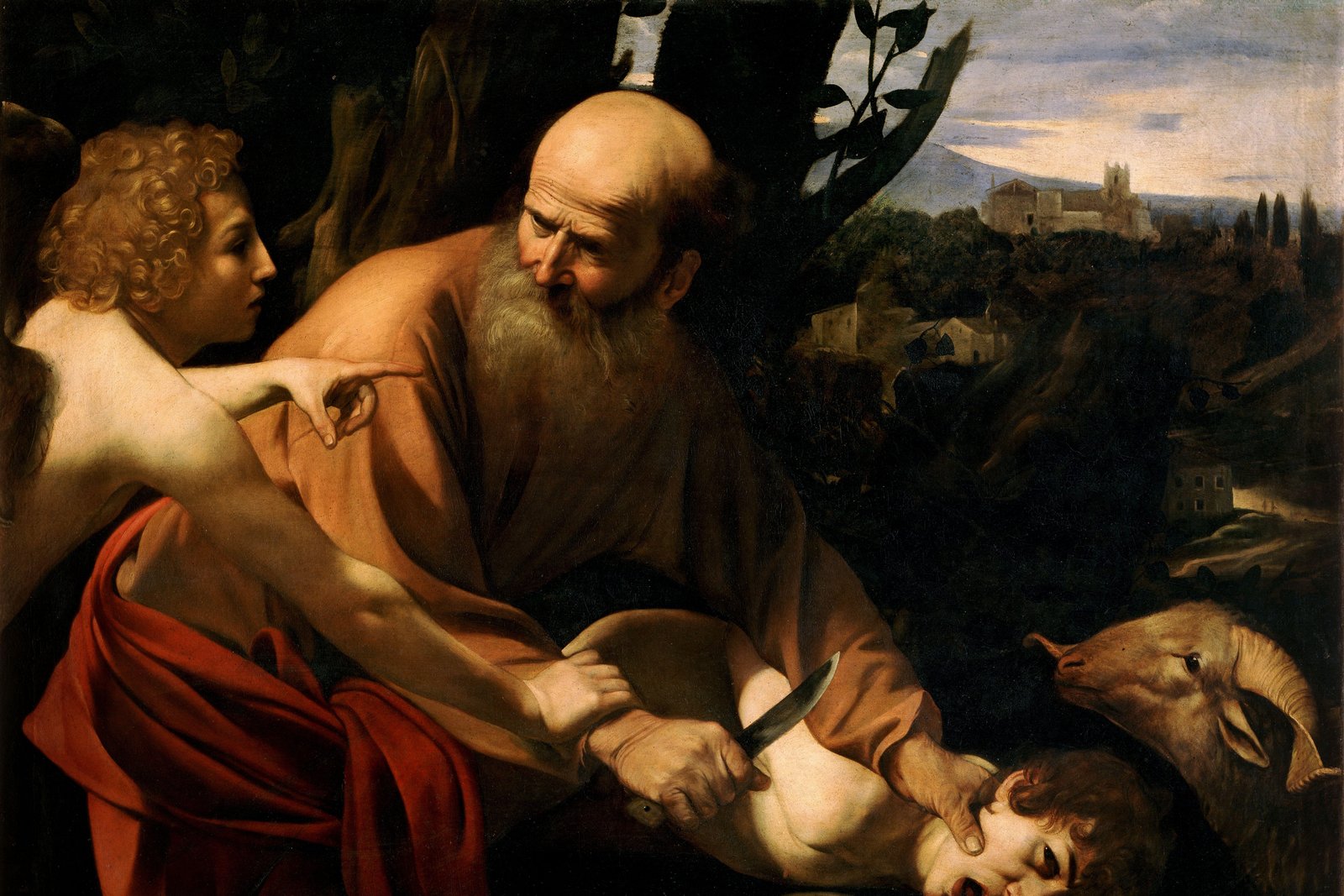
Caravaggio, The Sacrifice of Isaac, c. 1603. Public domain, Uffizi Gallery, Wikimedia Commons.
It's worth pausing on how the command is worded. Isaac isn't just named — he's described as "your only one, whom you love," language that makes the request as personally devastating as it could possibly be. Isaac was the son God had promised Abraham decades earlier at the call of Abraham, the child born to Sarah in her old age after years of barrenness, the entire future of the covenant God had made with Abraham resting in one boy. And now Abraham was being told to destroy him.
Three days of silence
What follows is one of the most restrained passages in Genesis. Abraham gets up early the next morning, saddles his donkey, cuts wood for the sacrifice, and sets out with Isaac and two servants — no debate recorded, no protest, no argument with God of the kind Abraham had been willing to make on Sodom's behalf just a few chapters earlier (Genesis 18:22-33). The journey to Moriah takes three days, and the text gives us none of Abraham's internal thoughts during that entire walk.
Near the site, Abraham tells the servants to stay behind: "the boy and I go on over there. We will worship and then come back to you" (Genesis 22:5). That last phrase — "come back to you," plural, both of them — is often read as a small but telling detail: whatever Abraham believed was about to happen, he told his servants both he and Isaac would return.
"Where is the sheep for the burnt offering?"
As they walk together, carrying the wood, fire, and knife, Isaac asks the question the whole scene has been building toward: "Father!... Here are the fire and the wood, but where is the sheep for the burnt offering?" Abraham's answer is careful, and true in a way he couldn't have fully understood yet: "God will provide the sheep for the burnt offering." (Genesis 22:7-8).
At the site, Abraham builds the altar, arranges the wood, binds Isaac, and lays him on top of it. Genesis 22:10 states it without embellishment: "Then Abraham reached out and took the knife to slaughter his son."
The angel's voice
That's the exact moment the story turns. "The angel of the Lord called to him from heaven, 'Abraham, Abraham!'... 'Do not lay your hand on the boy,' said the angel. 'Do not do the least thing to him. For now I know that you fear God, since you did not withhold from me your son, your only one'" (Genesis 22:11-12). Abraham looks up and finds a ram caught by its horns in a nearby thicket, and offers it in Isaac's place. He names the site Yahweh-yireh — "the Lord will provide" — and the angel returns a second time to renew God's covenant promise: descendants as countless as the stars, blessing extended to all nations through Abraham's line (Genesis 22:14-18).
Why Jewish tradition calls it the Akedah
In Jewish tradition, this episode is known as the Akedah, Hebrew for "the binding," a name that deliberately centers Isaac's ordeal rather than framing the story primarily around Abraham's test — a subtle but meaningful difference in emphasis from how Christian tradition has often told it. Jewish commentary across the centuries has wrestled intensely with Isaac's own experience: rabbinic tradition frequently imagines him as a grown man, not a small child, old enough to understand what was happening and to consent to it, which reframes the story as an act of shared faith between father and son rather than a test imposed on Abraham alone with Isaac merely a passive object. The Akedah occupies a central place in Jewish liturgy to this day; it's read in synagogue on Rosh Hashanah, and the ram's horn blown on that holiday, the shofar, is traditionally understood as a direct echo of the ram caught in the thicket that took Isaac's place. That shared textual inheritance is worth knowing on its own terms — the same difficult chapter of Genesis has generated centuries of serious reflection in a tradition older than, and distinct from, the Christian typological reading described below.
What the Church makes of it
This is one of the most theologically weighty passages in the Old Testament, and Catholic tradition holds two readings of it side by side without collapsing them into one. On its own terms, it's presented in the Letter to the Hebrews (11:17-19) and by St. Paul as the supreme demonstration of Abraham's faith — a willingness to trust God even against everything reason and love argued for, believing, as Hebrews puts it, that God was able to raise Isaac even from death if it came to that.
Alongside that reading, patristic and later Catholic tradition — reflected in the Catechism's brief mention of the episode (CCC 2572) — has long seen in Isaac carrying the wood for his own sacrifice a foreshadowing of Christ carrying his own cross, and in Abraham's willingness to offer his only beloved son a distant echo of the Father's offering of the Son on Calvary. This is a typological reading built up over centuries of Christian reflection, not a claim that the author of Genesis intended to write about Christ directly. Held that way, in its proper place as tradition and reflection rather than literal prophecy, it's part of why this single chapter has occupied so much space in Christian art, liturgy, and preaching for two thousand years.
Trivia
What did God command Abraham to do to Isaac?
What did Isaac ask his father on the way up the mountain?
What stopped Abraham from actually sacrificing Isaac?
Where did the binding of Isaac take place?
How does Catholic tradition interpret the binding of Isaac?
You May Also Like
Related Reading