Jesus Before Pilate

A Roman governor asking about kingship
By the time Jesus stands before Pontius Pilate, the Roman governor of Judea, he has already been arrested, questioned by the Jewish religious authorities, and brought before Pilate specifically because Rome, not the Jewish council, held the authority to carry out an execution. The interrogation Pilate conducts turns quickly to the question of kingship — a politically loaded topic for a Roman official to weigh, since any claim to kingship within Judea carried implications of rebellion against Roman rule. "Then you are a king?" Pilate asks directly.
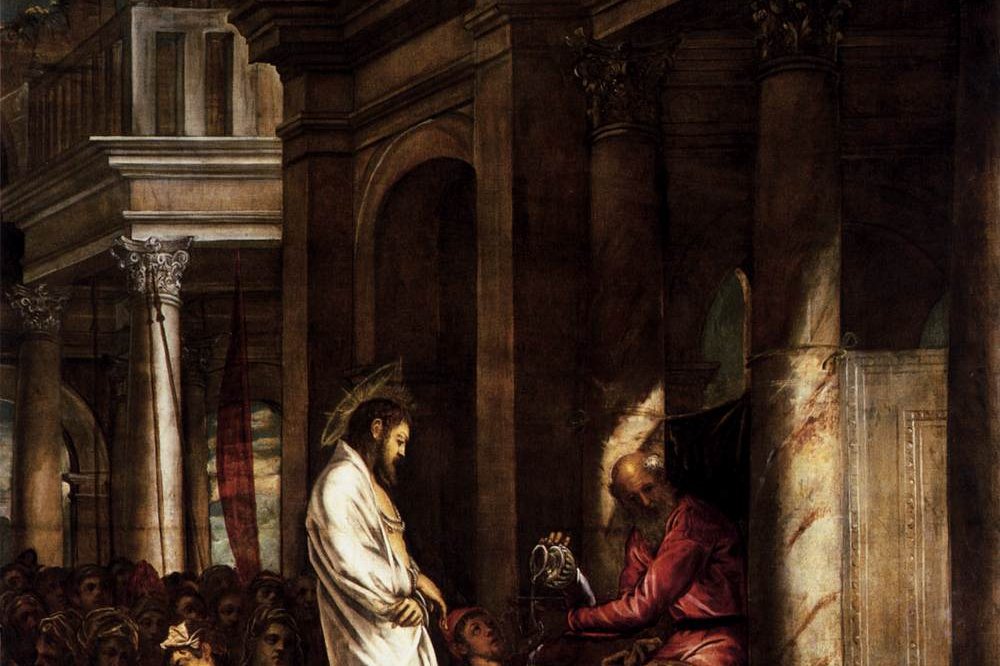
Jacopo Tintoretto, Christ before Pilate (16th century), public domain via Wikimedia Commons
An answer that redirects the question
Jesus's response neither confirms nor denies the title in the terms Pilate is asking about. "You say I am a king. For this I was born and for this I came into the world, to testify to the truth. Everyone who belongs to the truth listens to my voice" (John 18:37, NABRE). It's a striking answer for exactly the reason it likely frustrated Pilate as a legal matter — Jesus doesn't argue for or against the political charge in the terms it was framed, redirecting the entire question toward something Pilate, as a Roman administrator focused on order and political risk, may not have been equipped or inclined to engage with seriously.
"What is truth?"
Pilate's reply has echoed across nearly two thousand years of commentary: "What is truth?" (John 18:38, NABRE). What makes the moment so striking is what John's Gospel does next — nothing. No answer is given, no further exchange recorded on the question itself; Pilate simply turns and goes back out to the crowd. It reads less like a genuine philosophical inquiry than a dismissal, a governor with no patience or interest in pursuing an answer to the very question he's just posed, moving straight past it toward the practical matter of what to do with the man standing in front of him.
Innocence declared, more than once
Whatever Pilate makes of Jesus's answer about truth, he reaches a clear legal conclusion almost immediately afterward: "I find no guilt in him" (John 18:38, NABRE). This isn't a passing or uncertain judgment — Matthew's Gospel records Pilate reinforcing that same conclusion later with an even more dramatic public gesture, washing his hands before the assembled crowd and declaring, "I am innocent of this man's blood. Look to it yourselves" (Matthew 27:24, NABRE). By any straightforward reading, Pilate does not believe Jesus has committed any crime deserving death — and says so, repeatedly, in front of witnesses.
Pressure that outweighs conviction
What makes Pilate's role in this story so uncomfortable to sit with is the gap between what he states he believes and what he ultimately does. Matthew explains the turning point plainly: Pilate acts "When Pilate saw that he was not succeeding at all, but that a riot was breaking out instead, he took water and washed his hands in the sight of the crowd, saying, “I am innocent of this man’s blood. Look to it yourselves." (Matthew 27:24, NABRE) — not new evidence against Jesus, not a change of legal judgment, but the practical political calculation that resisting the crowd's demand risked disorder he'd rather avoid. Pilate's own declared conviction of Jesus's innocence simply doesn't survive contact with that pressure.
"We have no king but Caesar"
The scene's final exchange sharpens the political dimension even further. "Pilate said to them, 'Shall I crucify your king?' The chief priests answered, 'We have no king but Caesar.' Then he handed him over to them to be crucified" (John 19:15-16, NABRE). It's a striking line from Jerusalem's own religious leadership — a rejection not just of Jesus specifically, but of any king beyond the Roman emperor, spoken to secure exactly the outcome they wanted from a governor already looking for a reason to give it to them.
A warning Pilate chooses to ignore
Matthew's account adds a detail easy to overlook amid the larger political drama: while Pilate sits on the judgment seat, his own wife sends him an urgent message. "While he was still seated on the bench, his wife sent him a message, 'Have nothing to do with that righteous man. I suffered much in a dream today because of him'" (Matthew 27:19, NABRE). It's a striking moment to place right at the hinge of the narrative — even Pilate's own household registers alarm about what's about to happen, naming Jesus specifically as "righteous," before Pilate ultimately proceeds anyway. Whatever weight the dream carried for Pilate personally, Matthew records it only to show that the warning didn't change his course.
A prisoner the crowd chose instead
Pilate's hesitation plays out through more than just his own statements of innocence — Matthew describes an annual custom of releasing one prisoner at the crowd's request during the feast, and Pilate tries to use it as a way out. He offers the crowd a choice between "a notorious prisoner called Barabbas" and Jesus; Matthew notes that Pilate "knew that it was out of envy that they had handed him over" (Matthew 27:16-18, NABRE) — a detail suggesting Pilate understood exactly what was driving the accusation against Jesus, and hoped the crowd might choose differently if given the option. Matthew notes that the chief priests and elders actively worked the crowd to ask for Barabbas instead, and when Pilate asks a second time which of the two they want released, the answer comes back immediate and unified: "Barabbas!" (Matthew 27:20-21, NABRE). Even this attempt to let the people themselves decide away from his own authority fails to produce the outcome Pilate's own stated judgment would have favored.
A name repeated every time Christians recite the Creed
Pilate's role in this story became so central to how Christianity remembers the event that his name entered the Church's most basic statement of belief. The Nicene Creed, recited at Mass across the Catholic world, states that Christ "was crucified also for us under Pontius Pilate" — a rare case of a Roman administrative official's name being preserved, by intention, inside the Church's core profession of faith, less to honor him than to anchor the Passion to a specific, verifiable moment in real political history rather than legend. Pilate is remembered not as a villain invented for dramatic effect, but as a particular man holding a particular Roman office, whose documented hesitation and eventual capitulation became, for Christian memory, part of the historical scaffolding of the event itself.
A judgment overruled by convenience
What has kept this episode central to how Christians understand the Passion isn't legal ambiguity — the text goes out of its way to establish that Pilate found no case against Jesus, stated it clearly, and acted against his own stated conclusion anyway. It's a portrait less of a man deceived than of a man who knew the right answer and chose the convenient one, a dynamic that has made Pilate, across centuries of reflection, into something more than a minor Roman official: a recognizable figure for anyone who has ever known what was right and let pressure decide otherwise.
Trivia
What did Jesus say when Pilate asked if he was a king?
What was Pilate's famous response to that answer?
Did Pilate believe Jesus was guilty of a crime?
Why did Pilate hand Jesus over to be crucified despite finding him innocent?
What did the crowd and chief priests say when Pilate asked about crucifying their king?
Related Reading