The Parable of the Wedding Banquet

Set at a Dinner Table
Luke places this parable in a very specific setting: Jesus is a guest at a Sabbath meal in the home of "one of the leading Pharisees" (Luke 14:1), and the conversation around the table has already turned toward the kingdom of God. When one of the other guests offers the pious-sounding remark, "Blessed is the one who will dine in the kingdom of God" (14:15), Jesus answers not with agreement or correction, but with a story — a common rabbinic teaching method of the time, using narrative to reframe a question rather than answering it directly.
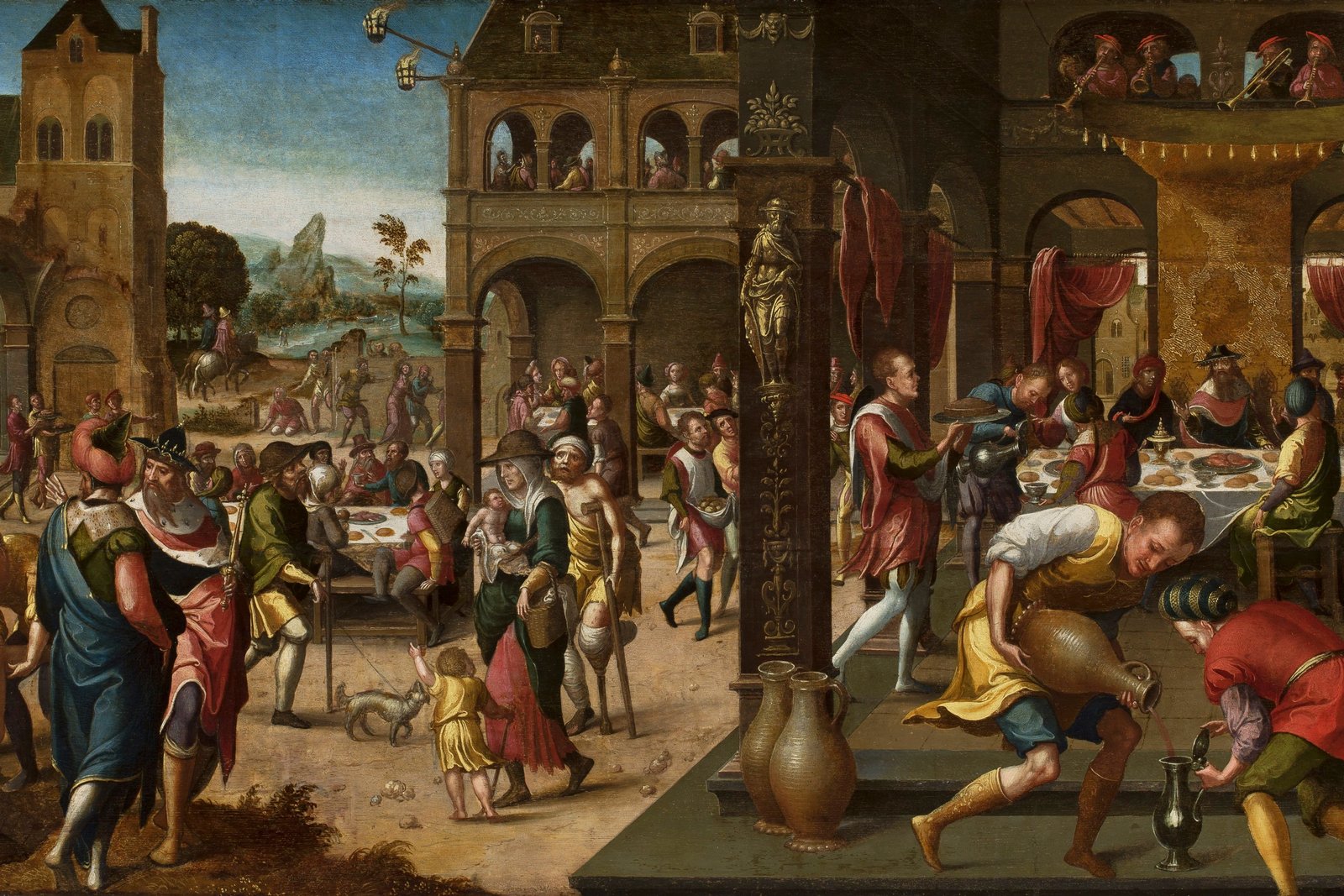
Brunswick Monogrammist, Parable of the Great Banquet (16th century) - Wikimedia Commons, public domain
"A man gave a great dinner to which he invited many. When the time for the dinner came, he dispatched his servant to say to those invited, 'Come, everything is now ready'" (14:16-17). The custom being described here was a familiar one in the ancient Near East: a formal invitation issued well in advance, followed by a second summons on the day itself once preparations were complete. Anyone who had already accepted the first invitation was expected, as a matter of basic social obligation, to respond to the second and actually attend.
The Excuses
What happens next is the hinge of the whole story. "One by one, they all began to excuse themselves" (14:18). Luke gives three specific examples. The first says, "I have purchased a field and must go to examine it; I ask you, consider me excused" (14:18). The second: "I have purchased five yoke of oxen and am on my way to evaluate them; I ask you, consider me excused" (14:19). The third gives the barest explanation of all: "I have just married a woman, and therefore I cannot come" (14:20).
None of these excuses is scandalous or shocking on its own terms — a new field, new livestock, a new marriage are all ordinary, even admirable, parts of daily life. That is precisely the parable's sharpest edge: the guests are not refusing out of hostility or crisis, but out of simple preoccupation with legitimate, everyday concerns that they have allowed to take priority over an invitation they had already accepted. Matthew's parallel version is blunter about the guests' attitude, describing some of the invited as simply refusing to come and going about their own business, while others seize and mistreat the messengers sent to summon them (Matthew 22:5-6) — a harsher framing generally read as pointing more directly at the specific historical rejection of the prophets and, ultimately, of Jesus himself by some of Israel's leaders.
Filling the Hall
The host's reaction, when his servant reports back, is anger — but anger channeled into an unexpected act of expansive generosity rather than simply canceling the event. "Go out quickly into the streets and alleys of the town and bring in here the poor and the crippled, the blind and the lame" (Luke 14:21). This is a striking reversal: the very people least likely to receive a formal social invitation in that culture — those without wealth, status, or the standing to reciprocate hospitality — are the ones brought in to take the original guests' places.
When the servant reports that there is still room, the host extends the search even further: "Go out to the highways and hedgerows and make people come in that my home may be filled" (14:23) — moving beyond even the town's own poor to whoever can be found on the roads outside it, entirely outside the host's existing social circle. The parable ends on a note of finality and consequence: "For, I tell you, none of those men who were invited will taste my dinner" (14:24). The refusal was not without cost; the invitation, once declined, was not simply held open indefinitely.
Matthew's Wedding Garment
Matthew's version of the parable, set explicitly as a king celebrating his son's wedding, follows much the same arc through the servants being sent, refused, and then sent out again to gather "whomever you find" (Matthew 22:9), "bad and good alike" (22:10), until the hall is filled. But Matthew adds a scene absent from Luke: the king, entering to see the guests, notices a man "not dressed in a wedding garment" (22:11) and has him bound and cast out.
This detail has long puzzled readers, since the man was presumably gathered in on short notice from the street, with no chance to prepare formal attire. Catholic commentary generally treats the wedding garment as a symbol rather than a literal expectation of dress code — representing an inner disposition, a readiness of heart, or a changed life that God's grace makes possible and that is expected of anyone who accepts the invitation into the kingdom. Being gathered in is not, in this reading, the end of the story; a genuine response, not mere physical presence, is what the parable asks of its hearers.
What the Banquet Represents
Catholic reading of this parable generally identifies the banquet with the kingdom of God, and in a more specific sacramental sense, with the eschatological wedding feast of the Lamb described in Revelation 19:9 and echoed in the Eucharistic liturgy itself, where the invitation "Blessed are those called to the supper of the Lamb" draws directly on this same image. The original invited guests, in the historical context of Jesus's own audience, are usually read as representing the religious leadership and people of Israel who had long been the first recipients of God's covenant invitation, while the guests gathered later from the streets and highways represent the wideness of that invitation once extended — including, pointedly, Gentiles, sinners, and the socially marginal, all those least expected to have a claim on the feast.
The parable's warning, though, is not aimed only at a single historical audience two thousand years removed from any contemporary reader. Its enduring force lies in how ordinary the guests' excuses are — a field, some oxen, a marriage — none of them evil in themselves, all of them capable of quietly displacing something more important if allowed to. Readers exploring more of Jesus's teaching in parables may also enjoy The Parable of the Ten Virgins, another story about readiness for a wedding feast, and The Prodigal Son, another parable built around an unexpected, generous welcome.
Trivia
Where does the Parable of the Wedding Banquet (or Great Banquet) appear in the Bible?
What excuses did the invited guests give for not coming?
Why did the host invite strangers off the street instead of simply rescheduling?
What is the meaning of the man without wedding attire in Matthew's version?
What is the parable's central meaning in Catholic interpretation?
Related Reading