Mary and Martha of Bethany

A welcome, and an uneven division of labor
Luke's own account doesn't name the village where this scene takes place — the identification of these sisters with the Mary and Martha of Bethany comes from John's Gospel, which introduces its own account of the sisters by naming "Lazarus from Bethany, the village of Mary and her sister Martha" (John 11:1, NABRE). Tradition has long read Luke's Mary and Martha as the same pair, though Luke's text alone leaves the village unnamed. Luke introduces the scene with characteristic economy: as Jesus and his disciples continue their travels, "he entered a village where a woman whose name was Martha welcomed him" into her home (Luke 10:38, NABRE). It's an act of genuine hospitality — opening one's household to a traveling teacher and his followers was no small undertaking in the ancient world, requiring real labor to manage properly. Luke immediately introduces Martha's sister as well: "She had a sister named Mary [who] sat beside the Lord at his feet listening to him speak" (Luke 10:39, NABRE). The contrast between the two sisters is set up in the very next breath after their introduction — one welcoming Jesus into practical service, the other settling in to simply listen.
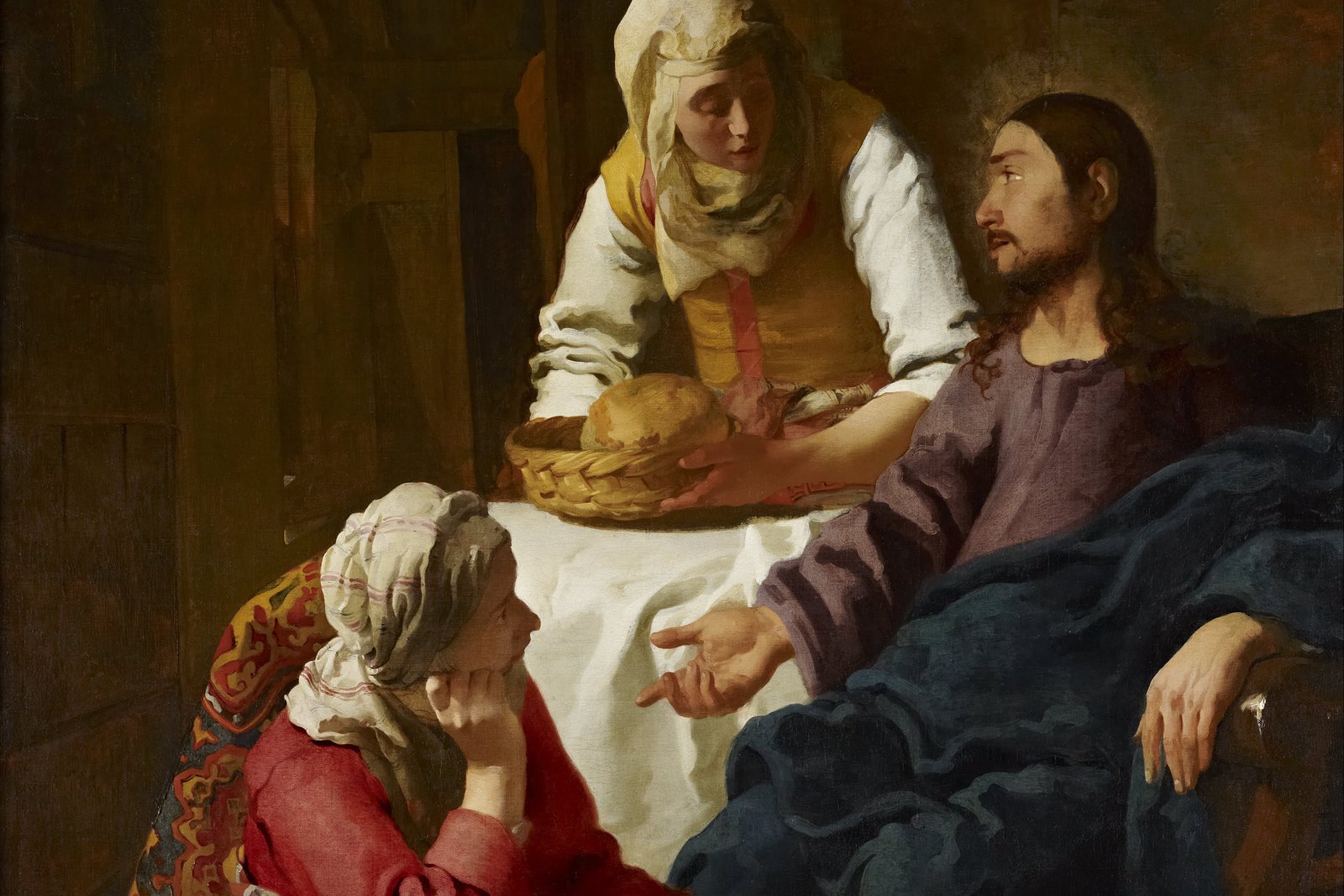
Johannes Vermeer, Christ in the House of Martha and Mary (c. 1654-1656), public domain via Wikimedia Commons
Burdened, and increasingly resentful
Martha's situation is described in a single, pointed phrase: she was "burdened with much serving" (Luke 10:40, NABRE) — not simply busy, but weighed down by it, doing what appears to be the substantial work of hosting largely on her own while her sister sits nearby, apparently unconcerned with helping. It's easy to sympathize with Martha's position even without the text spelling out every detail — she's carrying real, practical responsibility that her sister has, by choice, stepped away from.
A direct appeal to Jesus for intervention
Rather than confronting Mary herself, Martha brings her frustration straight to Jesus, framing it almost as a question of whether he even notices or cares about the imbalance: "Lord, do you not care that my sister has left me by myself to do the serving? Tell her to help me" (Luke 10:40, NABRE). It's a request for Jesus to settle the matter with his own authority — not simply sympathy, but an actual instruction to Mary to get up and start helping with the work Martha has been carrying alone.
An answer that doesn't take Martha's side
What Jesus says next is the reason this brief domestic scene has remained so widely discussed across centuries of commentary. Rather than agreeing with Martha's request, he gently redirects the whole framing of her complaint: "Martha, Martha, you are anxious and worried about many things. There is need of only one thing. Mary has chosen the better part and it will not be taken from her." (Luke 10:41-42, NABRE). It's worth noting precisely what Jesus names as the actual issue — not the serving itself, which nowhere in the passage is criticized as wrong or unnecessary, but Martha's internal state: anxious, worried, "about many things," in a way that has left her resentful of her sister's different choice in this particular moment.
Not a ranking of service beneath prayer
It would be easy to read this exchange as a simple hierarchy — listening to Jesus matters more than practical service, full stop. Many readers across the history of interpreting this passage have been careful to resist that flattened reading, since Scripture elsewhere consistently honors service to others as central to living out faith, not as a lesser concern to be set aside whenever possible. What Jesus addresses here is more specific to the moment: Martha's anxiety and her resentment toward her sister, not the value of hospitality or work itself. Mary's choice to sit and listen is affirmed as right for that particular moment, with that particular guest present — not as a permanent statement that stillness always outranks service in every circumstance that follows.
The same two sisters, a different crisis
John's Gospel gives Martha and Mary a second, much larger scene, and it complicates any temptation to reduce either sister to a single trait. When their brother Lazarus dies, it's Martha who goes out to meet Jesus on the road first, and her words carry both grief and real faith: "Lord, if you had been here, my brother would not have died. [But] even now I know that whatever you ask of God, God will give you" (John 11:21-22, NABRE). When Jesus tells her, "I am the resurrection and the life," he asks her directly, "Do you believe this?" — and Martha gives one of the most direct confessions of faith anywhere in the Gospels: "Yes, Lord. I have come to believe that you are the Messiah, the Son of God" (John 11:25-27, NABRE). The sister so often remembered only for her busy anxiety in Luke's account turns out, in John, to be the one who says plainly who she believes Jesus is.
Serving again, at a dinner after Lazarus is raised
Later, at a dinner held in Bethany after Lazarus's return to life, John notes in passing that "Martha served, while Lazarus was one of those reclining at table with him" (John 12:2, NABRE) — the same household role she held in Luke's account, offered again without any hint that it was ever the problem. In that same scene, Mary performs an act that has become almost as well known as her sitting at Jesus's feet: she "took a liter of costly perfumed oil made from genuine aromatic nard and anointed the feet of Jesus and dried them with her hair," filling the house with its fragrance (John 12:3, NABRE). Read alongside Luke's account, the two scenes together form a fuller picture of each sister — Martha's steady, practical devotion shown through hosting again and again, Mary's devotion shown through stillness and, here, an extravagant act of honor that some of those present criticized as wasteful.
Remembered together in the Church's calendar
The Catholic Church keeps a shared feast day for Martha, Mary, and Lazarus on July 29, having added Mary and Lazarus to what had originally been Martha's own feast day in the reformed General Roman Calendar. Tradition in parts of France, developed many centuries after the Gospel accounts and resting on legend rather than Scripture, holds that Martha later tamed a dragon near the town of Tarascon — a story worth naming as pious legend, not as a claim the Gospels themselves make about her.
A brief scene that keeps generating conversation
Few episodes in the Gospels pack as much ongoing discussion into so few verses. The tension between Martha's practical concern and Mary's stillness continues to resonate because most people recognize themselves in one sister or the other, sometimes in both at once — the pull toward necessary, valuable work, and the pull toward simply being present and attentive, especially when both feel urgent at the same time. Jesus's answer doesn't resolve that tension by dismissing one side entirely; it names what had actually gone wrong in Martha specifically — not her hands being busy, but her heart being anxious and divided while they were.
Trivia
Who were Mary and Martha, and how does their story begin?
What was each sister doing while Jesus was there?
What did Martha say to Jesus about the situation?
How did Jesus respond to Martha's complaint?
Does this story mean serving others is less important than prayer or listening?
Related Reading