The Agony in the Garden

An olive grove outside the walls
After the Last Supper, Jesus led his disciples out of Jerusalem, across the Kidron Valley, and up the slope of the Mount of Olives to a place called Gethsemane (Matthew 26:36, NABRE). The name itself is practical rather than poetic — it comes from Aramaic words meaning "oil press," marking the spot as a working grove where olives were crushed for oil, not a manicured garden. It was, by all accounts, a place Jesus and his disciples knew well; John's Gospel notes that Jesus "often met there with his disciples," which is exactly how Judas Iscariot would know where to find him later that night.
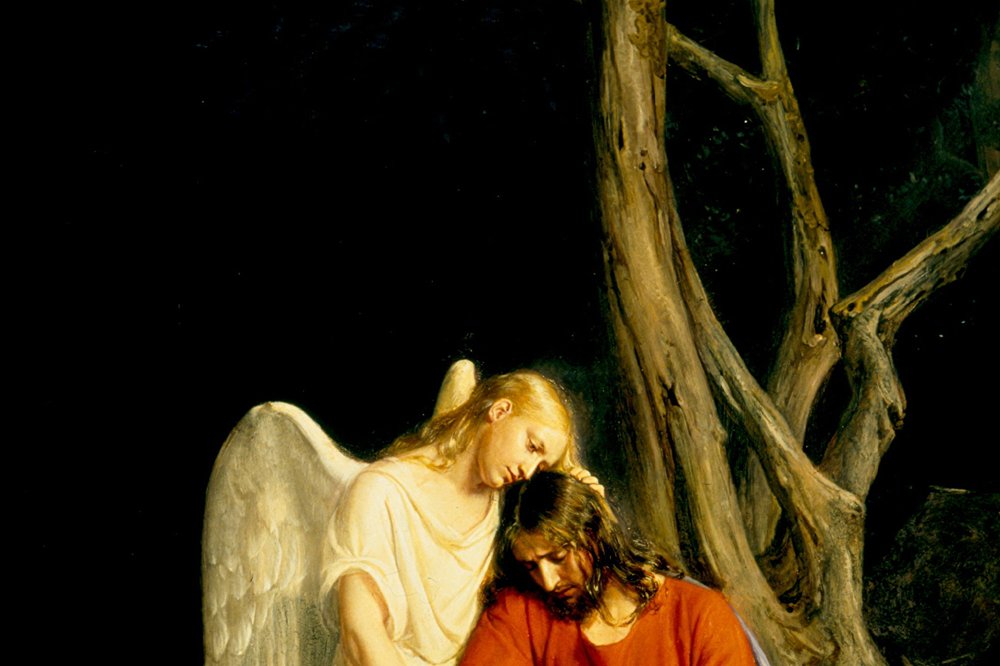
Carl Heinrich Bloch, "Gethsemane," 1873, Museum of National History, Frederiksborg Castle — public domain.
Jesus brought the group there and told most of them to wait while he went further in to pray. He took only Peter, James, and John — the same three who had witnessed his Transfiguration — and told them plainly what was happening inside him: "My soul is sorrowful even to death. Remain here and keep watch with me" (Matthew 26:38, NABRE). It's one of the rawest emotional statements attributed to Jesus anywhere in the Gospels.
"Not as I will, but as you will"
Moving a short distance further, Jesus fell to the ground in prayer. Matthew records his words directly: "My Father, if it is possible, let this cup pass from me; yet, not as I will, but as you will" (Matthew 26:39, NABRE). The "cup" is a common biblical image for a fate one must drink to the dregs — here, the suffering and death that awaited him. The prayer is remarkable for holding two things together without resolving the tension between them: a genuine, human plea for another way, and an unconditional surrender to his Father's will regardless of the answer.
He returned to Peter, James, and John and found them asleep. His question to Peter is gentle but pointed: "So you could not keep watch with me for one hour?" (Matthew 26:40, NABRE). He went back and prayed essentially the same prayer two more times, phrasing his second petition slightly differently — "if it is not possible that this cup pass without my drinking it, your will be done!" (Matthew 26:42, NABRE) — and each time returned to find the three still asleep, "for they could not keep their eyes open" (Matthew 26:43, NABRE).
Sweat like drops of blood
Luke's Gospel adds two details Matthew and Mark don't include: "an angel from heaven appeared to him" to strengthen him, and Jesus "was in such agony and he prayed so fervently that his sweat became like drops of blood falling on the ground" (Luke 22:43-44, NABRE). It's worth noting, in the interest of accuracy, that these two verses are missing from some of the earliest surviving manuscripts of Luke, which is why many modern Bibles — including the NABRE — set them apart with brackets, flagging them as a probably very early but not universally attested part of the text. Whether or not the detail is original to Luke, it has shaped Christian devotion for centuries, giving rise to a long tradition of art and prayer focused on the "Agony in the Garden" as a distinct scene of physical and spiritual suffering, sometimes discussed under the medical term hematidrosis — a rare condition in which extreme stress can cause capillaries to rupture and blood to mix with sweat.
The betrayal arrives
After the third round of prayer, Jesus returned to his disciples with words that mark the turning point of the whole night: "Are you still sleeping and taking your rest? Behold, the hour is at hand when the Son of Man is to be handed over to sinners. Get up, let us go. Look, my betrayer is at hand" (Matthew 26:45-46, NABRE). Almost immediately, Judas arrived with an armed crowd sent by the chief priests and elders, and identified Jesus with a kiss — the prearranged signal Judas had given them (Matthew 26:47-49, NABRE).
Why the scene matters
The Agony in the Garden sits at a hinge point in the Passion narrative: the last moment before Jesus's arrest, trial, and crucifixion begin in earnest, and the last moment in which he is, in a human sense, free. Christian tradition has long read it as the moment his full humanity is most visible — fear, sorrow, and reluctance held alongside total obedience. It's counted as the first of the Sorrowful Mysteries of the Rosary, prayed as a meditation on facing suffering with trust rather than resignation.
The scene also carries a quieter theme that shows up again and again in the Gospels: human weakness set beside divine faithfulness. Peter, James, and John — who would go on to become pillars of the early Church — simply could not stay awake for one hour with their friend in his worst moment. It's a detail the Gospel writers didn't need to include, and its honesty is part of why the scene has resonated with readers for two thousand years. For the events immediately following, see this blog's account of the carrying of the cross.
Trivia
Where is the Agony in the Garden found in the Bible?
What does 'Gethsemane' mean?
Did Jesus really sweat blood?
What did Jesus pray for in the garden?
Why did the disciples keep falling asleep?
Related Reading