The Parable of the Lost Coin

A Complaint Answered With Three Stories
The Parable of the Lost Coin does not stand alone. Luke places it as the middle panel of a set of three parables Jesus tells in direct response to a specific complaint: "The Pharisees and scribes began to complain, saying, 'This man welcomes sinners and eats with them'" (Luke 15:2). Rather than defending himself directly, Jesus answers with three short stories in a row — the lost sheep, the lost coin, and the prodigal son — each approaching the same underlying claim from a different angle: that seeking out what is lost, and rejoicing loudly when it is found, is not scandalous behavior to be criticized, but a direct reflection of God's own character.
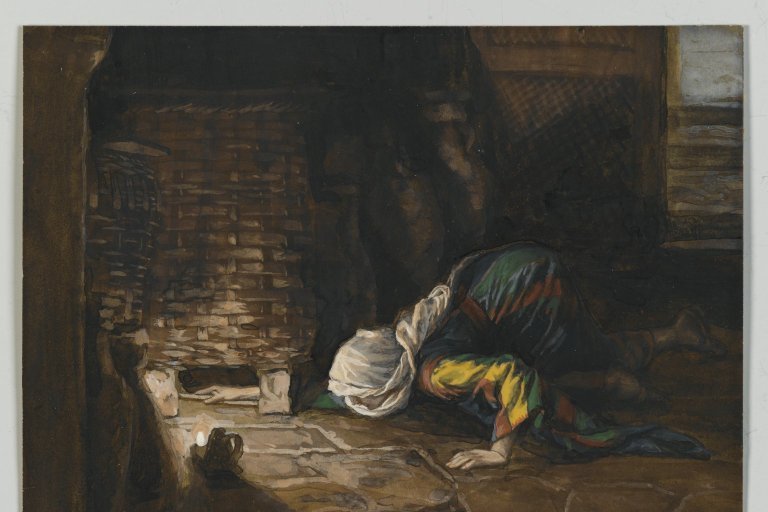
James Tissot, The Lost Drachma (c. 1886-1894), Brooklyn Museum - Wikimedia Commons, public domain
The lost coin sits at the structural center of that trio, and its brevity is part of its design. Where the prodigal son unfolds over an extended, emotionally layered narrative, the lost coin is told in just two verses — a compressed, almost understated parallel to the shepherd's search for one sheep out of a hundred that immediately precedes it.
Ten Coins, One Missing
"Or what woman having ten coins and losing one would not light a lamp and sweep the house, searching carefully until she finds it?" (Luke 15:8). The coin in question, a drachma in the original Greek, was a silver coin worth roughly a day's wage for an ordinary laborer — not a trivial sum, but far from a fortune either. Some scholars have suggested, based on cultural practices attested elsewhere in the region and period, that a set of ten such coins may have been worn strung together as a headdress or necklace, functioning as a woman's personal savings or as part of her dowry, worn visibly rather than kept locked away. If so, the loss would have been doubly felt: both the practical value of the coin itself and the incompleteness of a set that was meant to be whole, and perhaps worn or displayed as such.
The search Jesus describes is thorough and deliberate, not a casual glance around the room. Ordinary homes in first-century Galilee were typically small, single-room structures, often windowless or nearly so, with packed dirt floors that could easily swallow a small silver coin in the debris and shadow of daily life. Lighting a lamp in the middle of the day, and then sweeping the entire floor while searching "carefully" — the Greek term suggests a diligent, systematic effort, not a quick sweep — communicates the seriousness with which the woman treats even this one small, seemingly replaceable object.
A Celebration Bigger Than the Loss
The parable's payoff comes not with the finding itself, described in a single clause, but with what the woman does immediately afterward: "When she does find it, she calls together her friends and neighbors and says to them, 'Rejoice with me because I have found the coin that I lost'" (15:9). This detail rewards a moment's practical thought. Gathering friends and neighbors for a celebration — presumably involving food and hospitality, as such gatherings customarily did — would very plausibly have cost the woman more than the coin she was celebrating was actually worth.
That is not an oversight in the parable's logic; it is the entire point being made. The joy described here is not calibrated to the market value of what was recovered. It is a joy proportionate to the fact of restoration itself — of something that belonged, being found and made whole again — regardless of what a neutral accountant might say about the cost-benefit of the celebration.
Jesus Names the Meaning Directly
Unlike many of Jesus's parables, which he leaves for his listeners to interpret or which the Gospel writers record without further comment, this one closes with Jesus stating the meaning outright: "In just the same way, I tell you, there will be rejoicing among the angels of God over one sinner who repents" (15:10). The parallel structure is explicit and deliberate — the coin stands for a person, lost not through any fault of the coin itself (a detail worth noting, since a coin cannot wander off the way a sheep or a son can; it is simply misplaced, without any implication of willful rebellion), and the woman's careful, active search stands for God's own pursuit of that person.
This detail — that the coin is lost passively, through no active choice of its own, unlike the sheep that wanders or the son who deliberately leaves home — has led some commentators to read the three parables in Luke 15 as covering a spectrum of ways a person can become lost: through carelessness or straying (the sheep), through circumstances entirely outside their control (the coin), and through a deliberate, willful choice to leave (the prodigal son). In each case, though, the response from the one who seeks is the same: active effort, and a joy at recovery that exceeds ordinary proportion once what was lost is found.
Heaven's Accounting Is Not Ours
The recurring phrase across all three parables in Luke 15 — rejoicing that exceeds what a purely rational calculation would predict — carries a consistent theological weight in Catholic reading. It resists a transactional view of divine mercy, in which forgiveness might be imagined as grudging or proportional to how deserving the lost object or person is. Instead, the parable presents God's joy over a single repentant sinner as comparable to a woman celebrating one small coin with a party that costs more than the coin itself: not a rational trade, but an expression of how much the thing recovered mattered simply because it was hers, and had been missing.
For a Church founded, per Jesus's own words in Luke's Gospel just before this trio of parables, in table fellowship with tax collectors and sinners, the lost coin offers one of Scripture's plainest justifications for treating every single person, however small or seemingly insignificant their return might appear from the outside, as worth the entire effort of the search and the full extravagance of the celebration afterward. Readers interested in the other two parables in this same set may enjoy The Parable of the Lost Sheep and The Prodigal Son, which complete the trio Jesus told that day.
Trivia
Where does the Parable of the Lost Coin appear in the Bible?
What was the coin, and why did losing it matter so much?
Why did the woman light a lamp to search inside her own house during the day?
What did the woman do once she found the coin?
What is the parable's meaning, according to Jesus himself?
Related Reading