Peter's Confession at Caesarea Philippi

A question asked in a telling location
Matthew locates this exchange specifically: "When Jesus went into the region of Caesarea Philippi he asked his disciples, 'Who do people say that the Son of Man is?'" (Matthew 16:13, NABRE). The setting is worth pausing on — Caesarea Philippi was a city in the ancient world closely associated with pagan religious sites and imperial honors, a place where claims to divine or political power were already visibly on display in the surrounding landscape. It's within that backdrop that Jesus chooses to ask his own disciples the question that will become the center of the scene.
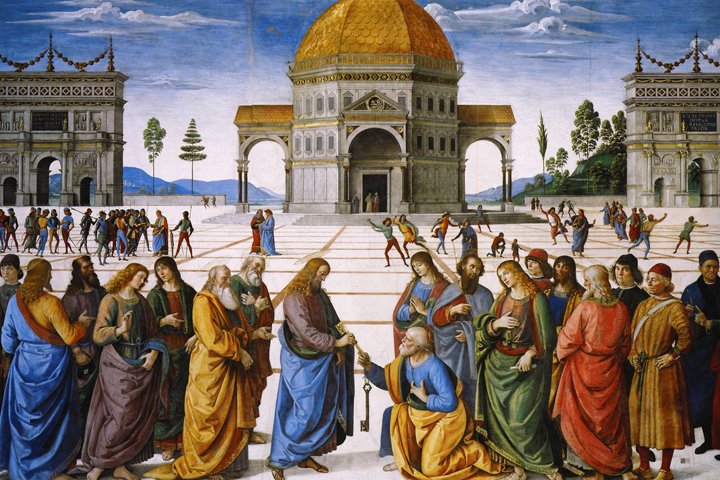
Pietro Perugino, Christ Handing the Keys to St. Peter (1481-1482), public domain via Wikimedia Commons
The crowd's guesses, and Jesus's sharper question
The disciples' first answer reflects the range of popular speculation they'd been hearing: "Some say John the Baptist, others Elijah, still others Jeremiah or one of the prophets" (Matthew 16:14, NABRE) — flattering comparisons, placing Jesus among Israel's most revered prophetic figures, but all of them still comparisons to other, earlier human beings. Jesus doesn't linger on this survey of popular opinion. He turns the question directly onto the twelve standing with him: "But who do you say that I am?" (Matthew 16:15, NABRE) — a much more personal, exposed question than the first, asking not what others think but what his own closest followers, after walking with him, have come to believe themselves.
An answer that goes further than anyone else had gone
It's Peter who speaks first, and his answer moves well beyond the earlier crowd of comparisons: "Simon Peter said in reply, 'You are the Messiah, the Son of the living God'" (Matthew 16:16, NABRE). This isn't simply another entry on the list of impressive historical figures — it's a direct claim about Jesus's divine identity and messianic role, something none of the popular guesses the disciples had just reported came close to suggesting. Peter's declaration marks a clear turning point in how Jesus is understood within the Gospel's own narrative.
"Flesh and blood has not revealed this to you"
Jesus's response makes clear that he doesn't treat Peter's answer as simply a clever guess or the product of careful reasoning. "Blessed are you, Simon son of Jonah. For flesh and blood has not revealed this to you, but my heavenly Father" (Matthew 16:17, NABRE) — crediting the insight itself to God's own revelation rather than to Peter's own perceptiveness. It's a notable move: even the correct recognition of who Jesus is gets framed here as a gift given rather than an achievement earned, before Jesus goes on to respond to Peter with something substantial in return.
A name, a foundation, and a promise
What follows is one of the most consequential single statements in the Gospels: "And so I say to you, you are Peter, and upon this rock I will build my church, and the gates of the netherworld shall not prevail against it" (Matthew 16:18, NABRE). Jesus plays directly on Peter's name — Peter (Petros) and rock (petra) sharing the same root — building a promise about the Church's founding and its ultimate security directly onto this moment of Peter's confession. Jesus continues with a further, specific grant of authority: "I will give you the keys to the kingdom of heaven. Whatever you bind on earth shall be bound in heaven; and whatever you loose on earth shall be loosed in heaven" (Matthew 16:19, NABRE) — language many later interpreters and Catholic tradition in particular have connected to a real, ongoing stewardship and authority entrusted to Peter specifically.
The Church's own reading of "the keys"
Catholic teaching treats this moment as more than a single dramatic exchange — the Catechism of the Catholic Church describes Jesus as having made "Simon alone, whom he named Peter, the 'rock' of his Church," giving him "the keys of his Church" and instituting him "shepherd of the whole flock," an office the Catechism says "belongs to the Church's very foundation and is continued by the bishops under the primacy of the Pope" (Catechism of the Catholic Church, 881). It's worth being precise about what's Church teaching and what's broader interpretation here: that Peter's role continues through the papacy is a definite doctrinal claim the Catholic Church makes about this passage, while the exact historical mechanics of how that office developed in the first Christian centuries is a separate question historians and theologians continue to study.
Almost immediately, a sharp rebuke
What makes this scene even more striking is how quickly the same Gospel chapter turns from Peter's high point to one of his lowest. Only a few verses later, after Jesus begins telling the disciples that he "must go to Jerusalem and suffer greatly... and be killed and on the third day be raised," Peter pulls him aside and objects: "God forbid, Lord! No such thing shall ever happen to you" (Matthew 16:21-22, NABRE). Jesus's answer is as sharp as his earlier blessing was generous: "Get behind me, Satan! You are an obstacle to me. You are thinking not as God does, but as human beings do" (Matthew 16:23, NABRE). The same man who had just spoken words Jesus credited to the Father now gets corrected in the harshest language Jesus directs at any of his disciples in the Gospels — a reminder that Peter's confession, however true, didn't make him immune to badly misunderstanding what following Jesus would actually require.
A single answer that reshapes the whole Gospel narrative
What gives this scene its lasting weight is how directly one man's correctly spoken answer becomes the hinge for everything Jesus says next. Peter isn't praised for cleverness or rewarded for a guess that happened to land correctly — his confession is treated as the recognition God himself had made possible, and Jesus responds to it not with simple approval but with a specific, structural promise about what would be built because of it. Peter's later story — his failures, his eventual leadership among the apostles — unfolds against the backdrop of this single exchange, where a fisherman's direct, uncomplicated answer to a hard question became the foundation Jesus chose to build on.
Trivia
Where did this exchange take place, and why does the location matter?
What did people say about who Jesus was, before Peter answered?
What did Peter say when Jesus asked the disciples directly?
How did Jesus respond to Peter's declaration?
What did Jesus mean by giving Peter 'the keys of the kingdom'?
You May Also Like
Related Reading