The Parable of the Pharisee and the Tax Collector

Luke Tells Us the Point Before the Story Starts
Most parables leave their meaning to unfold gradually, or to be asked about afterward by puzzled disciples. This one is unusual in that Luke states its target audience directly, before Jesus even begins speaking: "He then addressed this parable to those who were convinced of their own righteousness and despised everyone else" (Luke 18:9). Nothing about the story that follows is left ambiguous in its aim — Luke wants the reader to recognize exactly what kind of spiritual posture is under examination from the very first line.
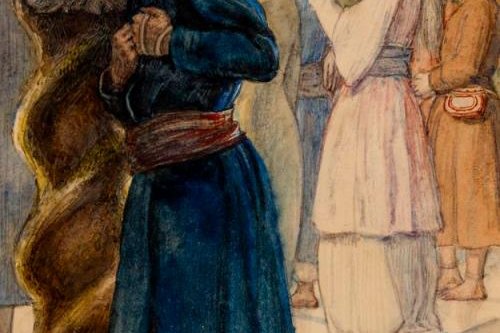
Sir John Everett Millais, The Pharisee and the Publican (1864) - Wikimedia Commons, public domain
The setting itself was ordinary and familiar to Jesus's original audience: "Two people went up to the temple area to pray; one was a Pharisee and the other was a tax collector" (18:10). Public prayer at set hours in the temple courts was a normal part of daily religious life in first-century Jerusalem, and both figures Jesus names would have been instantly recognizable social types to anyone listening — the Pharisee as a respected, scrupulously observant layman devoted to the details of the Law, the tax collector as a figure widely viewed with suspicion and contempt, employed by the Roman occupying government and often, though not invariably, personally enriched through the position.
A Prayer Made of Comparisons
The Pharisee's prayer is worth reading closely, because nothing in it is factually false. "The Pharisee took up his position and spoke this prayer to himself, 'O God, I thank you that I am not like the rest of humanity—greedy, dishonest, adulterous—or even like this tax collector. I fast twice a week, and I pay tithes on my whole income'" (18:11-12). Fasting twice weekly exceeded the single annual fast required by the Law on the Day of Atonement; tithing on all income, rather than only on agricultural produce as strictly commanded, was a stricter personal discipline than the minimum religious observance demanded. By any external measure available to his contemporaries, this man's account of his own righteousness would have checked out.
The failure Jesus identifies is not dishonesty about his own conduct, but the entire shape and direction of the prayer. Luke's Greek describes him praying "to himself" — a phrase some translations render as praying "about himself" — suggesting the prayer was less a genuine address to God than a kind of self-congratulatory recitation performed in God's presence. Its content is built entirely around comparison: what he is not, set against "the rest of humanity" and, with pointed specificity, "this tax collector" standing nearby. There is no request in the prayer, no acknowledgment of need, nothing asked of God at all — only a report of accomplishments already achieved.
One Sentence, at a Distance
The tax collector's posture and prayer stand in total contrast. "But the tax collector stood off at a distance and would not even raise his eyes to heaven but beat his breast and prayed, 'O God, be merciful to me a sinner'" (18:13). Every physical detail Luke records — standing apart, downcast eyes, the breast-beating gesture associated in Jewish custom with mourning and deep repentance — reinforces the same posture as the words themselves: a man approaching God with nothing to offer in his own defense, asking only for mercy he knows he has not earned.
It is worth noting what the tax collector's prayer does not include: no promise of future reform, no list of intended good deeds, no bargaining. Just an acknowledgment of what he is — "a sinner," with the definite article in the Greek text suggesting something closer to "the sinner," as though he considers himself the paradigm case rather than merely one example among many — paired with a direct appeal to God's mercy.
The Verdict
Jesus's conclusion reverses the expectation his original audience would almost certainly have carried into the story. "I tell you, the latter went home justified, not the former" (18:14) — using a specific term, justified, that carries the sense of being placed in right standing before God, reconciled and accepted, not merely forgiven in some vague or partial sense. The man widely regarded by his own society as a collaborator and likely cheat left the temple right with God; the man who kept the Law with genuine, verifiable rigor did not.
Jesus closes with a principle stated plainly enough to apply well beyond this one story: "for everyone who exalts himself will be humbled, and the one who humbles himself will be exalted" (18:14). This line appears elsewhere in Luke's Gospel in slightly different contexts, suggesting it functioned as something like a recurring theme in Jesus's teaching rather than a conclusion invented solely for this parable.
What the Parable Does Not Say
It is important, and consistent with Catholic teaching, to be precise about what this parable is not claiming. It does not suggest that fasting, tithing, or moral living are worthless or that outward religious observance is somehow suspect in itself — Scripture elsewhere commands and praises exactly these practices, and the Pharisee's specific disciplines are never criticized as wrong to perform. The Catechism of the Catholic Church draws directly on this parable (paragraph 2613) as a model for the humility proper to Christian prayer, not as an argument against good works altogether.
What the parable condemns is a particular spiritual error: treating one's own righteousness, however genuine, as grounds for either self-sufficiency before God or contempt toward others judged less observant. The Pharisee's problem was never his fasting — it was that his fasting had become, in his own mind, a claim against God rather than a gift received from him, and a weapon against his neighbor rather than a private discipline. The tax collector, with far less to commend him by any external religious standard, approached God with the one posture the parable holds up as sufficient: honest acknowledgment of need, and trust in mercy freely given rather than earned.
Readers interested in more of Jesus's teaching on humility and repentance may also enjoy The Prodigal Son, another parable centered on an unlikely figure restored through mercy rather than merit, and Zacchaeus in the Tree, the true story of another tax collector whose encounter with Jesus changed the direction of his life.
Trivia
Where does the Parable of the Pharisee and the Tax Collector appear in the Bible?
What did the Pharisee actually say in his prayer?
What did the tax collector say, and why does that matter?
What does Jesus say the outcome of the two prayers was?
Does this parable mean religious observance and good works don't matter?
Related Reading