The Sacred Heart of Jesus

A wound confirmed, not inflicted to kill
The image's most distant root is a small, precise detail from the crucifixion itself. John records that when soldiers came to break the legs of the crucified men — a standard method of hastening death — they found Jesus already dead, and didn't bother: "But when they came to Jesus and saw that he was already dead, they did not break his legs, but one soldier thrust his lance into his side, and immediately blood and water flowed out." (John 19:33-34, RSV-CE). The spear thrust wasn't the cause of death — it was, if anything, a confirmation of it, and the detail of blood and water flowing out has been read theologically for centuries as carrying meaning well beyond simple physiology. Early Church writers connected the two elements to the sacraments of baptism and the Eucharist, understanding water and blood flowing from Christ's side as a symbol of the Church itself being born from his wounded heart — an image sometimes compared to Eve being formed from the side of the sleeping Adam in Genesis, with the Church, in this reading, formed similarly from the side of Christ.
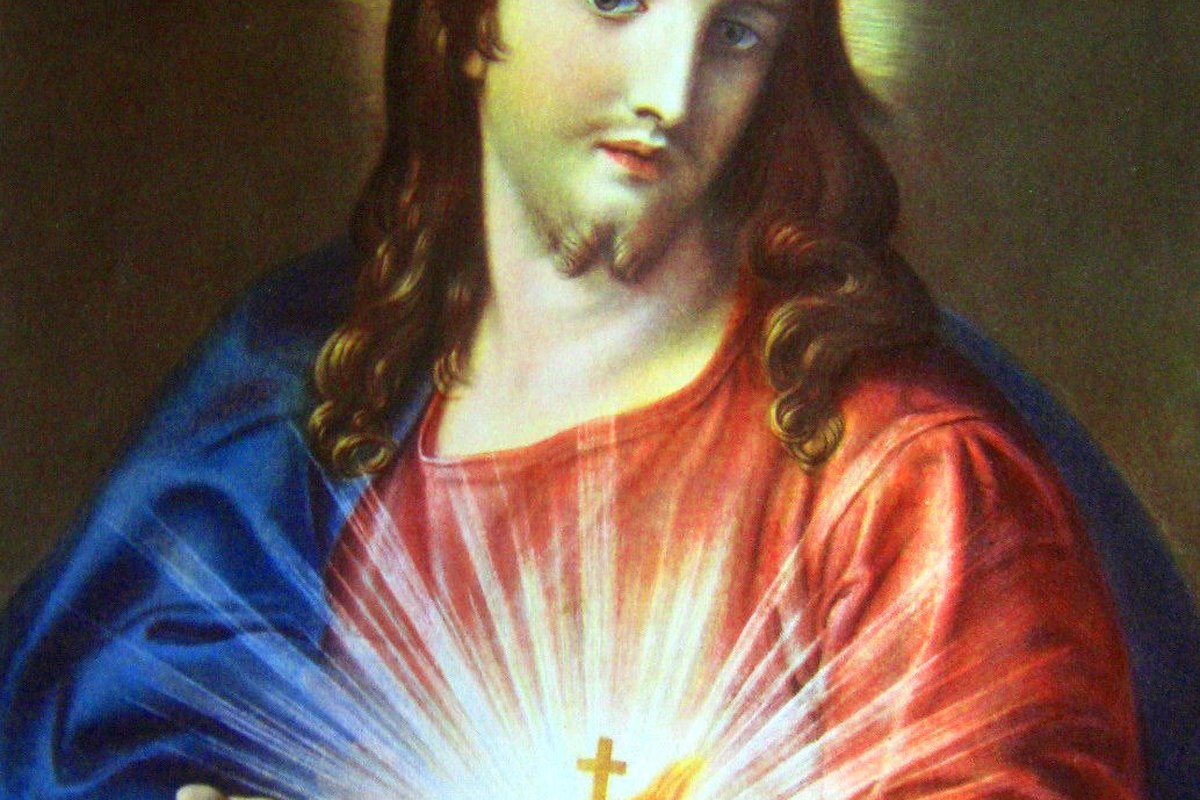
Pompeo Batoni, "Sacred Heart of Jesus," 1767 — public domain.
Devotion to Christ's heart specifically, as a symbol of his inner love and suffering, didn't begin with Alacoque in the seventeenth century — medieval mystics including Bernard of Clairvaux and Gertrude the Great had reflected on it centuries earlier, reading the wound in Christ's side as an opening into his inmost love, a place from which the faithful could draw comfort and union with him. What Alacoque's visions did was give that older, more diffuse contemplative tradition a specific, vivid, and reproducible image, along with an explicit request — as she reported it — that the devotion be formally established and spread throughout the entire Church, rather than remaining a private meditation for individual mystics and monastics.
A vision that arrived over a year and a half
The devotion as it's known today, though, traces to something far more recent: a series of apparitions reported by a French Visitation nun, Margaret Mary Alacoque, between December 1673 and June 1675. She described Jesus permitting her to rest her head against his chest and then revealing his heart directly — visible outside his body, burning, and surrounded by a crown of thorns — telling her, according to her own account, that he wanted this vision of his love made known to everyone, not kept private.
Alacoque reported these visions while living at the Visitation convent of Paray-le-Monial in Burgundy, a small community that became, almost overnight in the history of the Church, one of the most important sites of the devotion's spread — pilgrims still travel there today to the chapel where she said the apparitions occurred. She also recorded a series of specific promises she said Jesus attached to devotion to his Sacred Heart, among them peace within families, comfort in affliction, and blessing on homes where an image of the Sacred Heart was displayed and honored — promises that, along with a related practice known as the Nine First Fridays, in which the faithful receive the Eucharist on nine consecutive first Fridays of the month, became central to how ordinary Catholics practiced the devotion in the centuries that followed.
Fire and thorns, held together
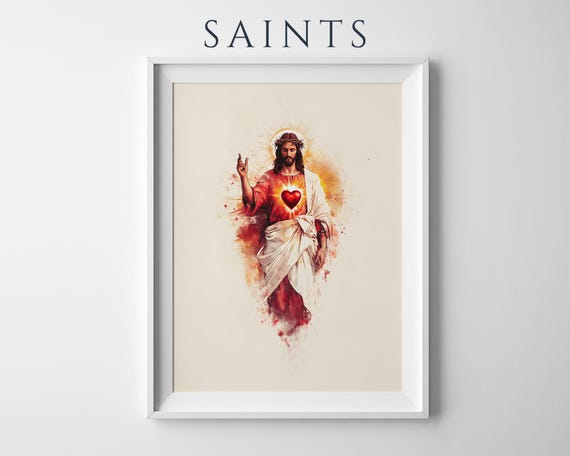
The specific imagery Alacoque described carries a deliberate double meaning that has shaped the devotion ever since. The flames represent the burning, uninterrupted love Christ holds for humanity; the thorns represent the ingratitude and sin that love continually meets in return. It's an image built to hold both truths simultaneously — neither softened into pure warmth nor reduced to pure suffering, but presented together, exactly as Alacoque said she saw them.
From a French convent to a universal feast
What began as one nun's private visions took nearly two centuries to become official Church-wide devotion. The Jesuits championed the practice even through early controversy within the Church, and the devotion spread gradually across Catholic Europe before Pope Pius IX formally designated the Friday after the octave of Corpus Christi as the feast of the Sacred Heart for the universal Church in 1856 — turning a single nun's account of what she'd been shown into one of Catholicism's most widely recognized devotional images.
The devotion continued to grow well past its official recognition. Pope Leo XIII, in 1899, consecrated the entire human race to the Sacred Heart of Jesus, extending a practice that individual families, parishes, and even nations had increasingly adopted for themselves — the formal act of consecration, offering a home, family, or country's devotion to Christ under this specific image. That practice of household consecration is part of why the Sacred Heart image became, and remains, one of the most common devotional pictures kept in Catholic homes, alongside images of Mary and individual patron saints: not simply an artistic depiction of the crucifixion's aftermath, but a specific, centuries-old invitation — first extended, according to Alacoque's account, in a quiet convent chapel in Burgundy — to bring that burning, thorn-wrapped love into the middle of ordinary domestic life.
Trivia
What is the biblical basis for the Sacred Heart?
Who was Margaret Mary Alacoque?
What do the flames and thorns in the image mean?
How did a private vision become a universal feast?
Related Reading