The Feeding of the Five Thousand

A crowd that gathered at the wrong moment
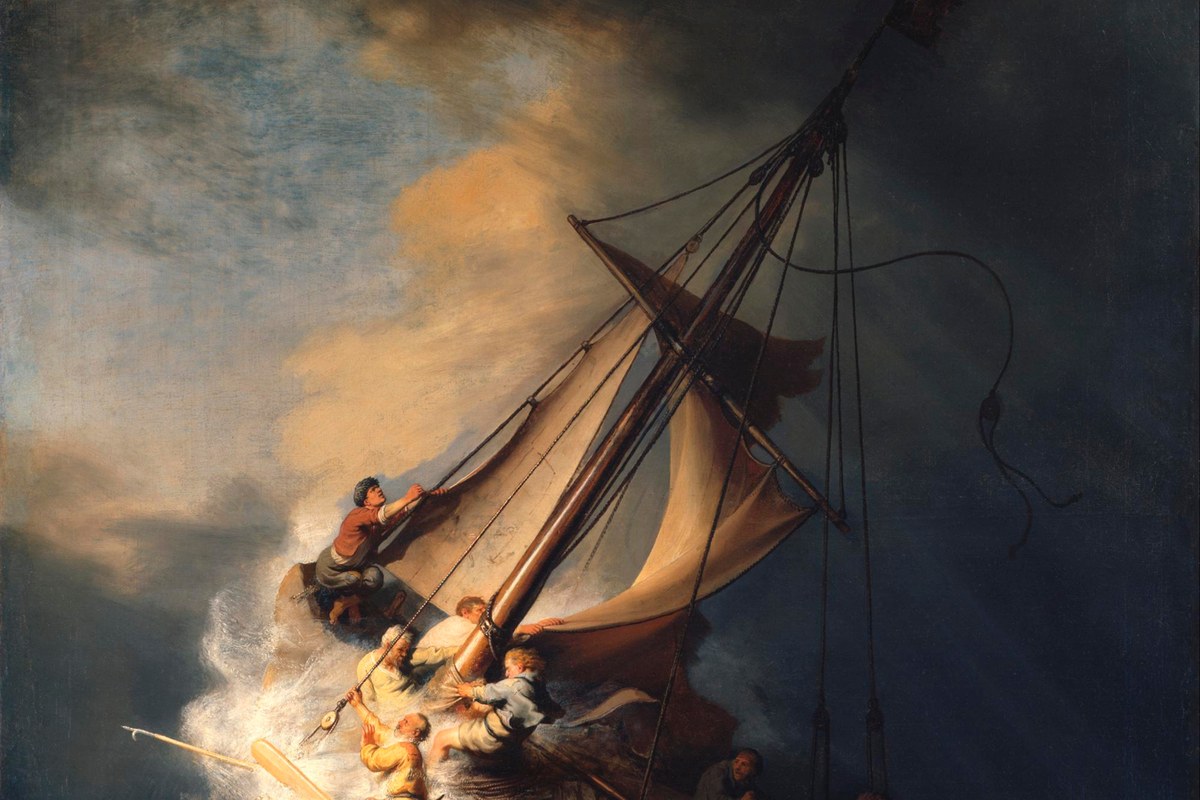
Matthew places this scene right after Jesus receives word of the death of John the Baptist, and his first instinct is to withdraw by boat to a remote place, apparently seeking time alone to grieve. The crowds don't allow it: they follow him on foot along the shore, and by the time his boat reaches land, a vast gathering is already waiting. Rather than turning them away, "When he disembarked and saw the vast crowd, his heart was moved with pity for them, and he cured their sick." (Matthew 14:14, RSV-CE) — spending the whole day in that work before the question of food ever comes up at all.
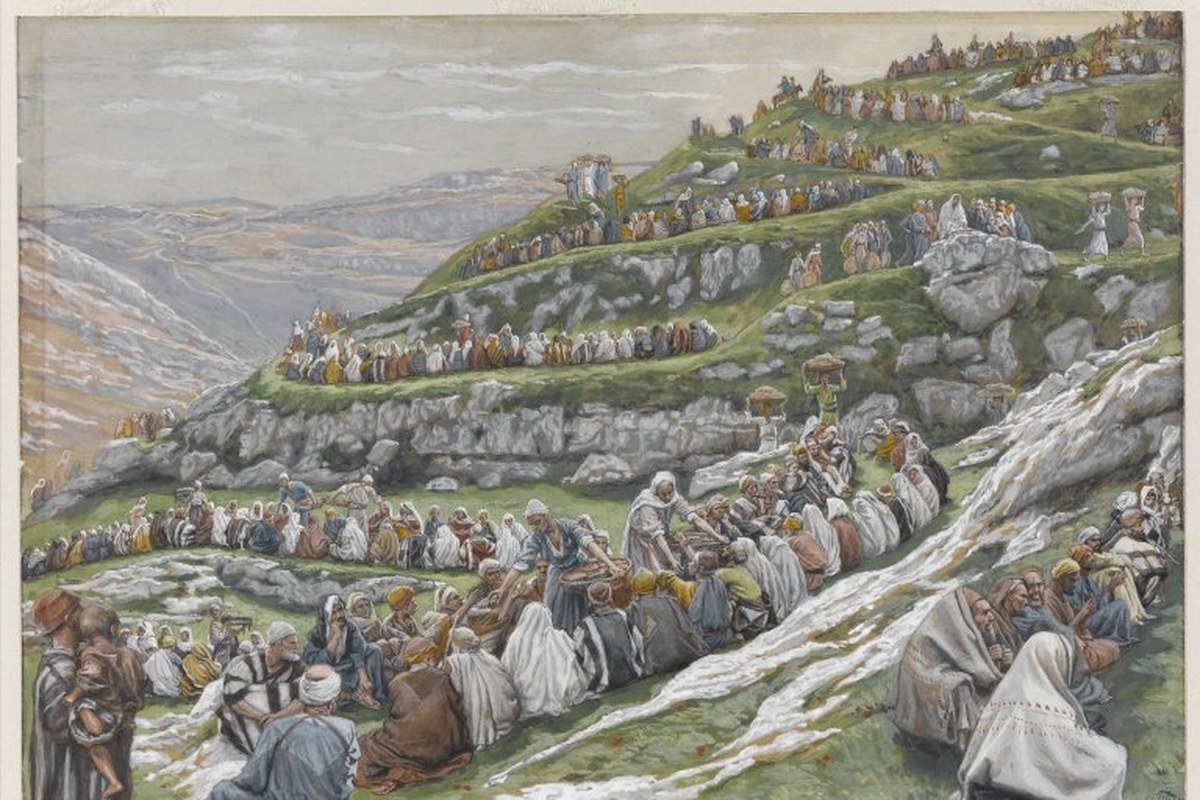
James Tissot, "The Miracle of the Loaves and Fishes," c. 1886–1894 — public domain.
A problem handed back to the disciples
The scene continues with a reasonable, practical concern. As evening approaches and the crowd shows no sign of dispersing, the disciples bring Jesus a sensible plan: "This is a deserted place and it is already late; dismiss the crowds so that they can go to the villages and buy food for themselves." (Matthew 14:15, RSV-CE). Jesus's answer isn't a rejection of the concern — it's a redirection of the responsibility: "There is no need for them to go away; give them some food yourselves." (Matthew 14:16, RSV-CE). The disciples' own resources, when they check, are almost laughably small: "Five loaves and two fish are all we have here." (Matthew 14:17, RSV-CE).
A crowd too large to count precisely
Ancient crowd estimates were rarely exact, and Matthew's own count — "about five thousand men, besides women and children" — signals that even the Gospel writer treats the number as an approximation rather than a census figure. If families are included, as the text implies, the real size of the gathering could plausibly have run well past ten thousand people, assembled on a single hillside with no advance planning and no nearby market large enough to feed them even if the disciples' original plan had gone ahead.
An unremarkable action, repeated at scale
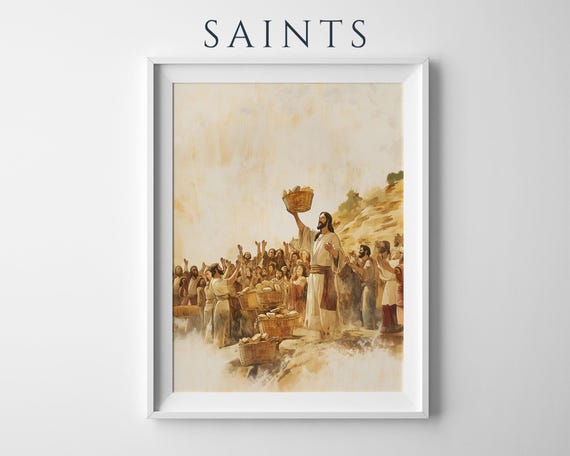
What Jesus does next is described without any special effects at all: "Taking the five loaves and the two fish, and looking up to heaven, he said the blessing, broke the loaves, and gave them to the disciples, who in turn gave them to the crowds." (Matthew 14:19, RSV-CE) — the same basic gesture any host would make at any ordinary meal, giving thanks and breaking bread. The text doesn't linger on the mechanics of the multiplication itself; it simply reports the outcome plainly, as though the miracle lay less in a visible act of transformation than in the fact that the food, once distributed, simply kept being enough.
More left over than they started with
The scale of the result is stated with matter-of-fact precision: "They all ate and were satisfied, and they picked up the fragments left over—twelve wicker baskets full. Those who ate were about five thousand men, not counting women and children." (Matthew 14:20-21, RSV-CE). Twelve baskets of leftovers — one, tradition often notes, for each disciple to carry — remained after a crowd that likely numbered well beyond five thousand had already eaten its fill from five loaves and two fish. The detail of the leftovers matters as much as the feeding itself: this was not a miracle calibrated to just barely cover the need.
An older story standing behind this one
The feeding wasn't entirely without precedent in Israel's own history. In the Second Book of Kings, the prophet Elisha faces a similar problem on a much smaller scale: a man brings him twenty loaves of barley bread to feed a hundred people, Elisha's servant objects that it isn't nearly enough, and the food is distributed anyway, with some left over afterward. For readers steeped in the Old Testament, Jesus performing a strikingly similar act on a vastly larger scale would have carried an unmistakable echo — not just a display of power, but a claim to stand in the same prophetic line as Elisha, only greater.
Matthew also records a second, separate feeding later in his Gospel, where four thousand people are fed from seven loaves and a few fish. The Gospels don't treat that repetition as redundant; if anything, having the event happen twice, in two different settings, seems to have reinforced for the earliest Christian communities just how central the story was to their memory of Jesus.
Why this miracle became a defining image
Of all Jesus's miracles, the feeding of the crowd is recorded in some form in all four Gospels — a rare point of agreement that underscores how central it was to how the earliest Christian communities remembered him. It has long been read as a preview of the Eucharist, where bread is again taken, blessed, broken, and given in abundance — a connection made even more explicit in John's Gospel, where this same episode leads directly into Jesus's teaching about himself as the bread of life. Along with the Wedding at Cana, it stands among the Gospel meals most closely tied to later Eucharistic imagery. But even read simply as a story on its own terms, its emotional center isn't the crowd or the miracle mechanics — it's the disciples being told that an impossible problem was, in fact, theirs to solve, with far less than they thought they needed.
Trivia
Why did the disciples want to send the crowd away?
What did Jesus actually have to work with?
How many people were actually fed?
What happened to the food that was left over?
Related Reading