Jesus Calms the Storm

Asleep through a storm experienced fishermen feared
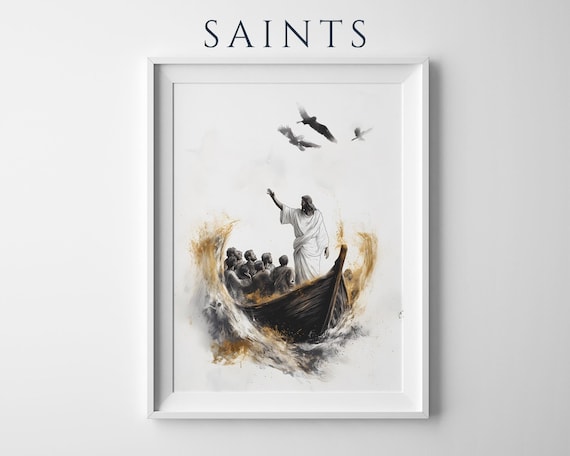
Several of the disciples in the boat were professional fishermen, familiar with the Sea of Galilee and its sudden, violent squalls. That makes what Mark records next worth noticing: as "a violent squall came up and waves were breaking over the boat, so that it was already filling up," Jesus himself "was in the stern, asleep on a cushion" (Mark 4:37-38, NABRE) — not merely resting his eyes, but genuinely, deeply asleep, undisturbed by conditions serious enough to frighten men who made their living on this exact water.
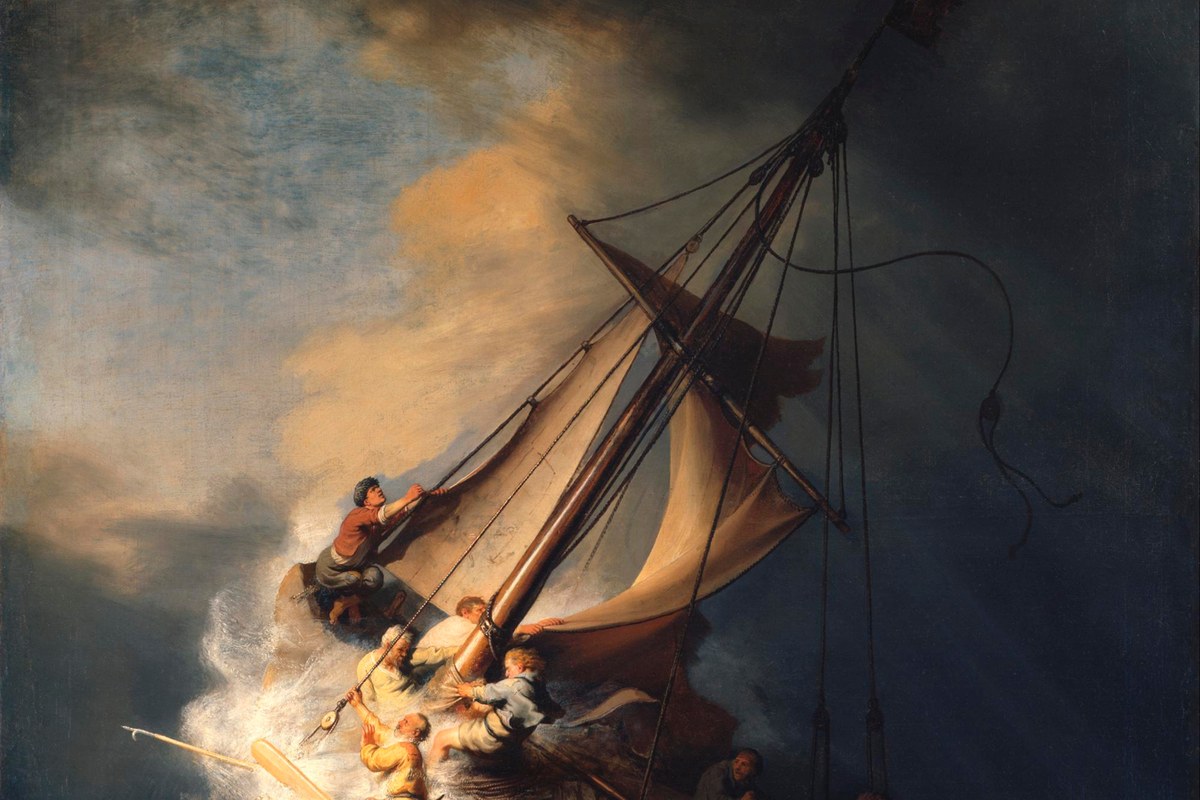
Rembrandt, "Christ in the Storm on the Sea of Galilee," 1633 — public domain.
The Sea of Galilee sits nearly 700 feet below sea level, ringed by hills that funnel cool air down onto the warmer water below, a geography that still produces sudden, dangerous storms today with little warning. The disciples' fear, in other words, wasn't an overreaction born of inexperience — it was the informed alarm of men who understood exactly how quickly this particular lake could turn deadly, and who knew the kind of vessel they were in was no match for a serious storm. Mark's Gospel places this episode right after a long day in which Jesus had been teaching large crowds in parables from a boat, which helps explain, in purely human terms, why he might have been exhausted enough to sleep through rough conditions in the first place — a detail the Gospel doesn't dwell on, but one that adds a note of ordinary human tiredness to a scene otherwise charged with supernatural tension.
A question aimed more at Jesus than the storm
The disciples' response, once they wake him, isn't a calm request for help. It's something closer to an accusation: "Teacher, do you not care that we are perishing?" (Mark 4:38, RSV-CE). The question says as much about their state of mind as the storm does — they aren't simply afraid of the water. They seem genuinely unsettled that Jesus could sleep through a crisis they were certain would kill them, as if his calm were itself a kind of abandonment.
It's worth noting how Matthew and Luke each record this same episode slightly differently, a detail that highlights how the Gospel writers each shaped the same core event to emphasize different things for their own audiences. Matthew's version has the disciples cry out, "Lord, save us! We are perishing!" (Matthew 8:25, RSV-CE) — a plea rather than an accusation. Luke's account is closer to Matthew's in tone: "Master, Master, we are perishing!" (Luke 8:24, RSV-CE). Mark's version, widely considered by scholars to be the earliest Gospel written and the source several other Gospel writers drew from, is generally regarded as preserving the rawest, least polished version of the disciples' reaction — consistent with Mark's broader style throughout his Gospel, which tends to present the disciples' fear and confusion with unusually blunt honesty.
A command, not a prayer
What Jesus does next is described with striking directness: "He woke up, rebuked the wind, and said to the sea, “Quiet! Be still!” The wind ceased and there was great calm." (Mark 4:39, RSV-CE). There's no prayer recorded here, no appeal to God on the disciples' behalf — just a command, addressed to the wind and the sea themselves, as though they were capable of obeying him directly. The storm doesn't gradually subside. It stops.
The word Mark uses for "rebuked" is the same Greek verb used elsewhere in his Gospel for Jesus's confrontations with unclean spirits, including his earlier command silencing a demon in the Capernaum synagogue. That word choice wasn't accidental for Mark's original readers, who were steeped in a Jewish scriptural tradition in which the sea itself often symbolized chaos and untamed danger — going back to the opening chapters of Genesis, where God's Spirit hovers over the formless waters, and to the Psalms, which repeatedly describe God alone as having power to still the sea. By having Jesus speak to the storm with the same commanding authority reserved elsewhere for confronting evil spirits, and using the same kind of language the Old Testament reserves for God's power over the waters, Mark is making a theological claim through action rather than direct statement — the storm isn't only a weather event to be calmed, but a stand-in for the kind of chaos only God himself was understood to have authority over.
A stranger question than the storm itself
The disciples' fear doesn't end once the water calms — if anything, it sharpens: "They were filled with great awe and said to one another, “Who then is this whom even wind and sea obey?" (Mark 4:41, RSV-CE). The calm sea raises a harder question than the storm ever did. It's a detail worth sitting with: the miracle here isn't simply rescue from danger, but the disciples' dawning, uneasy realization of exactly who had been asleep in the boat with them the entire time.
An episode that echoes throughout Christian tradition
This scene has resonated in Christian art, hymnody, and preaching for nearly two thousand years, in part because it captures something recognizable well beyond its original setting: the experience of fear in the midst of crisis, paired with the unsettling sense that God seems distant or silent exactly when he's needed most. The image of the boat itself has long served, in Christian symbolism, as a picture of the Church moving through a hostile or chaotic world — a connection made explicit in early Christian art, where boats appear frequently as a visual shorthand for the community of believers. A closely related miracle, Jesus walking on water, appears later in the Synoptic Gospels — right after the feeding of the five thousand — and returns to many of the same themes — the disciples afraid on the same lake, and Jesus once again demonstrating authority over the water itself, this time by walking across it rather than commanding it to be still. Read alongside each other, the two episodes reinforce the same core claim Mark is making here: that the one asleep in the boat, and the one walking toward it later, held an authority the disciples were only beginning to understand.
Trivia
What exactly happened on the boat?
What did the disciples say when they woke him?
What did Jesus actually do to stop the storm?
How did the disciples react once the storm had stopped?
Related Reading