Holy Days of Obligation — The Full List and What They Mean

An obligation older than the modern calendar
Catholics grow up hearing that Sunday Mass is required — that's the Church's first precept, spelled out plainly in the Catechism: "You shall attend Mass on Sundays and on holy days of obligation and rest from servile labor" (CCC 2042). What often gets less attention is the second half of that sentence. A small set of feast days scattered through the calendar year carry that same weight, even on a weekday, because the events they commemorate are considered central enough to the faith that the Church asks the same participation it asks every Sunday.
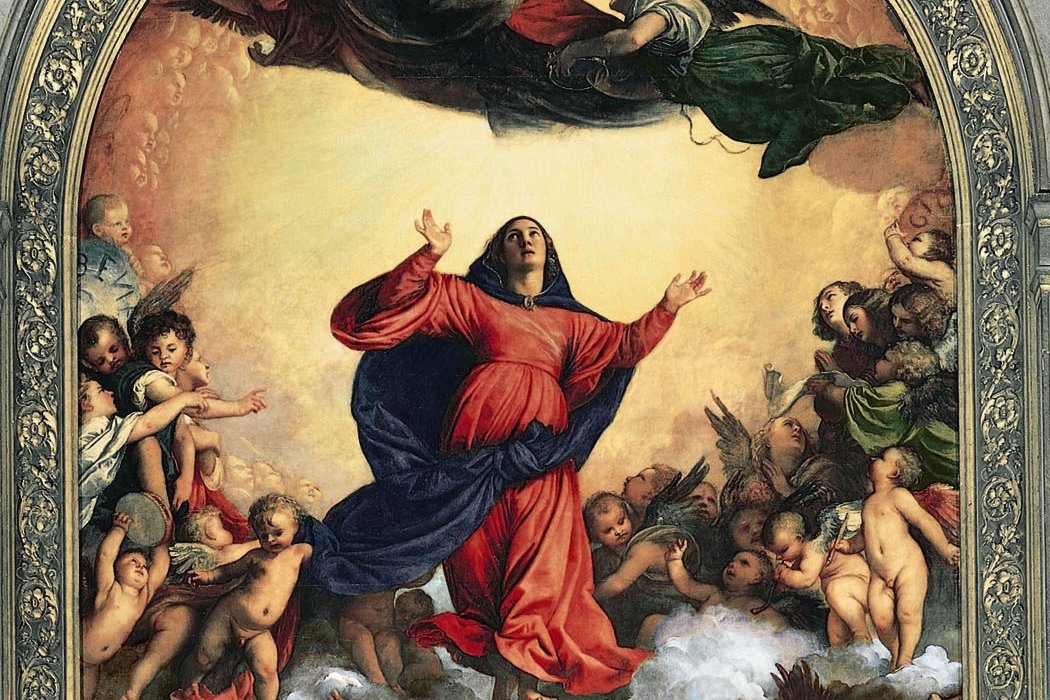
Titian, Assunta (Assumption of the Virgin), 1516–1518, Basilica dei Frari, Venice — public domain.
Universal Church law lists ten possible holy days of obligation: Christmas, Mary Mother of God, the Epiphany, Saint Joseph, the Ascension, Corpus Christi, Saints Peter and Paul, the Assumption of Mary, All Saints' Day, and the Immaculate Conception. But — and this surprises a lot of Catholics who assume the calendar is identical everywhere — no country is required to observe all ten. National bishops' conferences, with Vatican approval, can trim the list to fit local custom and pastoral practicality, and different countries have made very different choices.
The six kept in the United States
In the United States, the bishops have settled on six holy days of obligation observed most years:
Mary, Mother of God — January 1, the octave day of Christmas, honoring Mary's role as Theotokos, the Mother of God, a title formally affirmed at the Council of Ephesus in 431.
The Ascension of the Lord — traditionally the fortieth day after Easter, always a Thursday, marking Christ's ascension into heaven forty days after the Resurrection as recounted in Acts 1. Many ecclesiastical provinces in the US have moved this celebration to the following Sunday instead of keeping it as a separate Thursday obligation, so the actual date varies by diocese.
The Assumption of Mary — August 15, commemorating the Church's teaching that Mary, at the end of her earthly life, was taken up body and soul into heavenly glory. This is a dogma the Church formally defined in 1950, though belief in the Assumption traces back to ancient tradition.
All Saints' Day — November 1, honoring every saint in heaven, known and unknown, not only those with a feast day of their own on the calendar.
The Immaculate Conception — December 8, commemorating Mary's conception free from original sin from the first moment of her existence. This is the patronal feast of the United States, and it remains obligatory every year no matter what day of the week it falls on.
Christmas — December 25, the Nativity of the Lord, obligatory every year regardless of the day of the week, alongside the Immaculate Conception, since these two are treated as unconditional.
Four of the universal list's ten don't appear as separate obligations in the US: the Epiphany and Corpus Christi are transferred to the nearest Sunday rather than kept midweek; Saint Joseph's feast (March 19) and Saints Peter and Paul (June 29) are not observed as obligatory days at all in the American calendar, though they remain important feasts celebrated in the ordinary way.
The "Saturday or Monday" exception
One detail trips people up every few years: US bishops decreed that whenever January 1, August 15, or November 1 falls on a Saturday or a Monday, the Mass obligation for that particular feast is lifted for that year. The reasoning is practical — those three dates would otherwise fall immediately adjacent to a Sunday obligation, effectively requiring back-to-back Mass attendance on consecutive days. Christmas and the Immaculate Conception are exempt from this exception; they remain obligatory regardless of what weekday they land on, precisely because of how central the Church considers them.
This is why a Catholic who checked the obligation calendar two years running might have found August 15 obligatory one year and optional the next — it isn't inconsistency, it's a built-in adjustment tied to the day of the week.
Why obligation and not just custom
It would be easy to read "obligation" as legalistic, a rule for its own sake, but the Church frames it differently. The precepts of the Church, including the Sunday and holy-day obligation, exist to "guarantee to the faithful the very necessary minimum in the spirit of prayer" (CCC 2041) — a floor beneath ordinary Catholic life, not a ceiling. The Catechism is also direct about what's at stake in disregarding it: deliberately missing Mass on a Sunday or holy day without a serious reason is considered grave matter (CCC 2181), the same weight given to skipping Sunday itself. At the same time, the Church has always recognized that illness, caring for someone sick, dangerous travel conditions, or genuine impossibility excuse someone from the obligation without any sin attached — the rule is aimed at deliberate neglect, not circumstances beyond a person's control.
A calendar that varies by country
What surprises many American Catholics traveling abroad is discovering their host country keeps a different list entirely. Some nations observe all ten universal holy days; others have trimmed the list even further than the US has. A traveler who assumes the Assumption is obligatory everywhere, or that the Epiphany is always transferred to Sunday, can be caught off guard by a local custom that runs the opposite way. Checking the local diocesan calendar before assuming continuity with home practice is generally the safer bet — the underlying feasts are the same worldwide, even when the specific obligation attached to them isn't.
Understanding the list, and why it looks the way it does, turns what can feel like an arbitrary set of dates into something more coherent: a handful of moments the Church has decided are worth pulling the whole community together for, on par with Sunday itself, scattered through the calendar to mark the events it considers non-negotiable to the story of salvation.
Trivia
How many holy days of obligation are there in the United States?
Why does the obligation for some holy days get dropped in certain years?
Is the Ascension always celebrated as a holy day of obligation?
What happens if a Catholic misses a holy day of obligation without a serious reason?
Does every country observe the same holy days of obligation?
Related Reading