10 Catholic Churches Around the World Worth Knowing

1. St. Peter's Basilica, Vatican City
The largest church in Christendom stands over what tradition and archaeological excavation both point to as the burial site of St. Peter himself, at the heart of a building complex that took over a century to complete, spanning the work of Bramante, Michelangelo, and Bernini among others. The full history — the dome, the excavations beneath the altar, the scale of the piazza — deserves its own visit; read the complete story in St. Peter's Basilica.
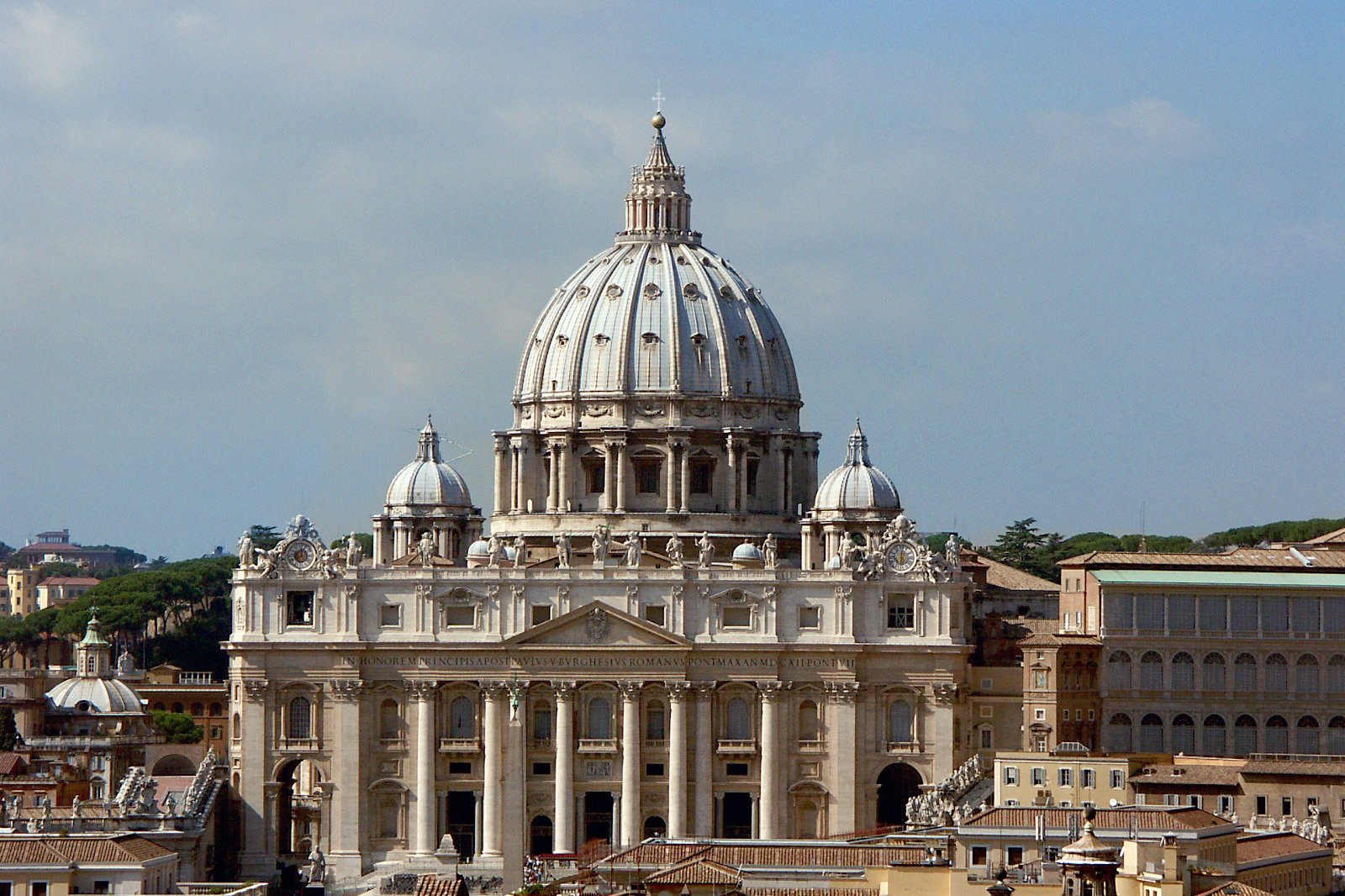
St. Peter's Basilica, Rome, view from Castel Sant'Angelo — public domain.
2. Notre-Dame de Paris
Notre-Dame's Gothic silhouette has defined the Paris skyline since the 12th century, survived the French Revolution's iconoclasm, inspired Victor Hugo's novel that helped save it from planned demolition in the 19th century, and made global headlines again after the devastating 2019 fire that destroyed its spire and roof. The cathedral reopened to the public in December 2024 following a five-year restoration. The full history is covered in Notre-Dame de Paris.
3. Sagrada Familia, Barcelona
Antoni Gaudí's unfinished masterpiece has been under continuous construction since 1882, funded entirely by donations and admissions rather than public money, and remains one of the only major cathedrals in the world still being actively built using techniques its original architect helped pioneer. For the deeper history of Gaudí's design and the project's remarkable funding model, see Sagrada Familia.
4. Chartres Cathedral, France
Chartres survived multiple fires between the 9th and 12th centuries before the current Gothic structure was built in a remarkably short span for its era — roughly 1194 to 1220 — giving it an unusual architectural unity compared to cathedrals built in stages across centuries. Its stained glass, much of it original medieval work rather than later restoration, is considered among the finest surviving anywhere. Full history at Chartres Cathedral.
5. Santiago de Compostela Cathedral, Spain
The traditional endpoint of the Camino de Santiago pilgrimage route, this cathedral is built, according to tradition, over the tomb of the Apostle St. James the Greater. Pilgrims have walked routes converging here from across Europe since the early medieval period, and the cathedral's massive incense burner, the Botafumeiro, remains one of the most recognizable liturgical spectacles in the Catholic world. More detail in Santiago de Compostela Cathedral.
6. Hagia Sophia, Istanbul
Hagia Sophia isn't a Catholic church today, and its story is worth knowing precisely because of that complexity. Built as a Christian cathedral under Byzantine Emperor Justinian I and completed in 537, it stood as the largest church in the world and the seat of the Patriarch of Constantinople for close to a thousand years, its enormous dome an engineering achievement that influenced church and mosque architecture across two civilizations. After the Ottoman conquest of Constantinople in 1453, it was converted into a mosque, its Christian mosaics plastered over rather than destroyed. In 1935, the secular Turkish republic converted it into a museum, and restoration work uncovered many of those long-hidden Byzantine mosaics of Christ, the Virgin Mary, and various emperors and empresses. In 2020, it was reconverted into a functioning mosque, a decision that drew international attention given the building's layered religious history. Visitors today can still see substantial Byzantine Christian mosaic work alongside the building's Islamic features — a rare place where both histories remain visibly, physically present in the same structure.
7. Basilica of Our Lady of Guadalupe, Mexico City
Built to house the tilma bearing the image associated with the 1531 apparitions of Our Lady of Guadalupe to St. Juan Diego, this basilica is the most visited Marian shrine in the world, drawing millions of pilgrims annually, especially around the December 12 feast day. The full history of the apparition and the basilica itself is in Basilica of Our Lady of Guadalupe.
8. Church of the Holy Sepulchre, Jerusalem
Built on the site tradition identifies as both Golgotha, where Christ was crucified, and the tomb from which he rose, this church is one of Christianity's most sacred sites and is jointly maintained under a centuries-old arrangement between multiple Christian traditions — Catholic, Greek Orthodox, Armenian Apostolic, and others — each with defined rights over different parts of the building. Full history in Church of the Holy Sepulchre.
9. Cologne Cathedral, Germany
Construction on this Gothic cathedral began in 1248 and wasn't completed until 1880 — a gap of over six centuries, during which the project was abandoned for long stretches before 19th-century German nationalism revived interest in finishing it according to the original medieval plans. It houses the Shrine of the Three Kings, a reliquary traditionally said to contain relics of the Magi. More at Cologne Cathedral.
10. Westminster Cathedral, London
Not to be confused with Westminster Abbey (which is Anglican), Westminster Cathedral is the mother church of Catholicism in England and Wales, completed in 1903 in a distinctive Neo-Byzantine style deliberately chosen to avoid competing visually with the Abbey's Gothic architecture nearby. Its striped brick-and-stone exterior and unfinished mosaic interior — much of the upper church remains bare brick, awaiting future decoration — make it one of the more visually unusual major cathedrals in Europe. Read more in Westminster Cathedral.
More cathedrals and pilgrimage sites worth a visit
Ten churches barely scratch the surface. This site covers a much wider set of cathedrals, abbeys, and pilgrimage destinations in their own dedicated articles — grouped here by region for anyone planning a longer itinerary.
Britain and the Continent
- Canterbury Cathedral — the 1170 murder of Archbishop Thomas Becket inside its walls turned it into medieval Christendom's greatest pilgrimage site.
- Aachen Cathedral — Charlemagne built his octagonal chapel here around the year 800 as a copy of a Byzantine church, then was buried inside it.
- Mont-Saint-Michel Abbey — a bishop's dream and a hole in his skull, tradition says, led to a medieval abbey crowning a tidal island off Normandy.
- Basilica of the Sacred Heart, Paray-le-Monial — a quiet Burgundy priory church where a 17th-century nun's visions of Christ's Sacred Heart launched a devotion now practiced worldwide.
Spain and the Camino
- Toledo Cathedral — built over the city's Great Mosque, itself built over a Visigothic church, and home to El Greco masterpieces and the seat of Spain's primate.
- El Escorial — Philip II positioned his own bedroom directly above the high altar and royal tombs, a king sandwiched between heaven and his ancestors.
- Montserrat Abbey — a Benedictine monastery built into the jagged cliffs above Barcelona, home to a centuries-old dark-wood statue of Mary that Catalonia has never stopped venerating.
- The Camino de Santiago, the Pilgrims' Way — how a hermit following mysterious lights in a field became the origin story for Europe's great pilgrimage route.
Italy
- Milan Cathedral (Duomo di Milano) — started in 1386 and only declared finished in 1965, it holds more statues than any other building on earth and a relic of the Holy Nail.
- Basilica of Santa Chiara, Assisi — behind a grille in this pink-and-white basilica rests the crucifix that spoke to Francis, and Saint Clare of Assisi's own body.
- Monte Cassino Abbey — Saint Benedict's hilltop monastery, birthplace of Western monasticism, has been destroyed four times across fifteen centuries and rose again after 1944.
- San Giovanni Rotondo, the Home of Padre Pio — a remote southern Italian mountain town became one of the world's busiest pilgrimage sites, built around one Capuchin friar's fifty years there.
Rome and the Holy Land
- The Basilica of Saint Mary Major — tradition says a summer snowfall on Rome's Esquiline Hill marked the spot for the greatest of the city's Marian churches.
- The Catacombs of Rome — forty miles of tunnels and tens of thousands of burials, behind a persistent myth about hiding from persecution that historians have largely put to rest.
- The Vatican Museums — a pope's private sculpture collection grew into a 54-gallery labyrinth, of which the Sistine Chapel is only one room.
- The Basilica of the Nativity, Bethlehem — a church built by Constantine's mother has survived war after war to remain one of the oldest churches still in use.
Farther afield
- Shrine of Sainte-Anne-de-Beaupré — a group of shipwrecked sailors' vow beside the St. Lawrence River in 1658 grew into Quebec's largest pilgrimage shrine and a reported site of healing.
Visiting with intention
Each of these buildings functions as an active place of worship, not simply a monument, which is worth remembering when planning a visit — dress codes, quiet during Mass or prayer times, and restrictions on photography during liturgies are standard at all ten. Beyond the architecture and the history, these are still, first and foremost, places where the Eucharist is celebrated (Hagia Sophia now being the exception) and where pilgrims have come for centuries not primarily to sightsee, but to pray. Approaching a visit with that in mind tends to make the experience considerably richer than treating any of them as simply another stop on an itinerary.
Trivia
Which Catholic church is the largest in the world?
Is Hagia Sophia still a functioning church?
What makes a church a 'basilica' rather than just a cathedral or a church?
Why is the Sagrada Familia in Barcelona still under construction after more than a century?
Do I need to be Catholic to visit these churches?
Related Reading