The Most Important Catholic Prayers and What They Mean

Our Father
Our Father, who art in heaven, hallowed be thy name. Thy kingdom come, thy will be done, on earth as it is in heaven. Give us this day our daily bread, and forgive us our trespasses, as we forgive those who trespass against us, and lead us not into temptation, but deliver us from evil. Amen.
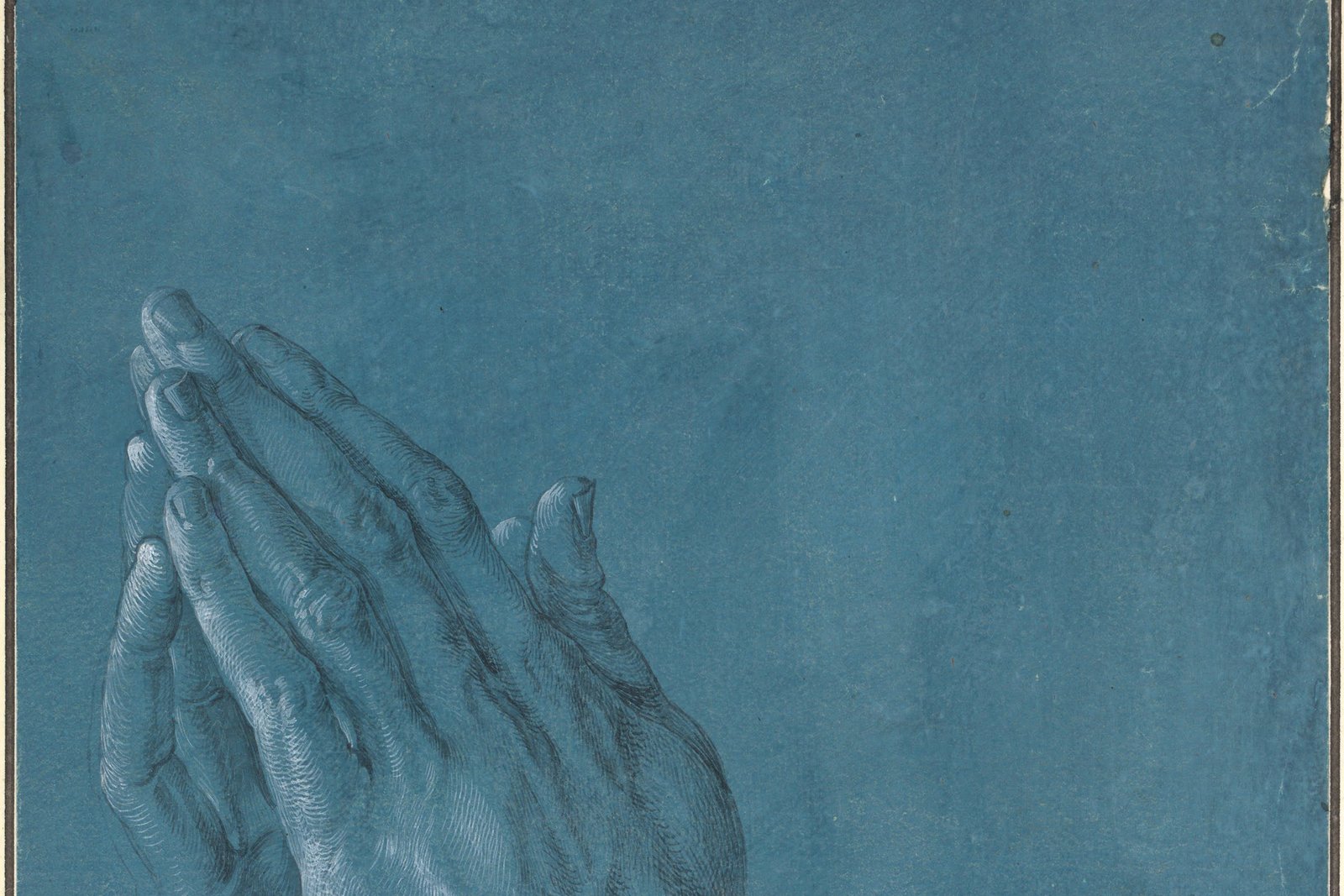
Albrecht Dürer, Praying Hands (Betende Hände), 1508, Albertina, Vienna — public domain.
This is the one prayer in the entire Catholic tradition that comes with a direct, recorded origin: the disciples ask Jesus how to pray, and he gives them this (Matthew 6:9-13, Luke 11:2-4). The Catechism treats it as the central, model prayer of the Christian life (see CCC 2759-2776) and unpacks its seven short petitions — three oriented toward God's glory, four toward human need — as a summary of the entire Gospel. The line most people stumble over in practice isn't theological but personal: "forgive us our trespasses, as we forgive those who trespass against us" ties God's forgiveness of us to our own willingness to forgive others, a condition Jesus repeats explicitly right after teaching the prayer (Matthew 6:14-15).
Hail Mary
Hail Mary, full of grace, the Lord is with thee. Blessed art thou among women, and blessed is the fruit of thy womb, Jesus. Holy Mary, Mother of God, pray for us sinners, now and at the hour of our death. Amen.
The first half of the Hail Mary isn't composed language at all — it's Scripture, stitched together from two separate moments in Luke's Gospel: the angel Gabriel's greeting to Mary at the Annunciation ("Hail, full of grace, the Lord is with thee," Luke 1:28) and her cousin Elizabeth's exclamation at the Visitation ("Blessed art thou among women, and blessed is the fruit of thy womb," Luke 1:42). The second half, added later in the prayer's development, is a direct request: asking Mary to intercede, exactly as one might ask a living friend to pray for them. The Catechism is explicit that the honor given to Mary is veneration, not the adoration owed to God alone (CCC 2096-2097) — a distinction worth knowing, since it's the most common point of confusion for non-Catholics encountering Marian devotion for the first time.
Apostles' Creed
I believe in God, the Father almighty, Creator of heaven and earth, and in Jesus Christ, his only Son, our Lord, who was conceived by the Holy Spirit, born of the Virgin Mary, suffered under Pontius Pilate, was crucified, died and was buried; he descended into hell; on the third day he rose again from the dead; he ascended into heaven, and is seated at the right hand of God the Father almighty; from there he will come to judge the living and the dead. I believe in the Holy Spirit, the holy catholic Church, the communion of saints, the forgiveness of sins, the resurrection of the body, and life everlasting. Amen.
Tradition once held that each of the twelve apostles contributed one line to this creed before scattering to preach the Gospel — a vivid legend, but pious tradition rather than documented history; the Catechism notes it developed from early baptismal formulas rather than being dictated by the apostles themselves (CCC 194-195). What it does reliably preserve is the oldest surviving outline of core Christian belief, organized around the three Persons of the Trinity, and it remains the creed used at baptism and woven into the Rosary. A longer, more doctrinally detailed cousin — the Nicene Creed, hammered out at the Councils of Nicaea (325) and Constantinople (381) specifically to settle disputes about Christ's divinity — is the one normally professed at Sunday Mass instead.
Glory Be
Glory be to the Father, and to the Son, and to the Holy Spirit. As it was in the beginning, is now, and ever shall be, world without end. Amen.
Also known as the Doxology, this is the shortest of the five and the only one that asks God for nothing at all — it exists purely to praise. Its structure moves through all three Persons of the Trinity by name, then insists, in its second half, that this glory has no beginning and no end: not a status God earned or might lose, but simply what God eternally is. Because it's so short, it functions as a kind of punctuation mark in Catholic prayer life, closing out each decade of the Rosary and appearing throughout the Liturgy of the Hours.
Angel of God
Angel of God, my guardian dear, to whom God's love commits me here, ever this day be at my side, to light and guard, to rule and guide. Amen.
This is the most modest of the five in origin — a traditional children's prayer rather than an ancient liturgical text — but it rests on a real piece of Church teaching: the Catechism affirms that human life, from its beginning until death, is surrounded by the watchful care and intercession of the angels (CCC 336), and that each person has a guardian angel assigned to them. The prayer's specific wording isn't formally fixed the way the Our Father's is; it's a devotional custom that happens to have become close to universal among English-speaking Catholics, especially as a bedtime prayer for children, precisely because it puts real doctrine into words simple enough for a four-year-old to memorize.
Why memorize prayers written by someone else at all
It can feel strange, at first, to lean on fixed, borrowed words instead of speaking to God spontaneously in one's own. But the Catholic tradition has never treated the two as competitors. Memorized prayer gives the mind and tongue somewhere reliable to stand — especially in moments of exhaustion, grief, or distraction, when finding one's own words is hardest exactly when prayer is needed most. These five are the scaffolding nearly every other Catholic prayer, from the Rosary to the Liturgy of the Hours, is built on top of. Learning them well enough to say without hunting for the words is less like memorizing a script and more like learning the alphabet: not the whole of prayer, but the letters everything else gets spelled with.
For a guided way to put several of these prayers together in sequence, see how to pray the Rosary, step by step, and for a simple daily rhythm built around the Our Father and a nightly examination, see morning and evening prayer for beginners.
Trivia
What is the Our Father and where does it come from?
Is the Hail Mary worship of Mary?
What is the difference between the Apostles' Creed and the Nicene Creed?
What does the Glory Be actually pray?
Is the Angel of God prayer official Church teaching?
Related Reading