What Is a Catholic Exorcism? Rite, Role, and Real Practice

A rite most priests never perform
Ask most Catholics about exorcism and the image that comes to mind is almost certainly cinematic — a darkened bedroom, a possessed voice, a priest locked in a physical struggle with something unseen. The actual Catholic practice looks almost nothing like that. Exorcism is a formal liturgical rite, contained in an official Church ritual book, and it is used rarely, cautiously, and only after a long process of discernment that most cases never survive. The overwhelming majority of priests will go their entire ministry without ever performing one, because the overwhelming majority of distressing spiritual experiences turn out to have other explanations.
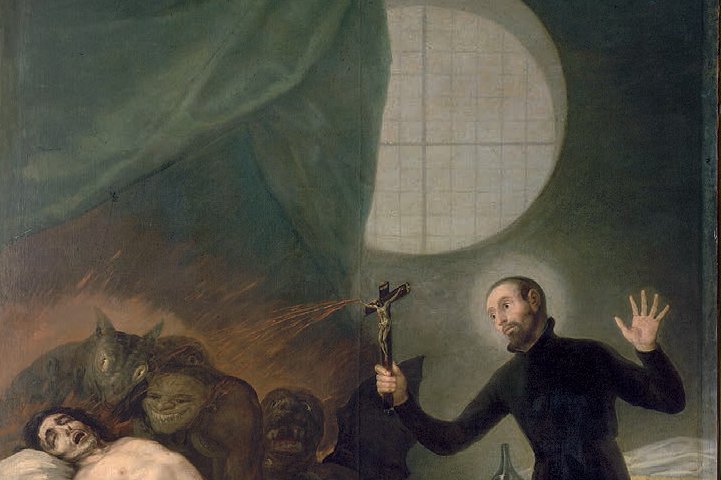
Francisco Goya, Saint Francis Borgia Helping a Dying Impenitent, c. 1788, Valencia Cathedral — public domain, Wikimedia Commons.
The Church's own teaching is direct about this caution. The Catechism (1673) states plainly that exorcism is used "when the Church asks publicly and authoritatively in the name of Jesus Christ that a person or object be protected against the power of the Evil One and withdrawn from his dominion," while also stressing that "illness, especially psychological illness, is a very different matter" — a distinction the Church takes seriously in practice, not just in theory.
Exorcism versus deliverance prayer
One of the most important distinctions in this area of Catholic practice — and one frequently lost in popular discussion — is between formal exorcism and what's often called deliverance prayer. Formal, or "solemn," exorcism is reserved specifically for cases of suspected full demonic possession and may only be performed by a priest explicitly authorized for the role by his bishop, using the Church's official rite.
Deliverance prayer, by contrast, is a much broader and more common category: prayer asking God's protection from evil, spiritual oppression, or lesser demonic influence that falls well short of possession. Many priests pray simple prayers of protection with parishioners regularly, and some traditions extend a version of this to lay prayer groups, without any of the formal authorization or investigative process required for a true exorcism. Confusing the two — treating any spiritual struggle as grounds for seeking a formal exorcism — is exactly the kind of misunderstanding Church guidelines are meant to prevent.
A careful, often slow process of discernment
Before a formal exorcism is ever authorized, Church guidance calls for a deliberate process of investigation, usually coordinated with the local bishop and involving consultation with medical or psychological professionals. The goal is to rule out natural explanations first — mental illness, neurological conditions, or other causes that could account for troubling symptoms — before any conclusion involving demonic activity is entertained.
Traditional discernment has looked to certain signs as potentially significant, including speaking or understanding a language the person has never learned, unusual physical strength disproportionate to the person's build, and a strong, specific aversion to sacred objects, prayer, or the name of Jesus. Even so, the Church treats these as points for careful investigation rather than definitive proof, aware that psychological and even fraudulent explanations have historically accounted for cases once assumed to be demonic.
The rite itself, and who performs it
An exorcist, in the formal Catholic sense, is a priest specifically appointed to the role by his diocesan bishop — not a title a priest can claim or exercise on his own initiative. Selection criteria have traditionally emphasized personal holiness, sound theological training, and psychological stability, since the role requires ongoing discernment rather than a presumption that every difficult case is demonic.
The Vatican significantly updated its official exorcism ritual in 1999 with the publication of De Exorcismis et Supplicationibus Quibusdam, the first major revision of the rite since 1614, followed by additional clarifying guidance in later years aimed at standardizing the investigative safeguards bishops are expected to apply before authorizing the rite's use.
Canon law's own specific requirements
Beyond the Catechism's general teaching, the Church's Code of Canon Law addresses exorcism directly, in Canon 1172, which states that no one may legitimately perform exorcisms over the possessed without the special and express permission of the local bishop (ordinary), and that this permission is to be granted only to a priest who has piety, knowledge, prudence, and integrity of life. The canon exists precisely to prevent the scenario popular imagination often assumes — any priest, acting alone, deciding on his own authority that a situation calls for exorcism. In the Church's actual structure, that decision belongs to the bishop, exercised through a specifically authorized delegate, not to any individual priest's personal judgment in the moment.
What changed between 1614 and 1999
For nearly four centuries, the Church's exorcism rite followed the form established under Pope Paul V in 1614, part of the Rituale Romanum. That text remained the Church's standard well into the twentieth century, even as medical and psychological understanding of mental illness developed considerably over the same period. The 1999 revision, De Exorcismis et Supplicationibus Quibusdam, didn't simply update the Latin or streamline the prayers — it incorporated a far more explicit emphasis on ruling out psychological and medical causes before treating a case as demonic, reflecting centuries of accumulated pastoral experience and a more developed working relationship between Church authorities and medical professionals than existed in the seventeenth century. Subsequent Vatican guidance since 1999 has continued refining the investigative standards bishops and their delegated exorcists are expected to apply.
Why the Church is so cautious
The Church's insistence on caution isn't a modern accommodation to skepticism — it reflects a consistent concern, stretching back through centuries of pastoral practice, that misdiagnosing a psychological or medical condition as demonic possession causes real harm to a suffering person, delaying appropriate treatment and potentially deepening their distress. A priest who moves too quickly to exorcism risks doing exactly the kind of damage the Church's own guidelines are built to prevent. That's also why the Church makes room for both ends of the spectrum: ordinary deliverance prayer remains freely available for anyone seeking God's protection from evil in a general sense, while the formal rite of exorcism stays deliberately rare, reserved for the narrow category of cases that survive a genuinely rigorous process of elimination.
A famous scene, and its real subject
The 18th-century painter Francisco Goya depicted this ministry directly in Saint Francis Borgia Helping a Dying Impenitent, showing the Jesuit saint praying over a man at the point of death while grotesque demonic figures flee the deathbed scene. The painting captures something the Church's actual teaching insists on more carefully than the drama suggests: the priest's role is not combative theater but intercession — prayer offered on behalf of someone in spiritual danger, grounded in confidence in Christ's authority over evil rather than in any special power belonging to the priest himself.
That emphasis — on prayer, humility, and careful discernment rather than spectacle — is ultimately what separates the Church's actual practice from its popular reputation. It remains a rare, tightly regulated ministry, exercised with far more caution than imagination usually allows.
Trivia
What is a Catholic exorcism?
What is the difference between exorcism and deliverance prayer?
How does the Church decide someone needs an exorcism?
Who is appointed as an exorcist, and how?
Has the Catholic Church updated its exorcism rite recently?
Related Reading