Rocamadour: The Cliffside Shrine of the Black Madonna

A village built into a cliff face
Rocamadour occupies one of the most dramatic settings of any pilgrimage site in Europe: a cluster of medieval buildings, chapels, and a fortified religious complex built directly into and against a sheer limestone cliff rising above a gorge carved by a tributary of the Dordogne River, in what is now the Lot department of southern France. The village's name itself reflects its setting, generally understood to derive from "roc," the French word for rock, combined with a reference to the site's association with Amadour, the legendary figure connected to its founding.
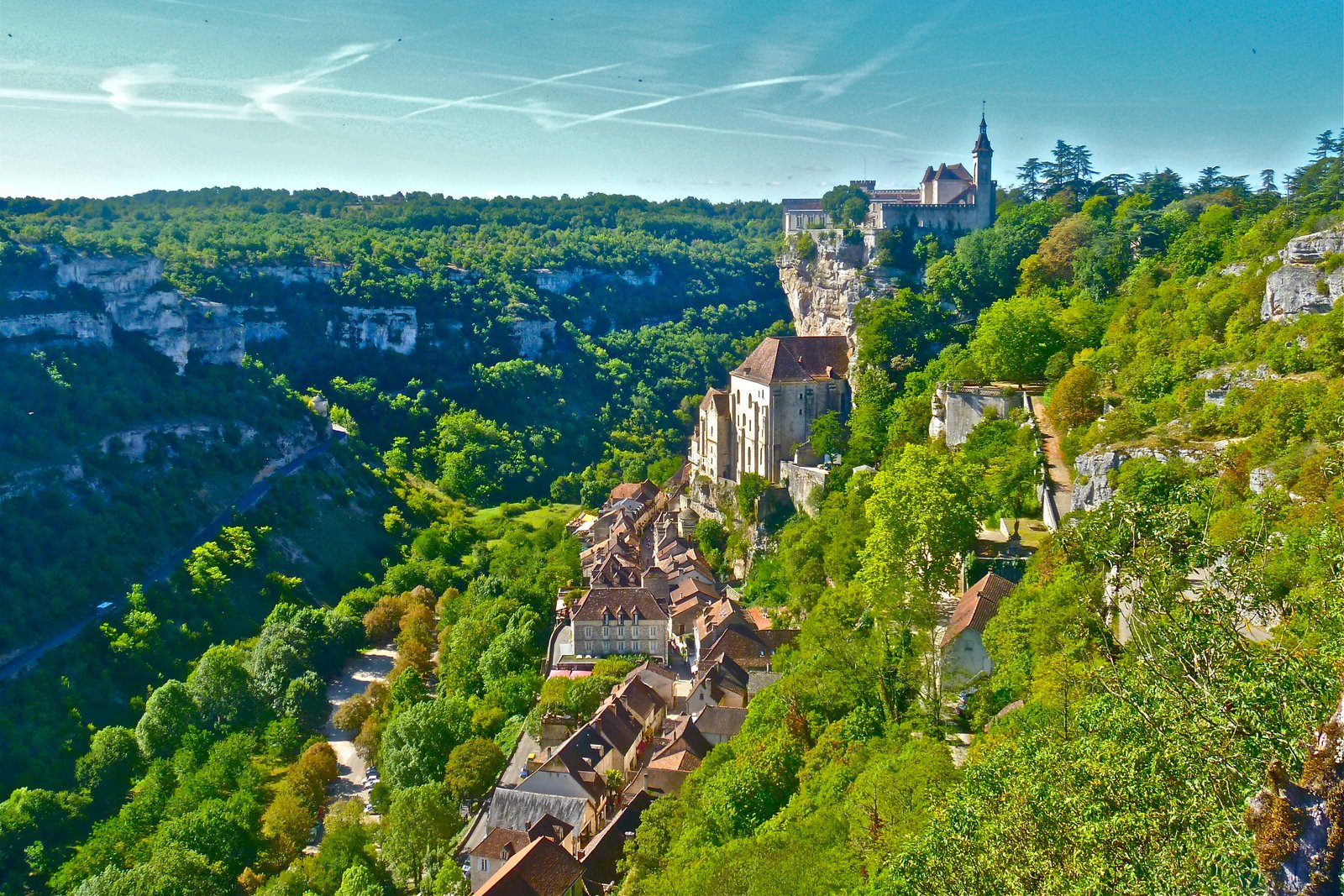
Photograph by Marinelc13, Rocamadour, Lot, France, 2011 — CC BY-SA 3.0, Wikimedia Commons.
The site's religious complex is arranged in tiers up the cliff face, with the town itself at the base, a cluster of chapels partway up known as the "Cité religieuse" reachable by a long stone staircase, and a fortified château at the very top of the cliff, originally built to protect the shrine below. Medieval pilgrims seeking the fullest expression of penitential devotion would climb the staircase — some 216 steps by traditional count — on their knees, a practice some pilgrims still observe today as an act of devotion.
The legend of Saint Amadour
Rocamadour's traditional founding narrative centers on a figure known as Saint Amadour, whose story belongs more properly to medieval legend than to confirmed history. Various accounts identify him differently — in one popular medieval tradition, he was identified with Zacchaeus, the tax collector from Luke's Gospel who climbed a tree to see Jesus, who according to this legend later traveled to Gaul with his wife Veronica and settled as a hermit at Rocamadour; other versions present him simply as an otherwise unknown local hermit or holy man. None of these identifications rest on verifiable historical evidence, and the Church has never formally defined Amadour's historical identity, so readers should understand his story as pious legend that shaped the site's devotional character rather than established fact.
What is better documented is the discovery, in 1166, of an ancient burial at the site containing remarkably preserved remains, which medieval observers identified as those of Saint Amadour — a discovery that, combined with growing reports of miraculous healings associated with the shrine's Black Madonna statue, transformed Rocamadour almost immediately into one of the most sought-after pilgrimage destinations in medieval Christian Europe.
The Black Madonna and medieval fame
The shrine's central devotional object, the small wooden statue known as the Black Madonna, depicts the Virgin Mary seated and holding the Christ Child, carved from walnut wood and dated by most scholars to roughly the twelfth century, though its precise origin remains debated. Its dark coloring, shared with a number of other notable "Black Madonna" statues venerated across medieval Europe, resulted primarily from centuries of exposure to candle smoke and the natural darkening of aged wood and varnish, rather than from any deliberate original intent regarding the statue's color.
Reports of miracles associated with the Black Madonna — healings, protection for sailors and travelers, and other favors attributed to Mary's intercession at the shrine — spread rapidly through medieval Europe, drawing pilgrims of every social rank, including kings of France and England and numerous other medieval nobility, some of whom made the journey as acts of penance for serious offenses. Rocamadour's growing prestige placed it firmly within the broader network of medieval pilgrimage, functioning as a significant stop connected to the wider medieval pilgrimage tradition associated with the Camino de Santiago, the great pilgrim road leading ultimately to the shrine of Saint James in northwestern Spain.
Decline, restoration, and revival
Rocamadour's fortunes, like those of many medieval pilgrimage sites, declined significantly in the centuries following the Reformation and the Wars of Religion in France, during which the shrine suffered damage from Protestant forces hostile to Catholic pilgrimage practices, and pilgrim traffic fell off substantially. The French Revolution brought further disruption, and by the nineteenth century the site's buildings had fallen into serious disrepair, with several structures close to ruin.
A significant restoration effort during the nineteenth century, driven by renewed Catholic interest in medieval pilgrimage traditions during that period, rebuilt much of the religious complex and revived Rocamadour's status as an active pilgrimage destination — a revival that has continued into the present day. The site's inclusion within the UNESCO World Heritage designation covering the Routes of Santiago de Compostela in France, recognized in 1998, formally acknowledged Rocamadour's historic role within that wider medieval pilgrimage network.
A living shrine in a striking setting
Today Rocamadour draws visitors for both religious and purely scenic reasons — its dramatic cliffside architecture ranks among the most photographed sites in southern France, and it remains, simultaneously, an active place of Catholic pilgrimage and worship, with regular Masses celebrated in its chapels and the Black Madonna still venerated by pilgrims who climb its stone stairway much as their medieval predecessors did. Few pilgrimage sites anywhere combine so directly the two elements that first drew medieval crowds here: a striking, almost improbable physical setting, and a small dark statue whose reputation for miracles turned an isolated gorge into one of Europe's essential places of Marian devotion.
Trivia
What is Rocamadour famous for?
What is the Black Madonna of Rocamadour?
Why did Rocamadour become a major pilgrimage site?
Who was Saint Amadour?
Is Rocamadour still an active pilgrimage site today?
Related Reading