Le Puy-en-Velay Cathedral: Where the Camino Begins

A cathedral built on a sacred hill
Long before the current cathedral rose on its volcanic terrace above the town, the hill known as Mont Anis was already, by local tradition, a place people considered set apart. Later Christian writers described a prehistoric dolmen on the site associated with healing, and while the details of that earlier history are impossible to verify with certainty, the pattern is a familiar one across Europe — a landscape already treated as significant before Christianity absorbed and reoriented that significance around a specific shrine. What can be said with more confidence is that Le Puy was already an established site of Marian devotion by the fifth century, making it one of the older continuously venerated Marian sanctuaries in France.
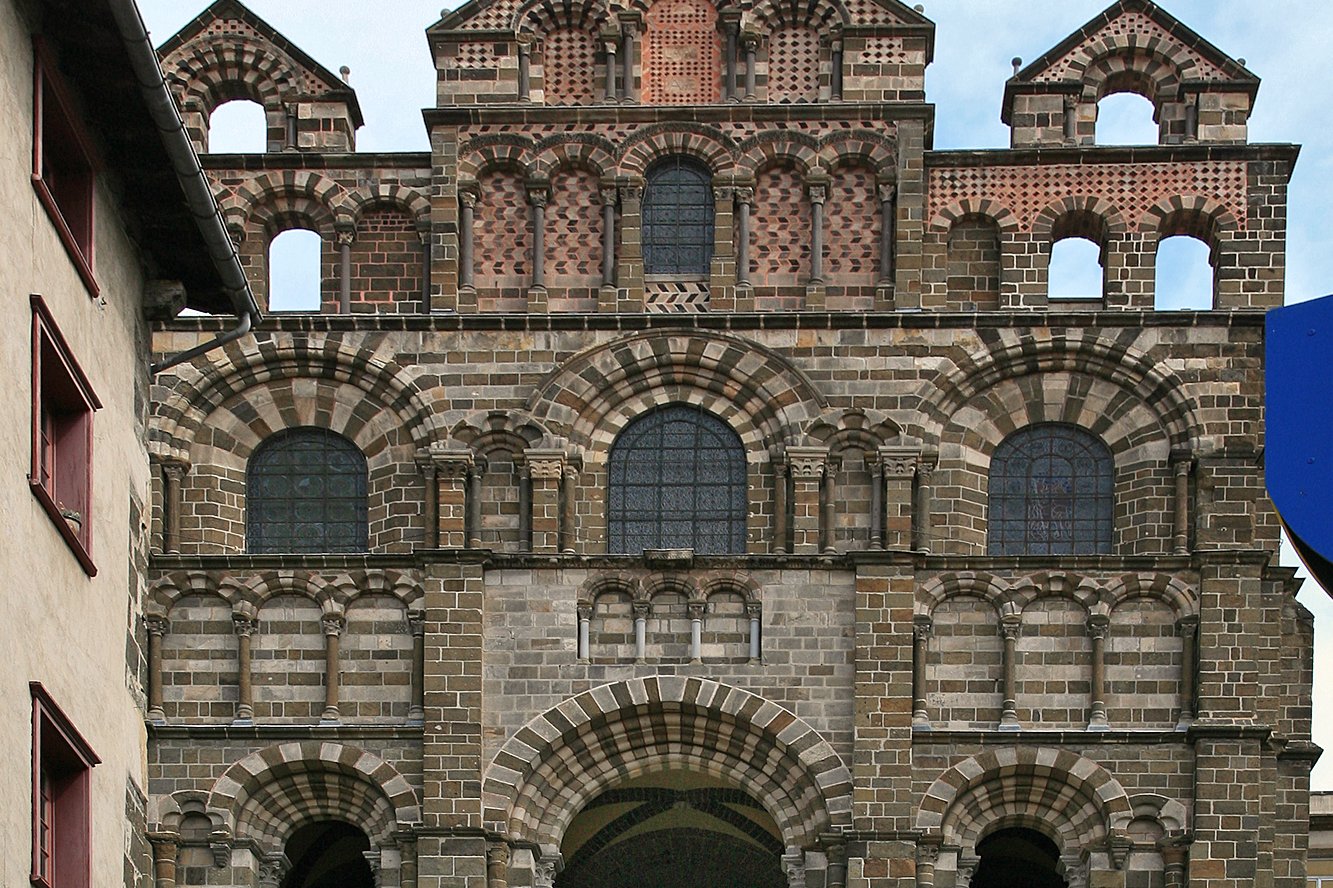
Photograph by W. Bulach, Cathedral of Notre-Dame du Puy, Le Puy-en-Velay, 2006 — CC BY-SA 4.0, Wikimedia Commons.
The cathedral that stands today, Notre-Dame du Puy, was built mainly across the eleventh and twelfth centuries, replacing and absorbing earlier structures. Its facade is unmistakable: alternating bands of dark volcanic stone and pale sandstone climb the front of the building in a striking checkerboard pattern, a hallmark of Auvergnat Romanesque architecture found nowhere else quite so dramatically. A monumental staircase — over one hundred steps — leads visitors up through a porch and directly beneath the nave itself before reaching the main body of the church, an unusual and physically demanding approach that has structured the pilgrim's arrival for centuries. Reaching the altar, quite literally, requires ascent.
The Black Madonna at the heart of the shrine
At the center of the cathedral's devotional life is its Black Madonna — a statue of the Virgin Mary holding the Christ Child, both dark-toned in a tradition shared with other famous medieval images such as the Black Madonna of Einsiedeln in Switzerland and Our Lady of Altötting in Bavaria. The original statue at Le Puy, according to tradition, may have had origins connected to the Crusades or to trade routes reaching into the Mediterranean world, though the documented history is thinner than the legends that grew up around it.
That original statue did not survive the French Revolution — it was seized and destroyed in 1794 during the anti-clerical campaigns of the period, a fate shared by many venerated medieval images across France. The statue now in the cathedral is a nineteenth-century replacement, carved in 1856 based on historical descriptions and older depictions of the original. Despite not being the medieval object itself, the replacement has itself become the focus of continuous devotion for well over a century and a half, carried in procession through the town on major feast days, particularly around the Assumption in August.
The starting point of the Via Podiensis
Le Puy's significance to pilgrimage history goes beyond its own shrine. By the High Middle Ages, it had become established as the traditional starting point of the Via Podiensis, one of four historic pilgrim routes across France that converge, after crossing the Pyrenees, on the Camino de Santiago and ultimately the shrine of Saint James at Santiago de Compostela in northwestern Spain. One of the earliest recorded pilgrims to make this specific journey was Bishop Godescalc of Le Puy, who traveled to Santiago in the year 950 — among the earliest documented non-Spanish pilgrims known to have undertaken the route, and a strong indication that Le Puy's association with the road to Santiago predates the height of medieval pilgrimage by more than a century.
The route leaving Le Puy, roughly 750 kilometers through south-central and southwestern France to the Spanish border, remains one of the most walked sections of the entire Camino network today. Modern pilgrims — a mix of religious pilgrims, hikers, and people simply seeking the discipline and reflection long-distance walking provides — still gather at the cathedral for a traditional blessing before setting out, a practice that in some form likely stretches back centuries. The scallop shell, the universal symbol of the Camino de Santiago pilgrim, is carved and painted throughout Le Puy's old town, marking the route from its very first steps.
Recognition and status today
In 1998, UNESCO inscribed the Routes of Santiago de Compostela in France as a World Heritage Site, a listing covering 78 individual monuments and stretches of route across the country recognized collectively for their role in medieval pilgrimage and the spread of Romanesque art and architecture along those roads. Le Puy-en-Velay's cathedral and its historic pilgrim quarter are included within that designation, reflecting both the building's own architectural importance and its specific role as a point of departure.
The town today functions as both a living pilgrimage site and a well-preserved medieval townscape, its steep streets still organized around the cathedral on its hill and the volcanic landscape surrounding it — most strikingly the eleventh-century chapel of Saint-Michel d'Aiguilhe, perched on its own narrow volcanic spire nearby, and the nineteenth-century statue of Notre-Dame de France atop the Rocher Corneille, cast from cannons captured at the Siege of Sevastopol. Pilgrims still climb the cathedral's stairs at dawn before setting off westward, following a road that has carried travelers toward Spain for over a thousand years.
Trivia
Why do pilgrims start the Camino de Santiago at Le Puy-en-Velay?
What is the Black Madonna of Le Puy?
How old is Notre-Dame du Puy cathedral?
Is Le Puy-en-Velay Cathedral a UNESCO World Heritage Site?
What does the town's setting on a volcanic outcrop have to do with its history?
Related Reading