The Book of Kells: An Illuminated Gospel Made to Dazzle

A Gospel book born of monastic devotion
The Book of Kells belongs to a distinctive tradition of early medieval manuscript production known as Insular art, centered on monasteries in Ireland and parts of Britain during the early Middle Ages, where monks combined Christian devotional purpose with a native artistic vocabulary of interlacing patterns, spirals, and stylized animal forms. Most scholars date the manuscript to around 800 AD, though its precise origins remain genuinely debated. The leading scholarly theory connects it to the monastery of Iona, a small island off the west coast of Scotland founded by the Irish monk Saint Columba in the 6th century, suggesting the book was begun there and possibly completed, or at least continued, at the monastery of Kells in Ireland after Viking raids on Iona in the early 9th century forced the community to relocate inland for greater safety.
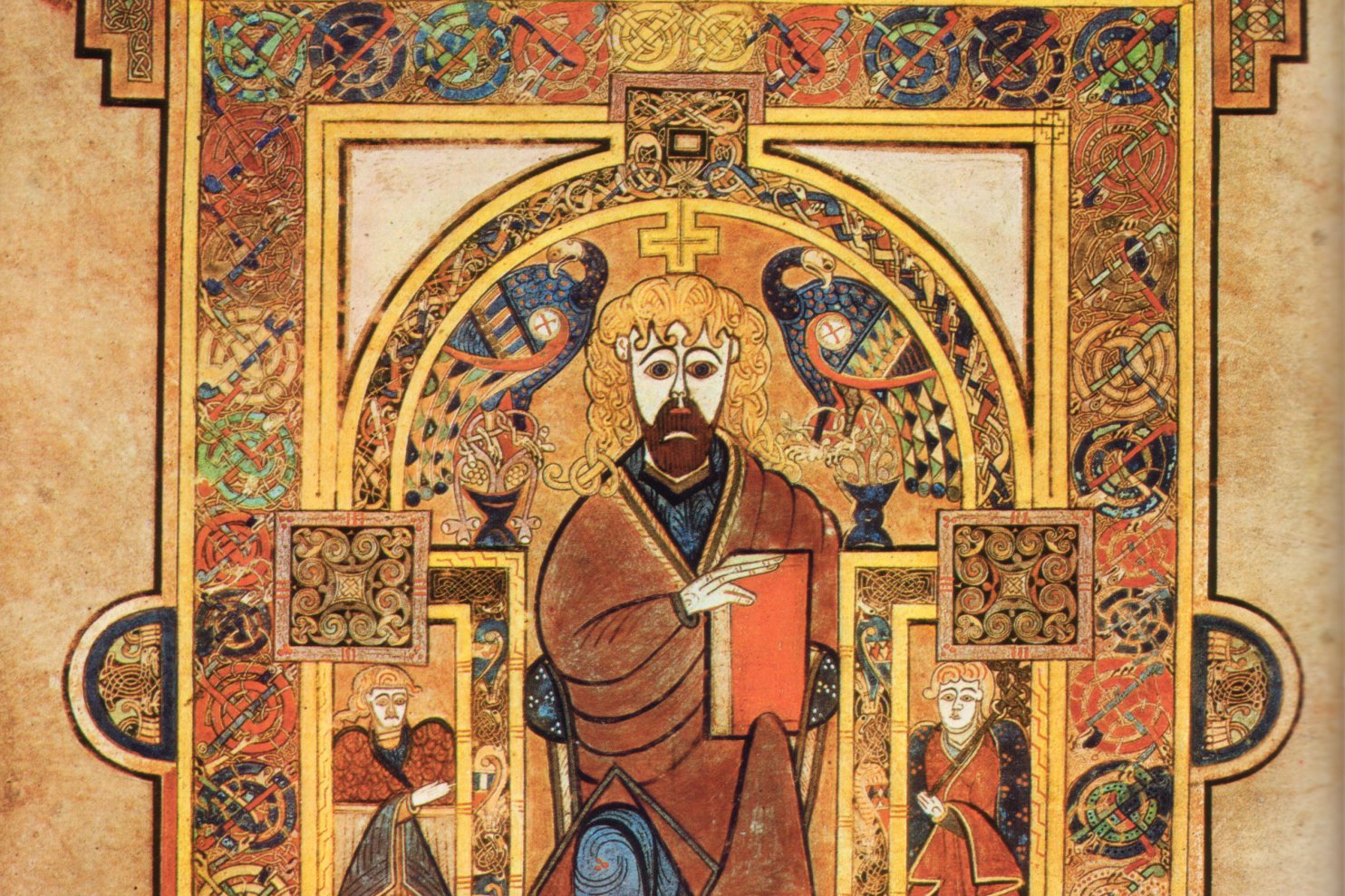
Book of Kells, folio 32v, "Christ Enthroned," c. 800 AD, Trinity College Library, Dublin — public domain.
An unfinished masterpiece
Despite its reputation as one of the most lavishly decorated manuscripts to survive from the early medieval period, the Book of Kells is, by most scholarly assessments, incomplete. Certain pages show illustrations sketched in outline but never fully colored, suggesting the ambitious decorative program planned by its makers exceeded what time, resources, or circumstances ultimately allowed them to finish. The manuscript has also lost material over the centuries of its survival, including, scholars believe, its final pages, likely containing the conclusion of the Gospel of John. Rather than diminishing the work's significance, these gaps offer valuable evidence of exactly how such manuscripts were produced, revealing preparatory underdrawing and the sequence of decorative stages beneath the finished illumination visible elsewhere in the volume.
A visual vocabulary of extraordinary density
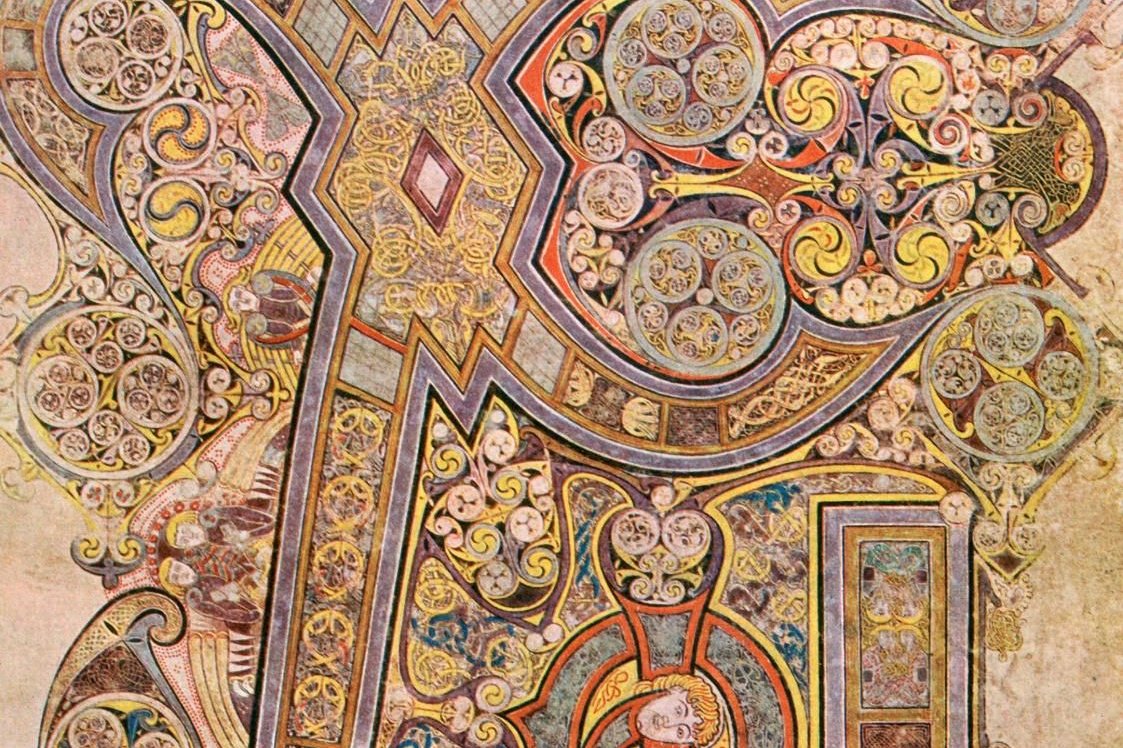
What has drawn sustained admiration for over a millennium is the sheer density and intricacy of the manuscript's decoration. Large initial letters opening each Gospel expand into elaborate compositions filling entire pages, dense with interlacing ribbon patterns, spiraling knotwork, and small figures of animals and humans woven so tightly into the ornamental scheme that they can be genuinely difficult to locate without careful, sustained looking. Modern conservators examining the manuscript under magnification have identified details invisible to the naked eye, a level of miniaturized precision that raises real questions about how the scribes achieved such fine work using the tools available to them. This intensity of ornament situates the Book of Kells within a broader Insular manuscript tradition that also produced other celebrated Gospel books, and readers curious about a related, slightly earlier masterpiece may enjoy our companion article on the Lindisfarne Gospels, produced in Northumbria in a related but visually distinct artistic tradition.
Full-page illustrations of sacred figures
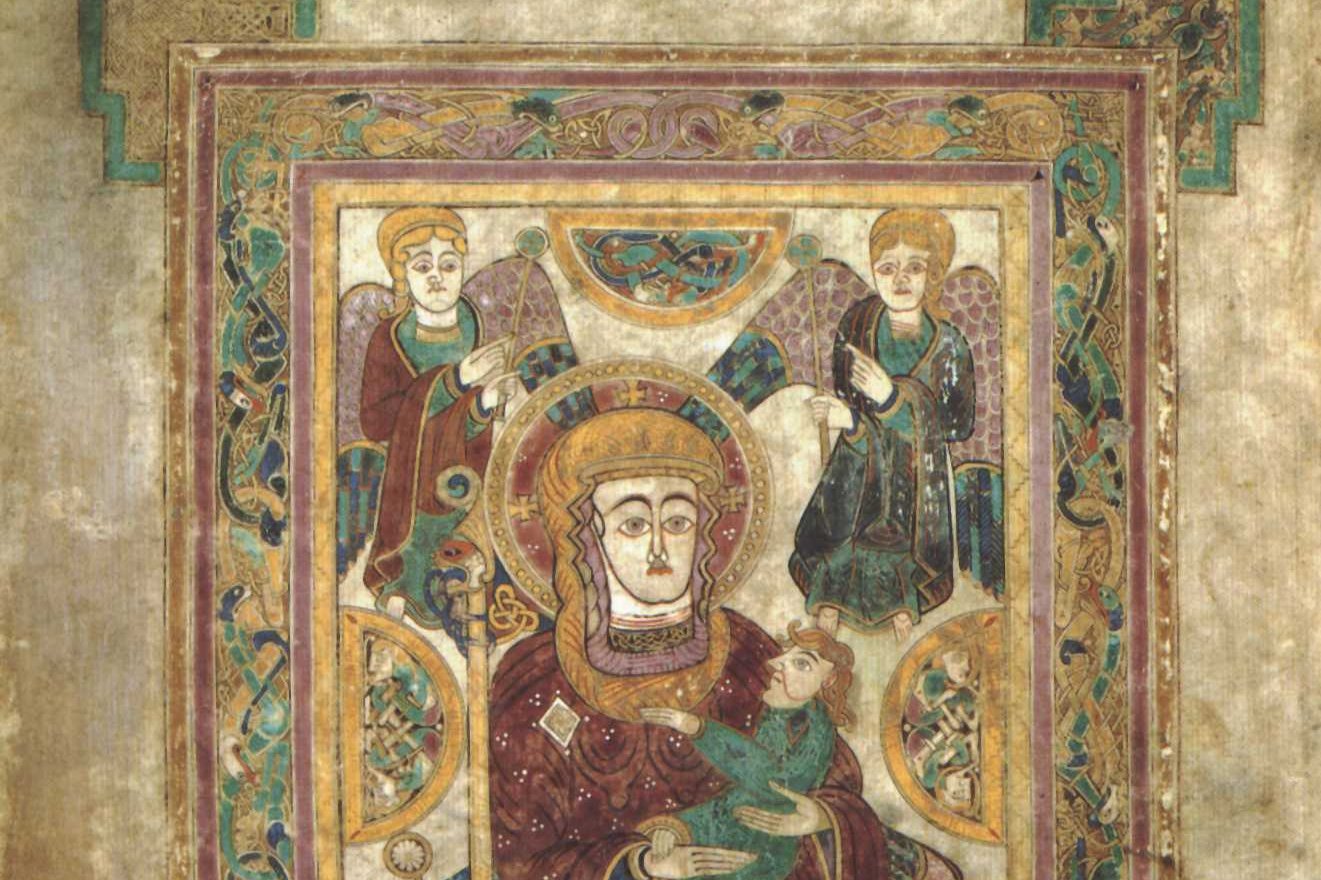
Beyond its decorated initials and border ornament, the Book of Kells includes several full-page illustrations depicting sacred subjects, including a portrait of Christ enthroned, images associated with the Virgin and Child, and symbolic representations of the four Evangelists, each traditionally paired with a specific symbolic creature — a man or angel for Matthew, a lion for Mark, an ox for Luke, and an eagle for John. These pages combine the manuscript's characteristic dense ornamental style with genuinely representational religious imagery, demonstrating that its makers were capable of figural portraiture as well as pure abstract pattern, blending both within a unified visual program intended to honor the sacred text the manuscript contained.
Praised, and nearly lost, across the centuries
The manuscript's fame is not purely a modern phenomenon. The 12th-century Welsh cleric and chronicler Gerald of Wales, visiting Ireland, described seeing an illuminated Gospel book, likely the Book of Kells or a closely related manuscript, so intricate in its decoration that he declared it must be the work of an angel rather than any human scribe — an account that reflects how extraordinary the manuscript's craftsmanship appeared even to medieval observers already familiar with fine manuscript production. Despite this reputation, the book's physical survival was never guaranteed: historical records mention a theft of the manuscript in the early 11th century, after which it was reportedly recovered, though missing its original elaborate cover, illustrating how close such irreplaceable objects have come to being lost entirely over their long histories.
A permanent home at Trinity College
Since the 17th century, the Book of Kells has been held at Trinity College Dublin, where it remains one of Ireland's most visited cultural treasures, viewed today by hundreds of thousands of visitors annually. The manuscript is typically displayed with two of its four bound volumes open simultaneously to illuminated pages, allowing visitors to see both decorated initials and full-page illustrations without requiring the entire fragile manuscript to remain permanently exposed. More than twelve centuries after Insular monks first set pen and pigment to vellum, the Book of Kells continues to stand as one of the definitive achievements of early medieval Christian art, a testament to how deeply devotion and artistic ambition could intertwine in the scriptorium of an early medieval monastery.
Trivia
What is the Book of Kells?
Where was the Book of Kells made?
What makes the Book of Kells' decoration so distinctive?
Is the Book of Kells complete?
Where can the Book of Kells be seen today?
Related Reading