The Lindisfarne Gospels: One Monk's Solitary Masterpiece

An island monastery on England's edge
Lindisfarne, also known as Holy Island, sits just off the Northumbrian coast in northeast England, connected to the mainland by a causeway that floods with the tide, cutting the island off twice daily. It was here that Irish monks from Iona established a monastery in the early 7th century, and the community quickly became one of the most important centers of Christian learning and manuscript production in early medieval Britain, closely associated with the revered bishop and hermit Saint Cuthbert, who served the monastery and later lived as a solitary ascetic on a nearby island before his death in 687. It was within this remote but intellectually vibrant monastic community that the Lindisfarne Gospels were created, likely in the decades immediately following Cuthbert's death, as part of the growing veneration surrounding his memory.
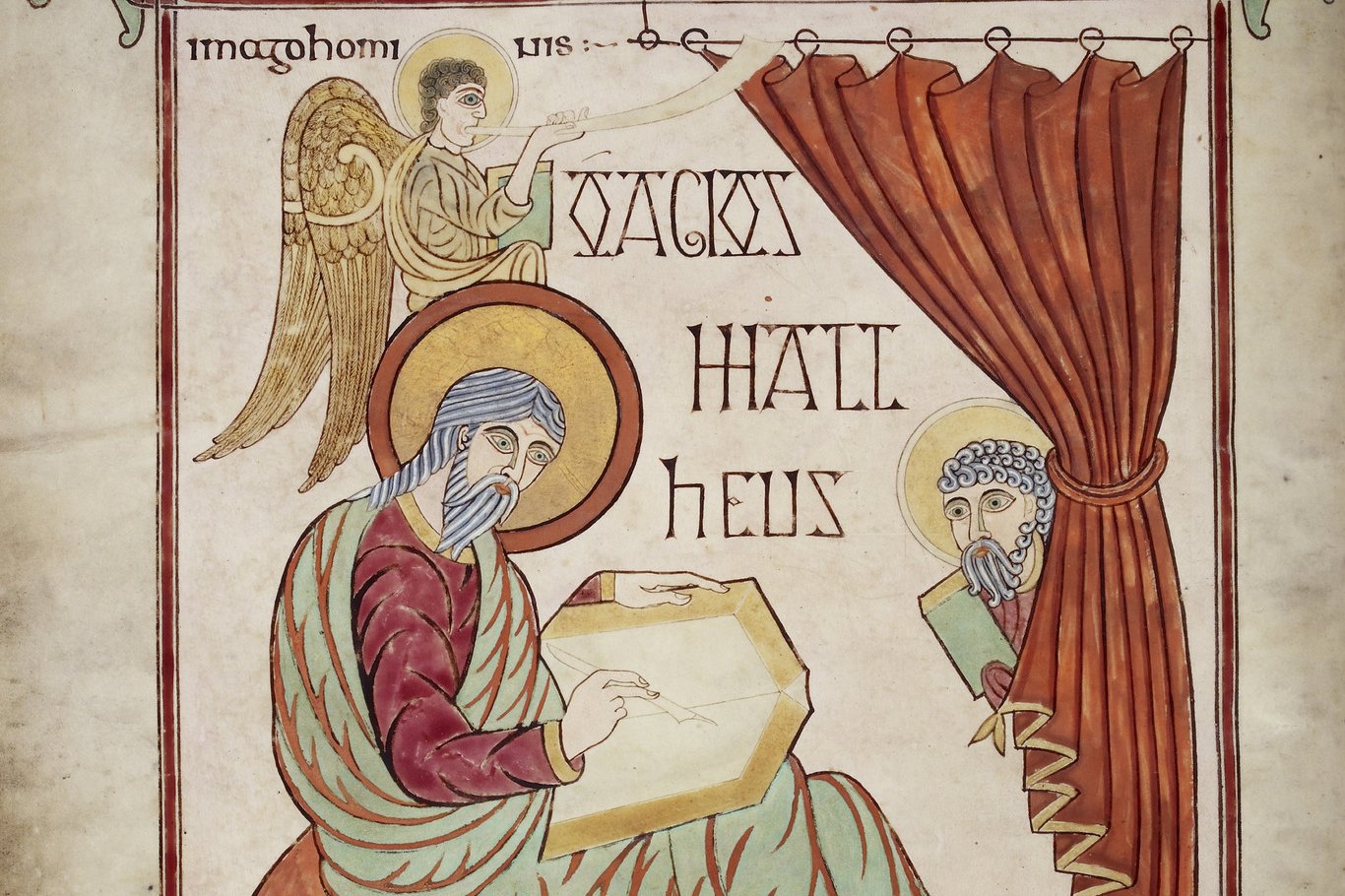
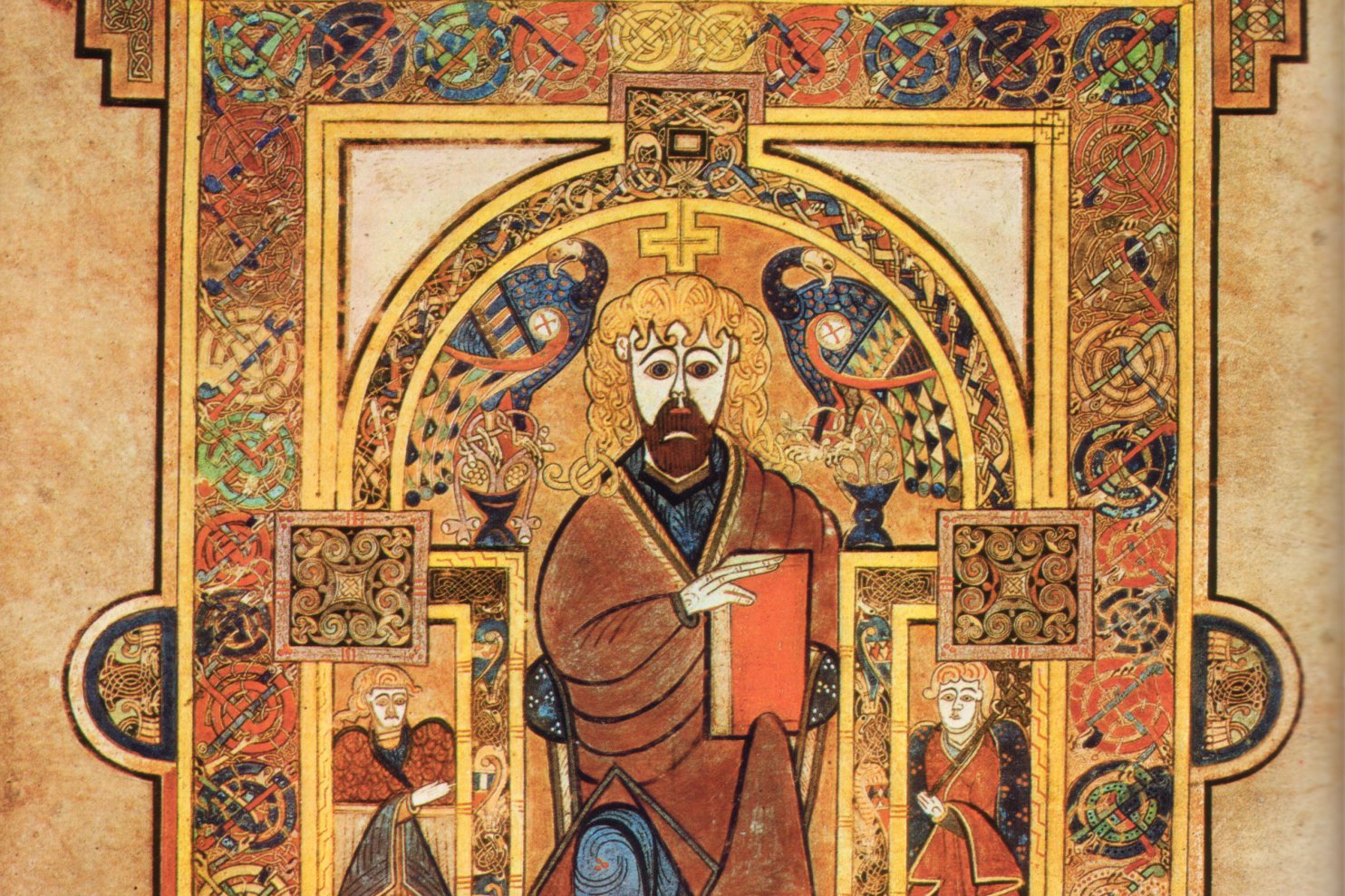
Lindisfarne Gospels, folio 25v, portrait of Saint Matthew, c. 710-721 AD, British Library — public domain (CC0).
One scribe, one extraordinary achievement
What sets the Lindisfarne Gospels apart from many comparable manuscripts is a note, known as a colophon, added to the book around 970 AD by a priest named Aldred, who identifies a monk named Eadfrith, who later became Bishop of Lindisfarne, as the person who wrote and illuminated the entire manuscript. If taken at face value, this means a single individual was responsible for transcribing the complete Latin text of all four Gospels and executing its extraordinarily intricate illumination program, an achievement that would have demanded years of sustained, solitary labor. Some modern scholars urge caution about reading the colophon too literally, noting that such attributions could carry symbolic or honorific weight beyond a strictly factual claim of sole authorship, but even skeptical assessments generally agree the manuscript reflects the work of an artist of extraordinary individual skill, whether working entirely alone or with limited assistance.
Carpet pages and geometric precision
Among the manuscript's most celebrated features are its so-called "carpet pages" — full pages of pure abstract ornament, unrelated to any accompanying text, densely filled with interlacing patterns, spirals, and stylized animal forms arranged with an almost mathematical precision that modern analysis suggests was achieved using compass and straightedge construction techniques. These pages, positioned at the opening of each Gospel, function as a kind of visual overture, preparing the reader for the sacred text to follow through sheer ornamental intensity rather than narrative content. The style shares clear affinities with the roughly contemporary and slightly later Book of Kells, produced within the same broader Insular artistic tradition, though scholars generally regard the Lindisfarne Gospels' geometric patterning as displaying an even more rigorous, almost engineered precision, distinct from the more freely flowing decoration found elsewhere in Insular manuscript art.
The oldest English translation of the Gospels
Roughly two and a half centuries after the manuscript's creation, the priest Aldred added something that gives the Lindisfarne Gospels significance well beyond art history: a word-for-word interlinear translation of the Latin text into Old English, squeezed in directly beneath the original lines. This gloss represents the oldest surviving translation of the four Gospels into any form of the English language, making the manuscript an object of major importance to linguists and historians of the English language, not only to art historians studying its illumination. Aldred's own note explaining his work also provides valuable information about the manuscript's production and later history, including his attribution of the original work to Eadfrith.
Surviving Viking raids and centuries of upheaval
Lindisfarne's exposed coastal position made it an early and famous target of Viking raids beginning in 793, an attack often cited as marking the symbolic beginning of the Viking Age in Britain. According to later tradition, the Lindisfarne community eventually fled the island altogether in the face of continued Viking threat, carrying with them the relics of Saint Cuthbert and, presumably, treasured manuscripts including the Gospels, in a lengthy period of wandering before finally settling at Durham, where Cuthbert's shrine remains to this day. That the manuscript survived this turbulent period of relocation and uncertainty, including a later legend that it was briefly lost overboard during a sea crossing and miraculously recovered undamaged, adds another layer to its remarkable eleven-century survival.
A monument to solitary devotion
Whether or not Eadfrith truly worked entirely alone, the Lindisfarne Gospels stands as a testament to what sustained individual dedication could achieve within the discipline of early medieval monastic life. Its combination of confident, elegant script, geometrically precise ornament, and evident personal devotion to the memory of a beloved local saint continues to place it, alongside the Book of Kells, among the very finest achievements of Insular manuscript art, produced not in a major cathedral city but on a small, tide-locked island at the edge of the known Christian world.
Modern conservation science has only deepened that appreciation. Detailed technical study of the manuscript's pigments, some derived from materials that would have required trade networks stretching well beyond Britain, has shown just how resourceful early medieval scribes could be in sourcing and preparing their materials on a remote island community. Combined with the exacting geometric planning visible in its carpet pages, the manuscript reflects not an isolated, provincial curiosity but a monastery fully engaged with the wider artistic and intellectual currents of its age, producing a Gospel book that has lost none of its power to astonish more than thirteen centuries later.
Trivia
What are the Lindisfarne Gospels?
Who made the Lindisfarne Gospels?
Why was the manuscript created?
What is unusual about the manuscript's later history?
Where can the Lindisfarne Gospels be seen today?
Related Reading