The Column of the Flagellation: The Pillar of Christ's Scourging

A punishment before the punishment
The Gospels are brief but unambiguous about what happened to Jesus before he carried his cross to Golgotha. "Then he released Barabbas to them, but after he had Jesus scourged, he handed him over to be crucified," Matthew records (27:26). John's account places the scourging even earlier in the sequence, right after Pilate's interrogation: "Then Pilate took Jesus and had him scourged" (19:1). Mark and Luke confirm the same basic episode. None of the four evangelists describes the instrument used to restrain Jesus during the beating in any detail — no mention of a post, a pillar, or how he was bound to it. That detail comes entirely from later tradition, not from the biblical text itself.
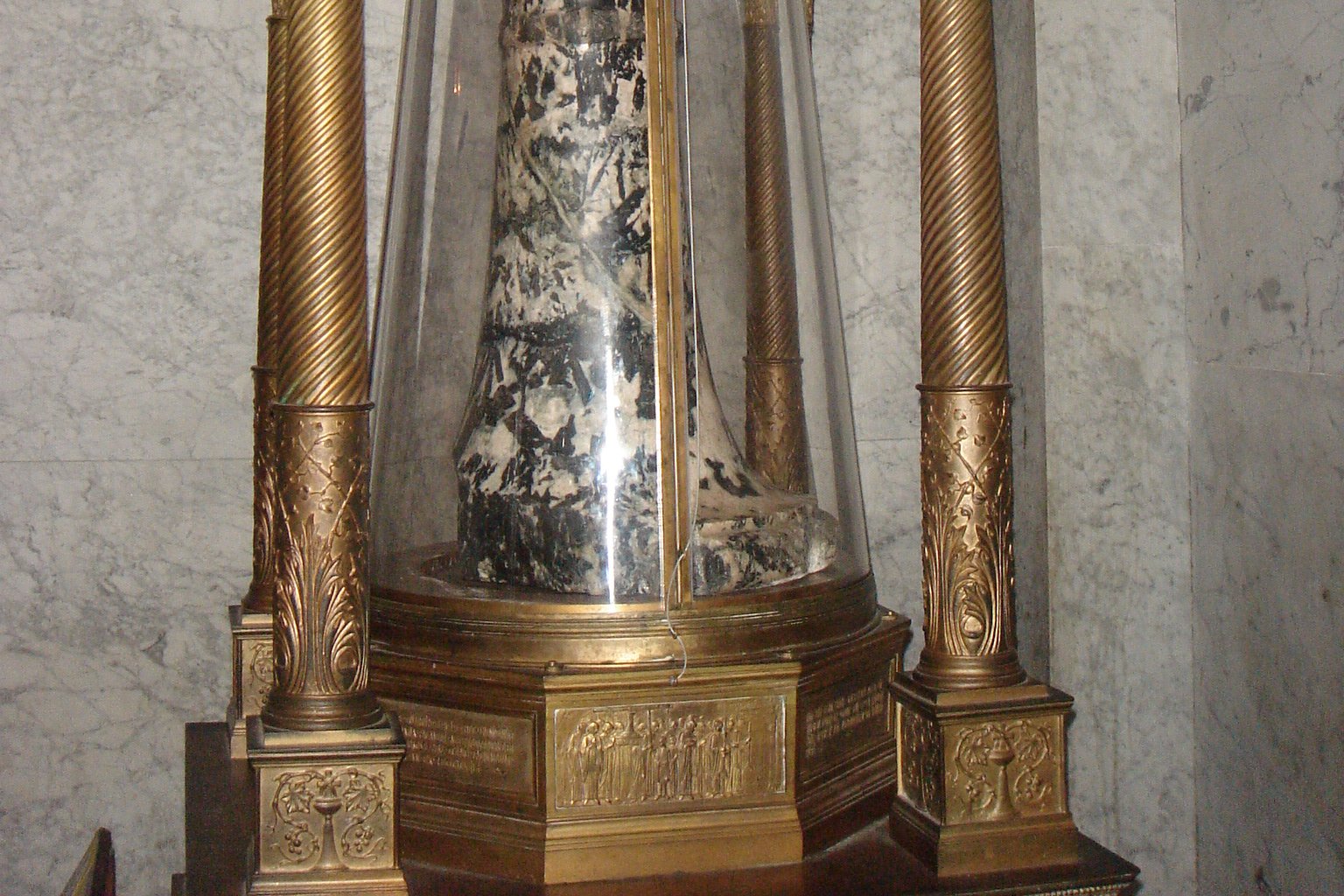
Lalupa, Monti - santa Prassede colonna flagellazione (2006). CC BY-SA 3.0, via Wikimedia Commons.
Roman scourging, as a legal punishment distinct from crucifixion, typically involved tying the condemned to a fixed point — a post, pillar, or low column — so the body could be struck repeatedly without the victim falling or struggling free. By the time Christian art began depicting the scene in detail during the Middle Ages, the "Flagellation at the Pillar" had become one of the most common ways to show this moment: Jesus bound to a short stone column, usually by the wrists, while one or more soldiers strike him with rods or scourges. The column became, in effect, visual shorthand for an event the Gospels describe in a single clause.
Two columns, two cities, one tradition
What makes the Column of the Flagellation distinctive among Passion relics is that two geographically separate traditions claim a piece of it, with different custody stories.
The better-documented of the two sits today in a side chapel of the Basilica of Santa Prassede in Rome. According to the tradition preserved there, the relic was brought back from Jerusalem in the early 13th century by Cardinal Giovanni Colonna, who had served as papal legate to the Holy Land under Pope Innocent III during the Sixth Crusade and later held the title of priest at Santa Prassede itself — a coincidence of names (Colonna meaning "column" in Italian) that chroniclers have long found irresistible to point out. The relic has remained at Santa Prassede since, now displayed upright in a glass reliquary in its own chapel; tradition also credits Saint Charles Borromeo, the 16th-century reforming archbishop of Milan, with a particular devotion to the church and its column whenever he visited Rome.
A separate fragment is venerated at the Church of the Holy Sepulchre in Jerusalem, the basilica built over the traditional sites of Christ's crucifixion and burial. That piece — a short length of red-mottled stone — is kept in a niche in the Chapel of the Apparition, a space cared for by the Franciscan friars of the Custody of the Holy Land, who have maintained a continuous presence at the holy places of Jerusalem for centuries. Tradition there holds that the stone still bears discoloration from Christ's blood where the scourge struck him against it. Each Holy Wednesday, according to the Franciscan custody and reporting from the National Catholic Register, the friars dress the column with flowers and drapery for a day of special veneration by pilgrims — a liturgical echo of the coming Passion, observed just two days before Good Friday.
These are presented as two distinct relics, not one object split in half with a documented chain connecting the pieces. A fifteenth-century German pilgrim, Felix Fabri, already noted the multiplicity in his own travel account: he recorded seeing separate columns of the Flagellation venerated at both Jerusalem and Rome, and a third claimed in Lyon, France — a reminder that, as with fragments of the True Cross, multiple churches came to hold objects venerated under the same title well before the age of documented provenance.
Part of a larger visual vocabulary
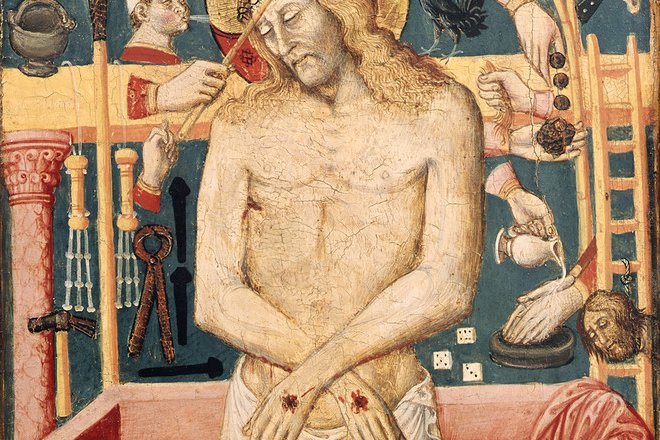
The scourging pillar belongs to a broader medieval devotional tradition called the Arma Christi — Latin for "the weapons of Christ" — which gathers the instruments used against Jesus during his Passion (the cross, the crown of thorns, the nails, the lance, the dice cast for his robe) into a single composite image, usually arranged around a depiction of the suffering Christ known as the Man of Sorrows. The column appears as a standard member of that grouping in manuscripts, panel paintings, and carved choir stalls across the late medieval period. Art historians have also noted its appearance, somewhat unexpectedly, in scenes of the Nativity — a visual foreshadowing meant to remind viewers that the infant in the manger was born for this future suffering. For the fuller history of that composite devotional image, see our article on the Arma Christi and the instruments of the Passion.
What veneration does, and doesn't, claim
As with any Passion relic whose documented history only begins centuries after the first century, a Catholic approaching either column is not required to treat its authenticity as settled historical fact. The Catechism of the Catholic Church lists the veneration of relics among the Church's encouraged forms of popular piety (no. 1674), but that veneration has always rested on honoring what an object represents — the real, historical suffering of Christ described plainly in the Gospels — rather than on a scientific guarantee that this particular stone was quarried and carved in first-century Jerusalem. Pilgrims who kneel before the pillar at Santa Prassede or the stone in the Chapel of the Apparition are, in that sense, doing something closer to what Christians have always done at Passion relics: using a physical object to focus attention on an event whose central claim — that it happened to a real man, at a real moment in history — needs no forensic confirmation to carry its full religious weight.
Trivia
What is the Column of the Flagellation?
How did the column get to Rome?
Is the Rome column the same relic as the one in Jerusalem?
What is the Arma Christi, and how does the column fit into it?
Does the Church teach that either column is definitely authentic?
Related Reading