The Bishop's Crozier: Shepherd's Crook and Symbol of Authority

A staff with a job description
Unlike many objects that found their way into Christian ceremony gradually and almost by accident, the crozier arrived already carrying a meaning attached to it. The Catholic Encyclopedia's entry on the subject is blunt about what the staff is supposed to say the moment it's handed to a new bishop: it is "a symbol of authority and jurisdiction." The words spoken over it in the old Roman Pontifical when it is conferred make the point explicitly, instructing the bishop-elect to be, in effect, gentle in encouraging virtue but firm in correcting faults — governing, as the medieval liturgist Durandus put it, "with a gentleness that is tempered with severity."
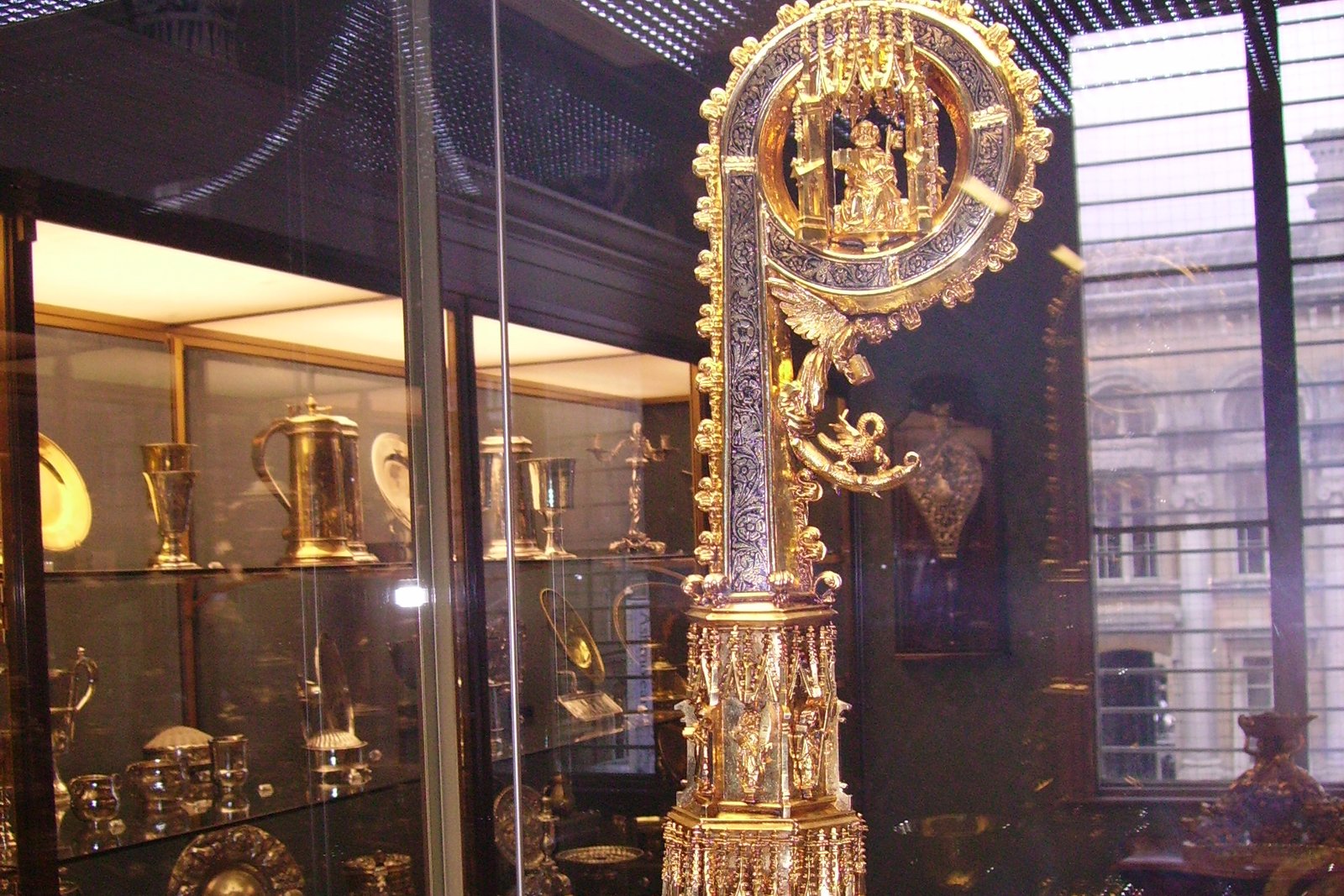
Mike Young, Bishop Fox Croisier (2006). Public domain, via Wikimedia Commons.
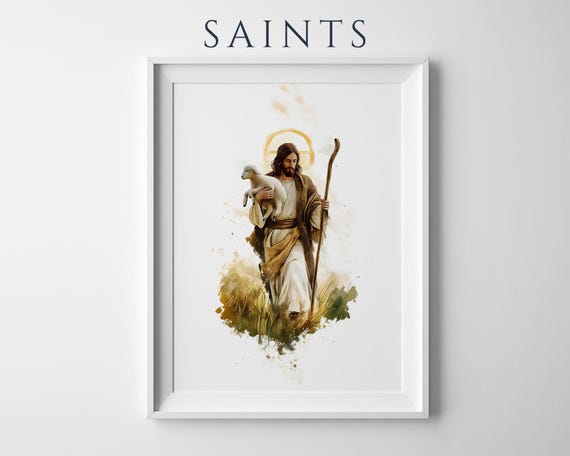
That dual image — gentle and firm at once — is exactly the image behind the shepherd's crook. A real shepherd's staff does two things: the curved hook at the top can draw a wandering sheep back toward the flock, and the length of the shaft can be used to prod a reluctant one forward. Christian writers read the bishop's staff the same way almost from the start. The connection to Christ's own description of himself runs through the whole tradition: "I am the good shepherd. A good shepherd lays down his life for the sheep... I have other sheep that do not belong to this fold. These also I must lead, and they will hear my voice, and there will be one flock, one shepherd" (John 10:11, 16). A bishop, in Catholic theology, acts as a shepherd of his particular portion of that one flock — and the crozier he carries is the plainest possible visual claim to that role.
From a bent stick to a liturgical fixture
The crozier's exact origin is genuinely uncertain, and the Catholic Encyclopedia is careful not to overstate the case. Some scholars have tied it to the shepherd's crook directly; others have pointed instead to the lituus, the curved rod Roman augurs used in their rites of divination, or simply to the ordinary walking sticks people carried for support before churches had pews. Whether any one theory is the full explanation isn't settled. What is clear is how early the staff became attached to the office of bishop specifically. A letter from Pope Celestine I, who died in 432, already mentions it. The first reference to it as an unambiguous liturgical object, rather than something that might just be a figure of speech borrowed from Scripture, comes from the twenty-seventh canon of the Council of Toledo in 633 — meaning that by the early seventh century, a council of bishops was already treating the staff as settled ecclesiastical furniture, not a new idea.
From there, its place solidified over the following centuries until, by roughly the time Western Europe's cathedral and monastic building boom was underway in the tenth and eleventh centuries, no bishop's consecration or abbot's formal installation was complete without one being placed in his hands. The Catholic Encyclopedia describes three early forms ecclesiologists distinguish: the pedum, a plain wooden rod bent into a crook at the top and pointed at the bottom (the oldest and simplest form); the ferula or cambuta, topped with a knob rather than a hook, sometimes surmounted by a cross, and associated more with papal use; and the crocia, topped with a Greek-T shaped cross whose arms were often carved to resemble two facing serpents, used by abbots and bishops of the Eastern Rite.
Two traditions, two silhouettes
That last form points to a real and lasting split between how the Western and Eastern Churches shaped their bishops' staffs. In the West, the pastoral staff — the name itself comes from the Latin pastor, shepherd — kept the curved crook as its defining feature, the single hooked loop still instantly recognizable on any bishop processing into a Latin Rite cathedral today.
In the Christian East, the staff, commonly called a dikanikion, developed a different silhouette: a small cross at the top, flanked by two carved serpent heads curling inward to face each other and the cross between them. According to Orthodox catechetical sources, the serpents are not a sinister image but a deliberately pointed one, tied to Christ's own instruction to his disciples to be "shrewd as serpents and simple as doves" (Matthew 10:16) — a call to wisdom in how a bishop governs, not cunning for its own sake. The same tradition connects the image further back, to the bronze serpent Moses was instructed to mount on a pole in the desert so that Israelites bitten by venomous snakes could look at it and live (Numbers 21:8-9), an episode Christian readers have long treated as a foreshadowing of the cross itself. Two very different objects, then — a shepherd's hook and a pair of serpents facing a cross — arrived at the same underlying claim: that the man carrying this staff is responsible for leading others safely, whether the danger is wandering off like a lost sheep or being poisoned by error.
Treasures of the goldsmith's workshop
Once the crozier became standard episcopal equipment, it also became one of the most lavish canvases available to medieval metalworkers, rivaling chalices and reliquaries for the sheer skill poured into a single object. Early examples were typically cypress wood, sometimes cased in gold or silver; later ones were made outright in ivory, gold, enameled copper, and silver gilt. The Catholic Encyclopedia points to the crozier preserved at the cathedral of Bruges, attributed to Saint Malo, a sixth-century bishop, as one of the oldest surviving examples — built from pieces of ivory joined by copper strips, though its decorative volute is a later addition. By the eleventh and twelfth centuries, goldsmiths were filling the crook's curve with dragons pierced by crosses, intricate floral scrollwork, and eventually, in the thirteenth century, whole scenes — saints, animals, biblical narratives — carved into the spirals of the head.
The gilt silver crozier made for Richard Fox, Bishop of Winchester, in the early sixteenth century and now held at Corpus Christi College, Oxford — the college Fox founded — is a late and particularly elaborate example of this tradition: a tightly spiraled Gothic shaft rising to a crooked head enclosing a small seated figure beneath a canopy of miniature tracery, with an angel and further carved ornament worked into the volute beneath it. Pieces like it, and the much larger and more famous processional treasures of Spanish and French cathedrals from the same centuries, show how far the form traveled from a bent stick in the hand of a desert shepherd — without the underlying claim it makes ever actually changing.
Who carries one, and when
The rules around who may use a crozier, and how, have stayed fairly precise. It is given to a bishop at his episcopal consecration and to a mitred abbot at his investiture, and from that point he is entitled to carry it whenever he performs a solemn pontifical function — by right within his own diocese or monastery, and by privilege when he celebrates outside it. Lower-ranking prelates occasionally granted the privilege of using one hold it with the crook turned inward toward themselves, rather than outward toward the people, a small positioning detail meant to visually distinguish genuine jurisdiction from a borrowed honor. Abbots' croziers, by old custom, are made smaller than a bishop's and are traditionally veiled whenever a bishop is present in the same ceremony, a quiet acknowledgment of rank even in metalwork.
The pope is the notable exception. According to the Catholic Encyclopedia, the Roman pontiff had already stopped using a crosier of the usual episcopal type by the time of Innocent III in the early thirteenth century, even though earlier images of popes on coins and monuments show them holding one. Rome's other long-standing staff, the ferula — topped with a cross rather than a shepherd's crook — took its place for papal use, and recent popes have revived carrying a ferula at major liturgies even though it isn't the same object an ordinary bishop carries.
Still shepherding, centuries later
None of this ceremony is treated today as costume for its own sake. At an episcopal ordination, the moment the crozier is placed into the new bishop's hands remains one of the rite's clearest visual statements of what he is being asked to do for the rest of his ministry: not rule from a distance, but shepherd a particular flock, the way the Gospel of John describes Christ doing for all of his sheep, "known" to him individually and called by name. Whether the staff in a given bishop's hand today is a plain modern design in wood and silver or an heirloom centuries old passed down through his diocese, the shape itself — curved, reaching, built to draw something back rather than drive it away — is still making the same argument it was making in the seventh century at the Council of Toledo: that authority in the Church is supposed to look, and act, like a shepherd's.
Trivia
What is a bishop's crozier and what does it symbolize?
How old is the tradition of bishops carrying a crozier?
Why do Eastern Orthodox bishops' staffs look different, with serpents on top?
Does the pope carry a crozier?
Can any priest carry a crozier?
Related Reading