Our Lady of Montserrat: Catalonia's Black Madonna on the Mountain

A light in the mountain
The mountains of Montserrat, about an hour inland from Barcelona, don't look like any other range in Catalonia. Instead of smooth ridgelines, they rise in rounded, almost sculptural stone towers — a landscape so strange that, in local legend, it was said angels themselves had carved it by hand. It is exactly the kind of place where a vision of lights and music in a cave feels, if not plausible, at least fitting. And that, tradition insists, is precisely what happened there in the year 880.
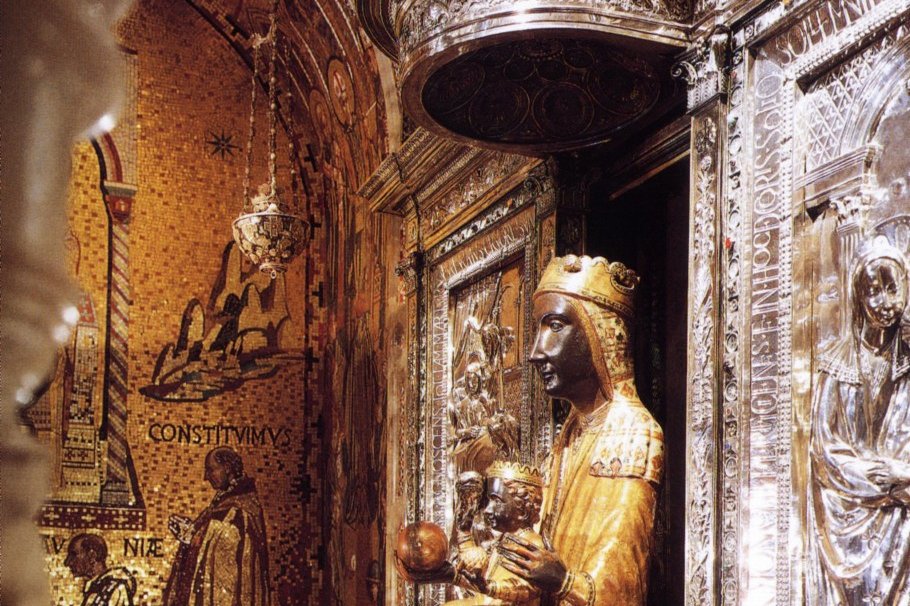
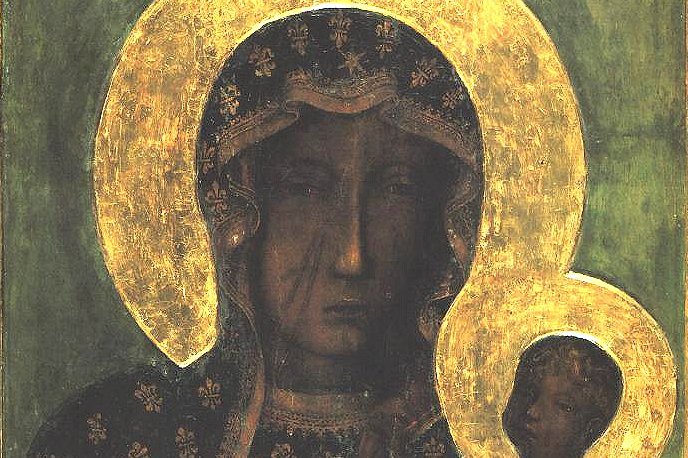
Departament de Premsa i Comunicació de Montserrat, photograph of the Virgin of Montserrat statue. Public domain, via Wikimedia Commons.
The legend of the shepherd children
According to the story Catalonia has told for over a thousand years, a group of shepherd children tending flocks near the mountain noticed a strange brightness coming from deep within one of its many caves, accompanied by music that seemed to have no earthly source. When the local bishop investigated, he and his companions discovered inside the cave a wooden statue of the Virgin Mary holding the Christ Child, dark with age, seated in the formal pose common to many of the oldest European Marian images.
A second, older layer of the legend tries to explain how the statue got there in the first place, reaching back centuries further. It claims the image had originally been carved by Saint Luke the Evangelist — a pious attribution given, without historical basis, to many ancient devotional images of Mary across medieval Christendom — and that it had been hidden in the cave during the Moorish invasion of the Iberian Peninsula in the early 8th century, to keep it safe from destruction or desecration, only to be forgotten until the shepherds' discovery more than a century later.
What the statue actually is, historically
Art historians who have studied the statue's carving style tell a different, more modest story than the legend does. The wood carving's techniques and proportions are consistent with Romanesque sculpture, a style that flourished across Western Europe roughly from the 11th through the early 13th centuries — meaning the statue now enshrined at Montserrat most likely dates to around the 12th century, not to the 1st century of Saint Luke, and not even to the legend's own claimed 9th-century discovery date. This kind of gap between a devotional legend's claimed origin and an object's actual datable style is common across many ancient Marian images, and it doesn't diminish the statue's centuries of genuine veneration so much as clarify which parts of its story are historical tradition and which parts are pious legend layered on afterward.
The statue belongs to the broader category scholars call Black Madonnas — a term describing the dozens of historic Marian images across Europe, mostly medieval, whose wood or pigment has darkened over centuries, whether through the natural aging of certain wood varnishes, centuries of candle smoke exposure, or, in some cases, a deliberate artistic choice from the start. Montserrat's is among the most venerated examples, and Catalans know it with evident affection as "La Moreneta" — "the little dark-skinned one" — a nickname that carries none of the formality of its full devotional title.
A monastery grows around the shrine
Once the statue's cult took hold, the practical religious infrastructure followed quickly, in the pattern common to many medieval shrine sites. A hermitage, then a church, and eventually a full Benedictine monastery were established directly on the mountain to house the image and receive the pilgrims it attracted. The Benedictine community has maintained the site for most of the period since, through periods of destruction and rebuilding — the monastery was largely destroyed during the Napoleonic Wars in the early 19th century and had to be substantially reconstructed afterward, a disruption that makes much of what pilgrims see at Montserrat today a 19th- and 20th-century rebuilding around a far older core devotion.
The basilica that now houses the statue places it in an elevated niche directly above and behind the high altar, reached by a separate side stairway so that pilgrims can approach and, according to long custom, touch or kiss the orb the Christ Child holds in his hand — a devotional gesture similar to the veneration practices found at other historic shrines across the Catholic world.
More than a religious site
What sets Montserrat apart from many other medieval Marian shrines is how thoroughly its religious identity has fused with Catalan regional identity more broadly. Pope Leo XIII formally declared Our Lady of Montserrat the patroness of Catalonia in 1881, but the association ran deep long before that official recognition — the monastery served at various points in Catalan history as a cultural refuge and a quiet point of regional continuity through periods when Catalan language and institutions faced pressure from Madrid. Even visitors with no particular religious devotion to the Virgin often find Montserrat described to them first in civic and cultural terms, as a symbol of Catalonia itself, before anyone mentions the statue inside.
Why the pilgrimage endures
None of the historical qualifications — the statue's later actual dating, the legendary rather than verifiable Saint Luke attribution — have slowed the stream of visitors who make the ascent to Montserrat each year, whether by the winding mountain road, on foot, or aboard the cable car and rack railway built in the 20th century specifically to manage the pilgrimage traffic. Many come for the Escolania, Montserrat's boys' choir, one of the oldest continuously operating choir schools in Europe, which still sings daily in the basilica. Others come simply for the mountain itself, whose strange silhouette has drawn awe from visitors for centuries regardless of what they believe about the statue inside it.
That combination — a genuinely ancient devotional image, a documented medieval cult, a dramatic natural setting, and a legend that has grown well beyond what the historical record alone can support — is, in the end, fairly typical of how many of Christendom's oldest shrines actually work. The devotion doesn't require the legend to be literal history to remain meaningful; it only requires, as Montserrat has shown for well over a thousand years, somewhere real to climb toward.
Trivia
Who is Our Lady of Montserrat, and why is the statue called 'La Moreneta'?
What does the legend say about how the statue was found?
Does the statue actually date back to the time the legend describes?
Why is Montserrat important to Catalan identity, not just Catholic devotion?
Why is Montserrat's mountain setting so distinctive?
Related Reading