The Black Madonna of Montevergine: Mamma Schiavona

A hermit's mountain retreat
The sanctuary that holds the Black Madonna of Montevergine began with a single hermit looking for solitude. Saint William of Vercelli, a monastic founder known for establishing several religious communities across southern Italy, climbed Mount Partenio in the Campania region in 1124 and founded a monastery there, giving rise to the Williamite congregation that would steward the site for centuries. The mountain's remoteness, roughly 1,270 meters above sea level and a genuinely difficult climb for medieval pilgrims, was exactly the point: a place set apart from the busy coastal towns below, including nearby Naples.
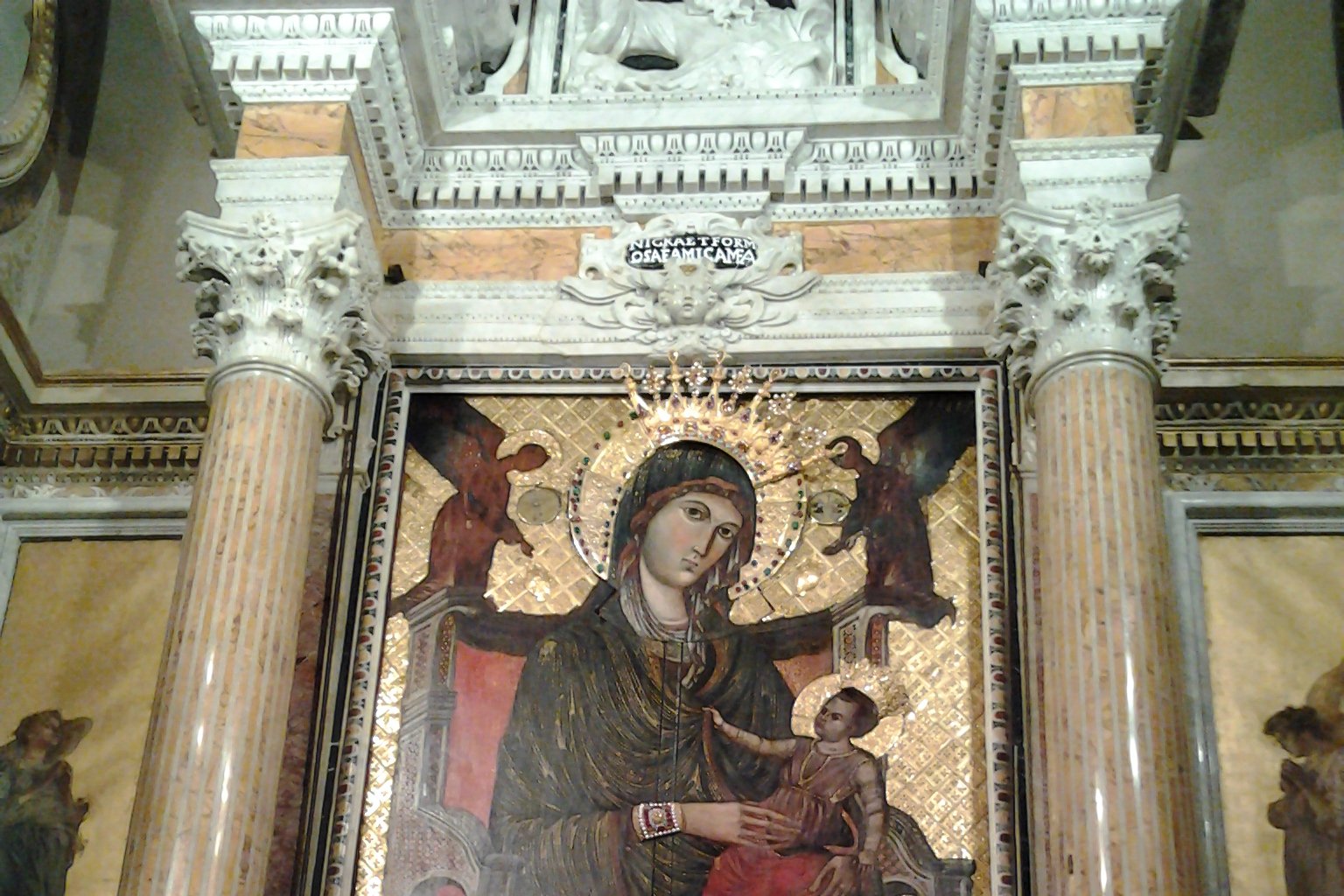
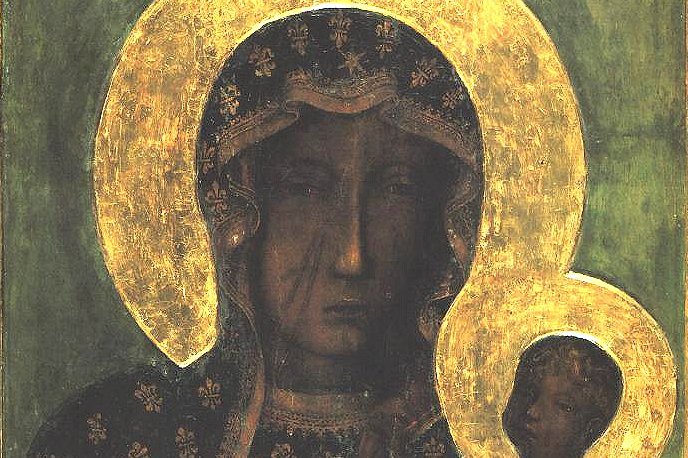
Photo of the Madonna di Montevergine icon, via Wikimedia Commons, CC BY-SA 3.0.
The icon that eventually gave the sanctuary its lasting fame is harder to date with precision than the monastery itself. Art historians generally place its creation somewhere in the 13th century, working in a style clearly shaped by Byzantine icon painting — the same broader artistic tradition that produced other famous "Black Madonna" images across Europe, including Our Lady of Czestochowa, covered elsewhere on this blog. As with many medieval icons, no contemporary documentation survives naming the artist or the exact year it was painted; what can be said with confidence is that it belongs to a well-established visual tradition of its period rather than to any one dateable commission.
Ground sacred before Christianity arrived
One of the more striking details about Montevergine's history is what, according to tradition and the consensus of most historians who have studied the site, stood there before William's monastery did. The mountain is widely believed to have hosted an ancient pagan temple dedicated to Cybele, a mother-goddess figure venerated across the Greco-Roman world and closely associated with mountains, wild nature, and fertility. Choosing to found a Christian sanctuary directly over or near such a site was not unusual for the period — it follows a well-documented pattern found at sacred sites across the Mediterranean and beyond, in which a new faith's holy places were deliberately built on ground a community already considered sacred, absorbing and redirecting existing devotion rather than simply erasing it. Whatever stood on Mount Partenio before William arrived, the mountain's long association with a protective maternal figure arguably made it fertile ground, in more than one sense, for the Marian devotion that followed.
The monastery and its icon survived centuries of change on the mountain, including periods of decline and restoration, before the most dramatic transformation of the site's architecture in the 20th century. The current basilica, a striking building that departs from the older medieval structure, was completed in 1961, designed with clear Byzantine architectural influences that echo the icon's own stylistic roots — a rare case of a modern building consciously built to visually rhyme with the centuries-old image it was constructed to house.
Mamma Schiavona and a pilgrimage unlike any other
Among Neapolitans, the icon carries an affectionate nickname that outweighs its formal title in everyday speech: Mamma Schiavona, roughly "dark-skinned mother" or "Slavic mother" depending on which etymology one follows, a title that reflects both the icon's darkened coloring and centuries of popular devotion that has treated her less as a distant, formal object of veneration and more as a protective maternal figure close to ordinary life in Naples.
That sense of closeness reaches its most distinctive expression every February 2nd, the feast of the Presentation of the Lord (Candlemas), when the sanctuary becomes the site of the Juta dei femminielli — literally the "pilgrimage of the femminielli," using a Neapolitan dialect term for a long-recognized local community of gender-nonconforming individuals with roots stretching back centuries in the city's culture. According to popular legend passed down through generations, the Madonna of Montevergine intervened to protect members of this historically marginalized community from violence and persecution, and in gratitude, the community has made an annual pilgrimage to her shrine ever since, dancing and singing before her icon as part of the observance. It is worth being clear-eyed about what this tradition is and isn't: it is a genuinely documented, long-standing local devotional custom, well attested in Neapolitan folklore and increasingly covered by scholars of popular Catholic piety — but it reflects a specific regional legend and community practice, not a formal position of the Catholic Church on the broader social questions the tradition touches.
A monastery community that endured
The Williamite congregation William of Vercelli founded at Montevergine did not remain unchanged across the nine centuries since its founding. Religious communities on the mountain weathered periods of decline, reform, and reorganization typical of many medieval monastic foundations, and at various points the sanctuary's governance and affiliated religious orders shifted. What persisted through all of it was the mountain's identity as a place of pilgrimage and the icon's place at the center of that identity — even as the buildings, the surrounding community, and the formal religious structures around it changed considerably across the centuries.
The climb itself remained part of the devotion for most of that history. Before modern roads and the cable car that now carries many visitors partway up Mount Partenio, reaching the sanctuary meant a genuinely demanding ascent on foot, a physical dimension to the pilgrimage not unlike the long walks pilgrims still undertake to reach shrines such as Our Lady of Caacupé in Paraguay — the effort of the climb itself treated as part of the devotional act, not merely an inconvenience on the way to it.
A mountain that still draws crowds
Outside of February, Montevergine remains one of Campania's most visited pilgrimage sites, drawing visitors for its Marian devotion, its mountain setting, and its long, layered history stretching from a pagan temple to a hermit's cell to a 20th-century basilica built in deliberate conversation with a medieval icon. Few Marian shrines anywhere combine quite so many distinct threads — ancient religion, monastic founding, art history, and a modern social story still actively unfolding — into a single mountaintop.
Trivia
What is the Black Madonna of Montevergine?
Who founded the Sanctuary of Montevergine?
Was there a pagan temple at Montevergine before the Christian sanctuary?
What is the 'Juta dei femminielli'?
Why is the icon called 'black'?
Related Reading