The Crown of Thorns of Notre-Dame: History of a Relic

A crown meant to mock, kept to honor
Nothing about a crown of thorns was meant to be venerated. It was improvised cruelty — Roman soldiers, according to the Gospel accounts, twisting together a circlet of thornbranches as part of mocking a condemned man they'd dressed up as a counterfeit king. Matthew records the scene plainly: "Weaving a crown out of thorns, they placed it on his head, and a reed in his right hand" (Matthew 27:29, NABRE), part of the same episode in which soldiers knelt before Jesus in false homage, shouting "Hail, King of the Jews!" John's account, independent of Matthew's, describes the identical detail: "the soldiers wove a crown out of thorns and placed it on his head, and clothed him in a purple cloak" (John 19:2, NABRE). Neither Gospel says what kind of thorn bush supplied the branches, how many thorns were involved, or what happened to the object once the mockery ended and the crucifixion began. That silence left centuries of room for tradition, politics, and devotion to fill in the rest of the story.
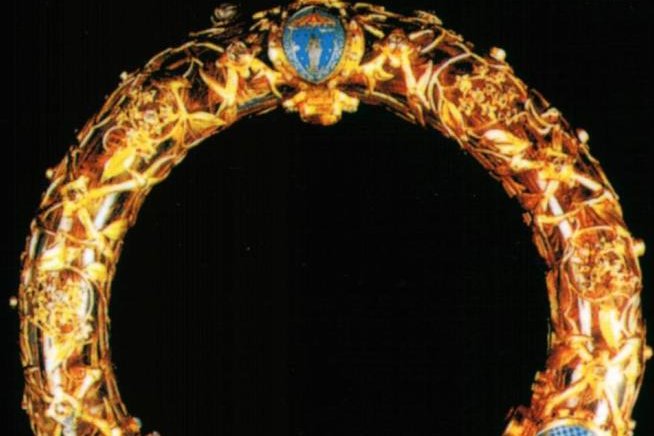
Photo by Gavigan (2007), Couronne d'épines - Crown of Thorns Notre Dame Paris. CC BY-SA 3.0, via Wikimedia Commons.
From Jerusalem to a pawnshop in Constantinople
The relic's documented history, as opposed to its biblical origin, begins to come into focus only in late antiquity, when pilgrim accounts first mention a crown of thorns being venerated in Jerusalem. By the early medieval period, the relic had made its way to Constantinople, the capital of the Byzantine Empire, where it joined an enormous imperial collection of relics associated with Christ's life and Passion — one of the largest assemblages of sacred objects anywhere in the Christian world at the time.
That collection became a casualty of the Fourth Crusade's aftermath. Constantinople fell to Western crusaders in 1204, and the Latin Empire they established there over the following decades was chronically short of money. Baldwin II, the last Latin Emperor, resorted to pawning imperial treasures — including the Crown of Thorns — to Venetian merchants as collateral for loans he had little prospect of repaying. It was, in other words, a desperate ruler's last resort, not a formal sale, and it put one of Christendom's most prized relics at real risk of being lost to debt collectors.
Saint Louis and the Sainte-Chapelle
King Louis IX of France — canonized decades later as Saint Louis, the only French king the Church has ever declared a saint — saw an opportunity where Baldwin II saw a crisis. In 1239, Louis paid off the Venetian loan and had the Crown of Thorns transported to Paris, where he received it personally outside the city in an elaborate ceremony, reportedly walking barefoot in procession to mark the occasion. It was the beginning of a wider pattern: over the following years, Louis acquired a series of other Passion relics from the collapsing Latin Empire, assembling one of the most significant relic collections in medieval Western Europe.
To house them properly, Louis commissioned a dedicated royal chapel within his own palace complex on the Île de la Cité — the Sainte-Chapelle, completed in 1248. Its soaring stained-glass walls, among the finest surviving examples of 13th-century glasswork, were designed in part to frame the Crown of Thorns as the building's central treasure, displayed on ceremonial occasions from an elevated platform where the relic and the stained-glass image of Christ crowned with thorns behind it would have been seen almost as reflections of one another. The chapel functioned for centuries as both a royal shrine and a diplomatic statement: a French king who possessed relics of this caliber held a kind of sacred prestige that rivaled, in symbolic terms, anything Rome or Constantinople could claim.
From royal chapel to cathedral treasury
The French Revolution broke that arrangement. Revolutionary authorities seized church property across France in the 1790s, and the Sainte-Chapelle's relics were dispersed or threatened with destruction along with countless others. The Crown of Thorns survived the upheaval — accounts describe it being preserved through the intervention of sympathetic custodians and eventually the Bibliothèque Nationale — and in the 19th century it was transferred to the Archdiocese of Paris, which placed it in the care of Notre-Dame Cathedral, where it remains today rather than at its original home in the Sainte-Chapelle nearby.
The reliquary now used to display the relic dates to this later period: a ring-shaped vessel of gold, crystal, and glass, created in the 19th century to hold the circlet securely while still allowing it to be seen. It is this reliquary, not the full historical crown in any reconstructed form, that is processed and venerated at Notre-Dame on Fridays during Lent and on Good Friday.
The fire of April 2019
The relic's best-known modern moment came on the night of April 15, 2019, when a fire broke out in Notre-Dame's attic and spread rapidly through the medieval timber roof structure, eventually bringing down the cathedral's spire. As flames consumed the roof, Father Jean-Marc Fournier — chaplain to the Paris Fire Brigade — entered the burning building with firefighters to help retrieve the cathedral's most precious treasures before the fire or the risk of structural collapse made rescue impossible. The Crown of Thorns, along with other items from the treasury, was carried out safely that night, an episode widely reported at the time as one of the few clearly positive details to emerge from an otherwise devastating loss. The relic was displayed again publicly in the years that followed and returned to the restored cathedral after its 2024 reopening.
What's actually inside the reliquary — and what isn't
A persistent and reasonable question follows any relic with this long a documented history: does the object venerated today still contain actual thorns? The honest answer is no, not currently. What survives in the gold-and-crystal reliquary is a circlet woven from rushes — a flexible plant material, not thornwood itself — believed to be the base structure onto which thorns were once set. Individual thorns were removed and given away as separate relics over the centuries, a well-attested medieval and early-modern practice: French kings distributed thorns as diplomatic and devotional gifts to other rulers, religious orders, and cathedrals, which is why isolated thorns said to come from this same crown are venerated today in several churches across Europe, much as fragments of the True Cross were scattered from a single original source (a history this site's companion article on fragments of the True Cross traces in detail).
This dispersal complicates any simple claim about "the" Crown of Thorns being intact in Paris — what's preserved there is better understood as the surviving core structure of a once-larger object, most of whose individual thorns are now scattered among other reliquaries. The Crown of Thorns also appears, alongside the nails and the cross, as one of the standard objects in the Arma Christi tradition — the grouped medieval artistic motif that depicted the instruments of Christ's Passion together as a devotional image, distinct from any of the physical relics themselves.
Devotion without certainty
As with the True Cross, the Holy Nails, and the Church's other Passion relics, the Crown of Thorns carries a documented medieval provenance stretching back to Louis IX's 1239 acquisition, but nothing that modern forensic science could use to confirm a first-century Judean origin for the plant material itself. The Catholic Church has never dogmatically certified any relic of this kind as materially authentic. Veneration of relics remains an encouraged form of popular piety, as the Catechism of the Catholic Church notes (no. 1674), and the underlying theological principle — affirmed since the Second Council of Nicaea in 787 AD — is that honor shown to a relic passes to what it represents, not to a scientifically verified object.
That distinction is what has let the Crown of Thorns survive eight centuries of political upheaval, revolution, and now a catastrophic fire, as an object of continued devotion rather than a relic whose authenticity has to be settled before anyone can approach it. Whether or not laboratory analysis could ever confirm the botanical origin of the rushes inside that gold-and-crystal case, what Parisians lined up for in the days after the 2019 fire — and what pilgrims still venerate on Good Friday at Notre-Dame — is the same thing Louis IX walked barefoot to receive outside Paris nearly eight hundred years earlier: a physical sign, however uncertain in its particulars, of the Passion the Gospels describe in only a few spare lines.
Trivia
What do the Gospels say about the Crown of Thorns?
How did the Crown of Thorns relic get to Paris?
Why was the Sainte-Chapelle built?
Was the Crown of Thorns relic saved from the 2019 Notre-Dame fire?
Does the relic still contain any actual thorns?
Related Reading