The Eucharistic Miracle of Lanciano: Flesh, Blood, and a Doubting Monk

A monk's doubt, and what followed
The story, as it has been told in Lanciano for generations, is simple enough to summarize in a sentence: a monk who struggled to believe that the bread and wine of the Mass truly became the Body and Blood of Christ watched the elements in his own hands turn visibly into human flesh and blood. What makes the story endure, though, isn't the simplicity — it's that the object at the center of it is still sitting in a church in the Abruzzo region of Italy, and people are still walking in to look at it.
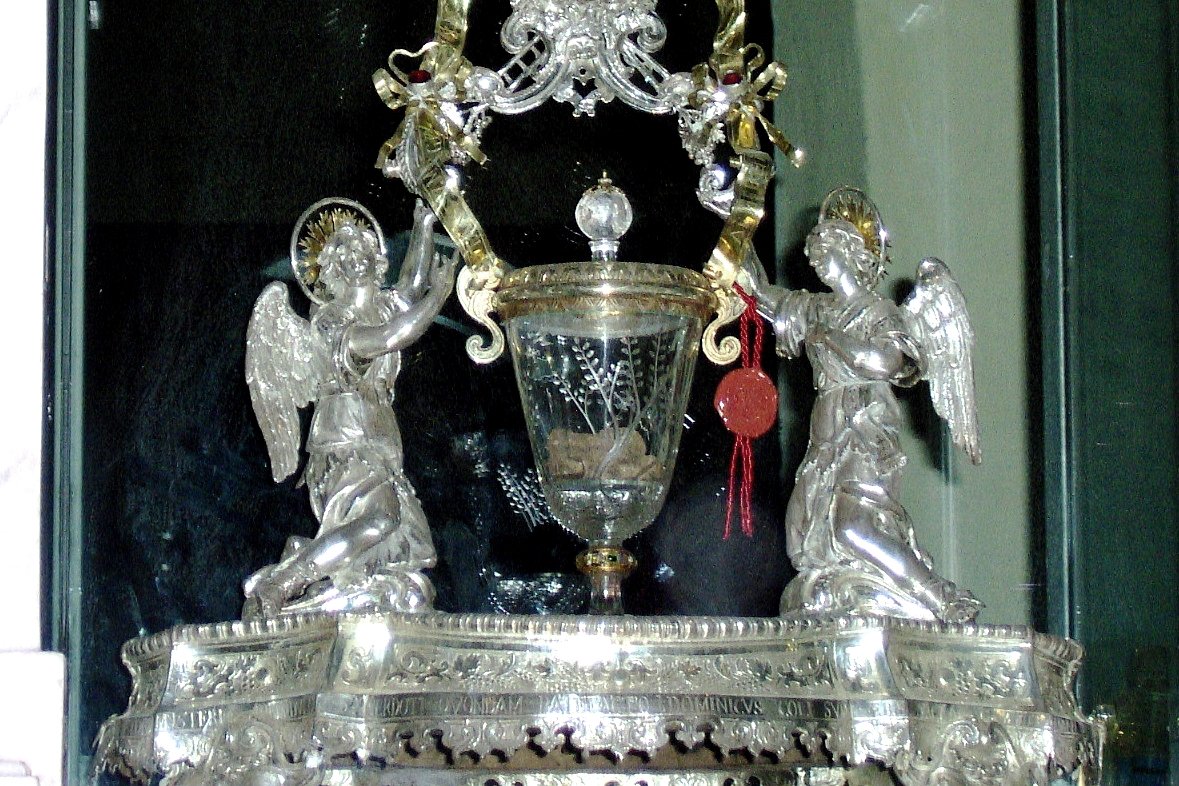
Photo by Wikimedia user Junior (2006). Public domain, via Wikimedia Commons.
Tradition places the event in the little church of San Legonziano (later rebuilt and today known as San Francesco), in Lanciano, a hill town roughly 100 miles east of Rome on the Adriatic side of the Italian peninsula. The monk, most accounts identify as a member of the Basilian order — Greek-rite monks who maintained several communities in this part of Italy before the Franciscans eventually took over custodianship of the church — was celebrating Mass when, at the moment just after he spoke the words of consecration, the host in his hands reportedly changed into a disc of visible flesh, and the wine in the chalice thickened and darkened into blood. According to the tradition, the monk then showed the congregation what had happened, and word of the event spread through the region.
A tradition without a precise date
Here it's worth being direct about something many retellings skip past: the exact year of the miracle is not settled. Popular tradition most commonly places it around 700 AD, in the 8th century, and some versions narrow it further to a specific decade; but the written accounts that describe the event in detail come from later centuries, not from a surviving document contemporary with the Mass itself. That gap between the event and its earliest detailed written record is common to many medieval devotional traditions, and it means Lanciano's dating should be understood the way the Church itself generally treats such traditions — as a long and sincerely held pious memory, not a precisely documented historical fact with a verifiable paper trail back to the 8th century.
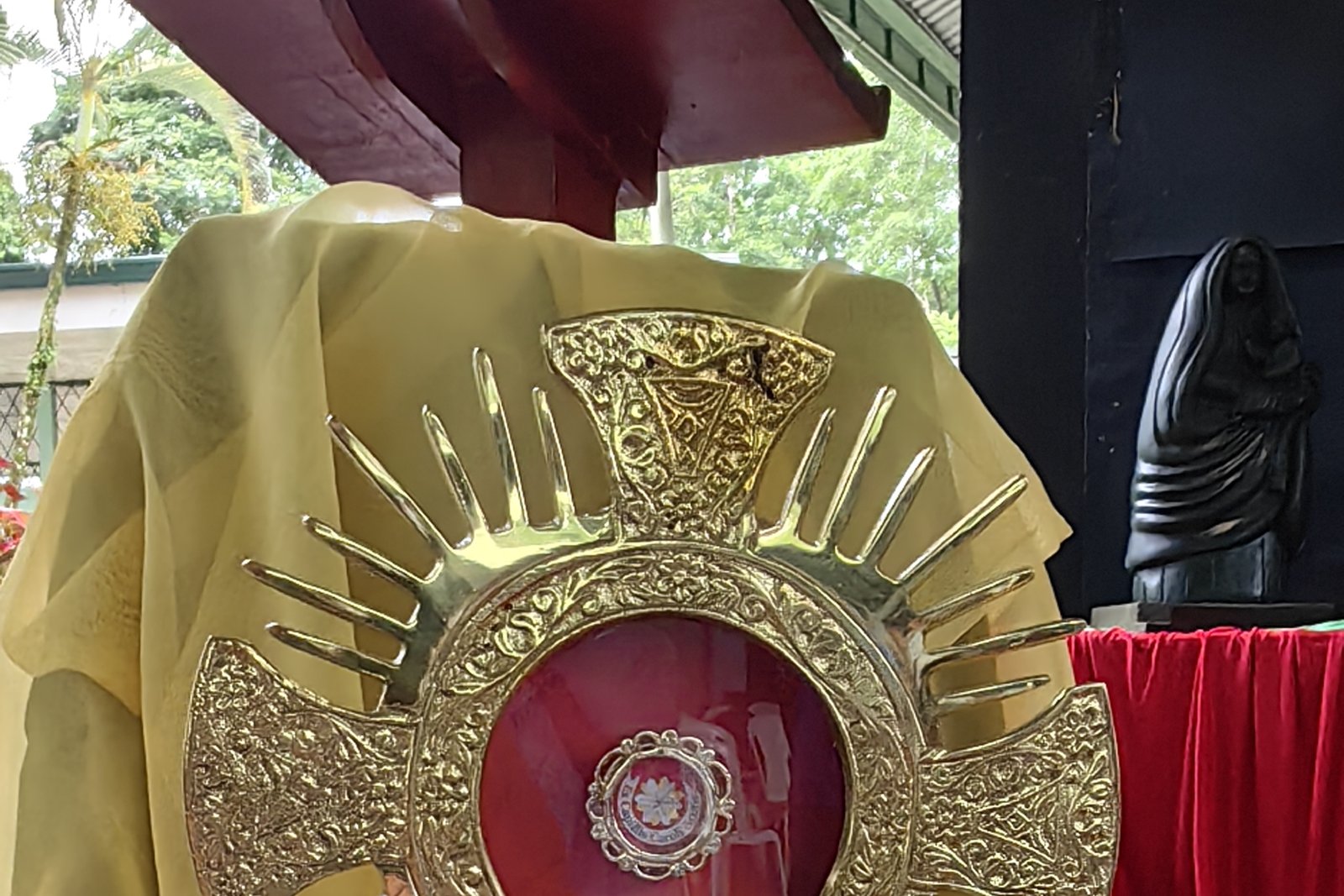
What is better documented is the relic's more recent custodial history. It has been kept and displayed by the Franciscan friars at the Church of San Francesco for centuries, and in 1713 a new reliquary — an elegant silver monstrance, still in use today — was crafted to hold both the flesh and a sample of the clotted blood, which is itself divided into several irregularly shaped pieces kept in a crystal vessel. The flesh and blood have been exposed to public veneration, examined by local clergy and visiting scientists at various points, and transported for closer study on at least two occasions in the 20th century — all without, according to the accounts kept by the custodians, any sign of the kind of decay organic tissue normally undergoes over centuries.
What the 1970-71 analysis reported
The most frequently cited scientific episode in the relic's history came in 1970 and 1971. With permission from Church authorities, a sample was sent for laboratory analysis to Dr. Edoardo Linoli, at the time head of the laboratory of clinical analysis and pathological anatomy at the hospital in Arezzo and a professor of anatomy and pathological histology. Linoli examined the tissue between November 1970 and March 1971, and in his report — later published in the journal Quaderni Sclavo di Diagnostica Clinica e di Laboratorio — he stated that the flesh was authentic human tissue, specifically identifying it as myocardium, the muscular wall of the heart, along with structures he associated with the endocardium and a branch of the vagus nerve. He further reported that the blood sample tested as human blood of type AB.
It is worth being as careful here as the tradition of careful record-keeping that surrounds the Shroud of Turin deserves, and for the same reason: a single researcher's published laboratory report, however credentialed the researcher, is not the same thing as a result independently repeated by separate teams under modern forensic chain-of-custody protocols, with the kind of peer review and replication that would let a finding like this stand as settled scientific fact rather than a historical scientific claim. Some accounts describe a later review convened in connection with the World Health Organization that reportedly reexamined Linoli's conclusions over a period of months and did not overturn them; even accepting that at face value, that still falls short of the full independent replication that a claim this extraordinary would need to be treated as conclusively proven in the way a modern forensic laboratory finding normally would be. The honest summary is that Linoli's report exists, has not been contradicted by a competing study, and has also never been independently repeated under the kind of controlled, blinded conditions that would settle the question scientifically beyond reasonable doubt.
What the Church actually says
This is the point where Lanciano's story is easiest to overstate, in either direction. The Catholic Church has permitted and encouraged devotion to the relic for centuries, and multiple popes and bishops have visited or spoken favorably of it — but, as with the Shroud of Turin and relics of the True Cross, the Church has not issued a dogma requiring belief that the flesh and blood kept in Lanciano are supernaturally produced rather than, say, an unusually well-preserved medieval devotional object whose precise origin cannot now be reconstructed with certainty. Catholic teaching on the Eucharist itself is dogmatically clear and does not depend on Lanciano at all: the Catechism of the Catholic Church teaches that "by the consecration the transubstantiation of the bread and wine into the Body and Blood of Christ is brought about. Under the consecrated species of bread and wine Christ himself, living and glorious, is present in a true, real, and substantial manner" (CCC 1413). That belief rests on the words of Christ himself in the Gospel of John — "my flesh is true food, and my blood is true drink" (NABRE, John 6:55) — and on nearly two thousand years of consistent Church teaching, not on any one reported miracle.
What a venerated Eucharistic miracle like Lanciano offers, in the Church's own framing, is not proof of that teaching but an aid to faith in it — a vivid, physical sign pointing toward a truth Catholics already hold on other grounds. Lanciano appears today among the Vatican-associated international exhibition of Eucharistic miracles that catalogues dozens of such traditions from across the Christian world, grouped alongside other reported cases rather than singled out as uniquely certified; the exhibition itself describes these as traditions worthy of devotion and reflection, language careful enough to leave the question of scientific certainty where the Church generally leaves such questions — open, but not therefore empty of meaning.
Why pilgrims still go
None of that caution has slowed the stream of visitors to Lanciano. Pilgrims come specifically to stand before the 1713 monstrance and look at what tradition holds is thirteen centuries old, and for many of them the appeal is close to what draws people to the Shroud of Turin or a splinter of the True Cross: not a courtroom-grade verdict on authenticity, but a physical object that makes an invisible belief feel, for a moment, startlingly close. Lanciano's particular resonance is with Eucharistic adoration — the practice of praying before the consecrated host outside of Mass — since the tradition frames the relic as, in effect, a permanent and visible answer to the very doubt that adoration is meant to address. Whether or not a modern laboratory could ever settle every question about the tissue in that monstrance, the devotion built around it has already done what such devotions are meant to do: turn an abstract doctrine into something a pilgrim can kneel in front of.
Trivia
What is the Eucharistic Miracle of Lanciano?
When did the Eucharistic Miracle of Lanciano supposedly happen?
What did the 1971 scientific analysis find?
Does the Catholic Church teach that the Lanciano miracle is scientifically proven?
Where can the relic be seen today?
Related Reading