The Chains of Saint Peter: A Relic of Two Prisons


Chained twice, freed once
Peter's first imprisonment is told in sharp, cinematic detail in the Acts of the Apostles. King Herod Agrippa I, looking to please the Jewish authorities, had already executed James, the brother of John, and then moved against Peter, having him "taken into custody and put in prison under the guard of four squads of four soldiers each" (Acts 12:4, NABRE). The night before his trial, Peter was asleep between two guards, "secured by double chains" (Acts 12:6), when an angel of the Lord appeared, struck him awake, and the text says simply: "The chains fell from his wrists" (Acts 12:7). Peter walked past the guards and through a gate that opened by itself, convinced for a moment that he was dreaming — "he thought he was seeing a vision" (Acts 12:9) — until he reached the street and realized the rescue was real.
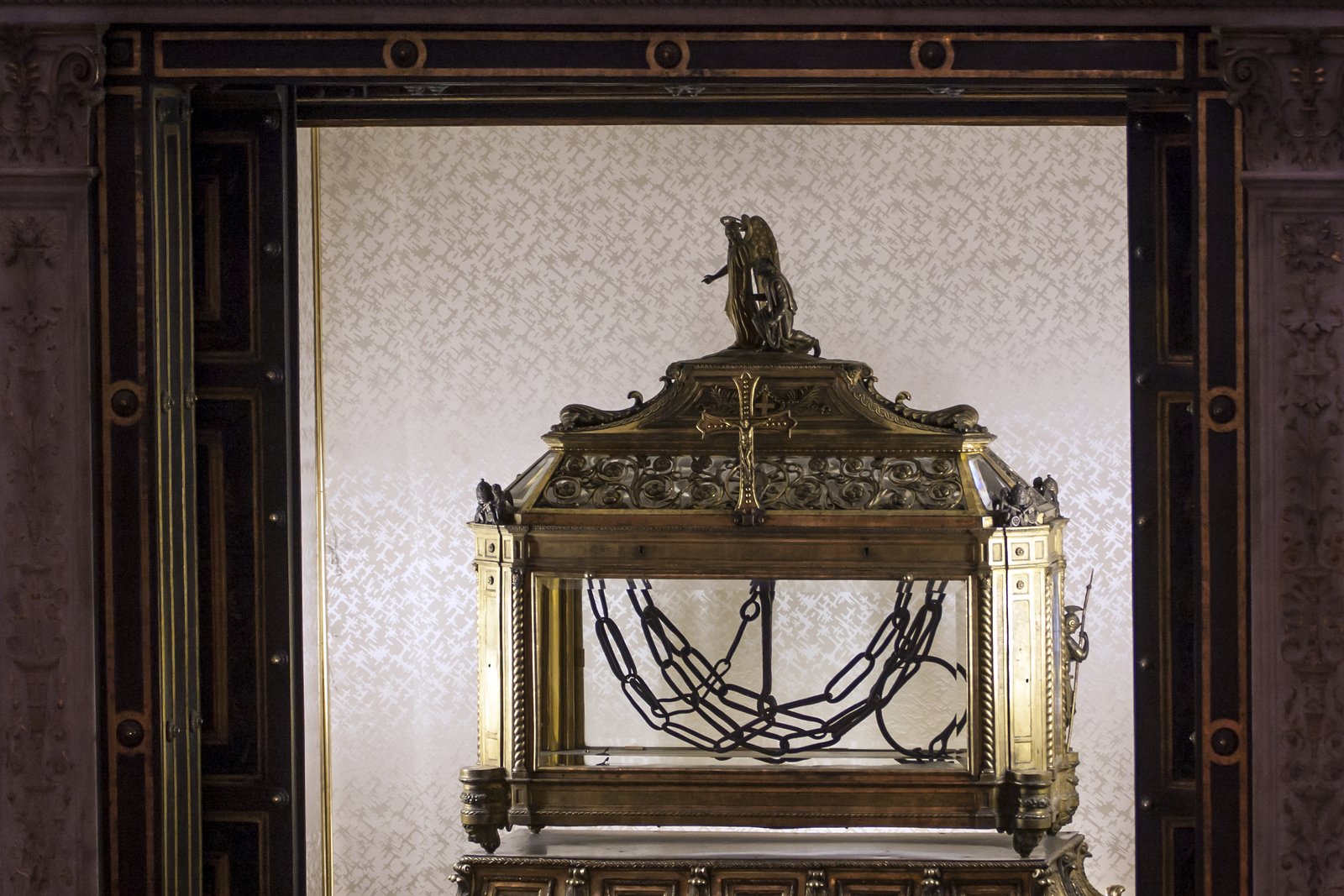
Photo by David Castor. Public domain (CC0), via Wikimedia Commons.
That dramatic escape is where the biblical record of Peter's imprisonment ends. What tradition adds is a second chapter, set years later and an empire away: Peter's final imprisonment in Rome, in the years leading up to his martyrdom under the emperor Nero, traditionally placed in the 60s AD. Christian tradition most often locates this second captivity in the Mamertine Prison, an ancient underground holding cell near the Roman Forum, though the New Testament itself does not narrate this imprisonment the way it does the one in Jerusalem — this part of the story rests on later tradition rather than scriptural account, and should be read as such.
Two chains, one relic
The basilica that exists today to house this relic — San Pietro in Vincoli, "Saint Peter in Chains," on Rome's Esquiline Hill — was first built in the 5th century, with a church on the site traditionally dated to around 432-440 AD, under Pope Sixtus III. According to the Catholic Encyclopedia's 1911 account, the building's origin is tied directly to the relic: the empress Eudoxia, having obtained in Jerusalem the chain believed to have bound Peter there, brought it to Rome and gave it to Pope Leo I. The pope is said to have compared it with a second chain already venerated in Rome — the one traditionally associated with Peter's final imprisonment there — and, as the story is told, when the two chains were held close together, they joined into a single chain.
That fusion story is the heart of the relic's popular legend, and it is worth being plain about what kind of claim it is. It appears in later devotional and legendary accounts of the relic's history rather than in a contemporary, independently verifiable record from the 5th century itself. Nothing here is a matter of Church dogma — the Catechism of the Catholic Church encourages the veneration of relics as a legitimate expression of popular piety (no. 1674), but it does not require belief in any specific legendary detail attached to a given relic's history. The fusion of the two chains belongs to pious tradition, not defined teaching, and it is best presented to readers exactly that way: a beautiful story that shaped centuries of devotion, not a historical fact to be taken at face value.
Whatever actually happened to produce the chain now enshrined in Rome, the basilica built to hold it became one of the city's notable pilgrimage churches, its name (in Latin, Vincula Sancti Petri — "the chains of Saint Peter") built directly into its dedication rather than merely associated with it, unlike churches named for a saint in general.
A basilica better known today for Moses
Walk into San Pietro in Vincoli today and most visitors head straight past the altar toward the south aisle, where Michelangelo's monumental tomb of Pope Julius II stands — a project the artist worked on, on and off, for decades, and never fully completed to its original, far more ambitious design. Its centerpiece, the seated marble figure of Moses, horned (per a medieval mistranslation of a Hebrew word for "radiant") and gripping the tablets of the Law, is one of the most studied and reproduced sculptures of the Italian Renaissance. It draws a steady stream of art pilgrims who come for Michelangelo and only afterward notice the reliquary near the high altar — a quiet irony for a church whose entire reason for existing, over a thousand years earlier, was the relic rather than the art.
The chains themselves are kept today in a bronze and crystal reliquary beneath the basilica's main altar, where they are visible to visitors throughout the year, kept behind glass rather than brought out only on special occasions.
The Feast of Saint Peter in Chains
The relic has its own place on the liturgical calendar: August 1 marks the Feast of Saint Peter in Chains (in Latin, the feast that gave the basilica its dedication), traditionally the day of the church's consecration and the occasion for the relic's fullest public veneration, when pilgrims and the faithful of Rome have historically gathered to see the chains up close. The date predates and is distinct from the Church's main feast honoring Peter and Paul together, June 29 — a reminder that Peter's memory is marked by the Roman calendar more than once, in more than one register: as apostle and martyr on one date, and through the specific, physical memory of his imprisonment on another.
What the chains are meant to point toward
It would be easy to get lost in the question of forensic authenticity — whether a chain forged two thousand years ago could really have survived, whether two unrelated iron chains could have been, or seemed to have been, joined into one. The Church's own theology of relics, reflected in the Catechism's brief, careful treatment of the subject, does not ask visitors to settle that question before they're permitted to venerate what's in the reliquary. The chains are venerated not as forensic evidence but as a physical reminder of something Scripture states plainly: that Peter was imprisoned, that he suffered for his faith, and that — at least once, in Jerusalem — God intervened directly to set him free. The second imprisonment, in Rome, had no angel and no open gate. Peter's chains there held, and tradition says he died for the faith he had once been freed to go on proclaiming. Whether or not the specific iron in that Roman reliquary is the iron that held him, the memory it anchors is not in question: a man who was given one miraculous rescue, and then, near the end of his life, was asked to give everything instead.
Trivia
Where are the chains of Saint Peter kept today?
Is it true the chains miraculously fused together?
What is the Feast of Saint Peter in Chains?
Why is San Pietro in Vincoli famous today?
Was Peter imprisoned more than once?
Related Reading