The Infant of Prague: A Statue's Journey from Spain to a Carmelite Altar

A small statue with a long road behind it
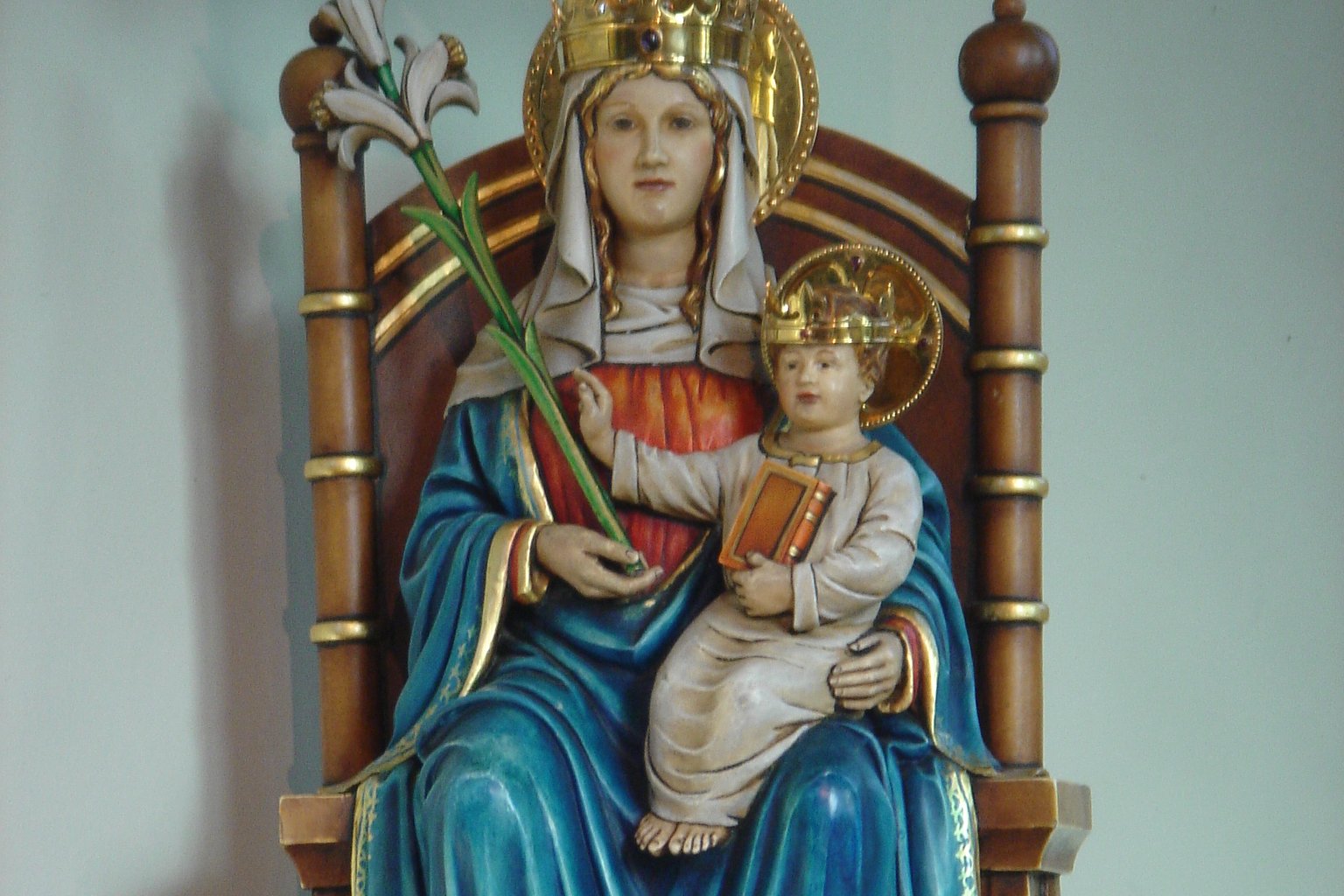
Inside the Church of Our Lady Victorious, in Prague's Malá Strana district, a side altar holds a statue barely a foot and a half tall: a child with a wax face and hands, dressed in a jeweled crown and a robe of stiff, embroidered fabric, holding a small globe topped with a cross in one hand and raising the other in blessing. Pilgrims call it the Infant of Prague — in Czech, Pražské Jezulátko — and for close to four centuries it has been one of the most recognizable devotional images to come out of Central European Catholicism, copied in homes and churches on nearly every continent.
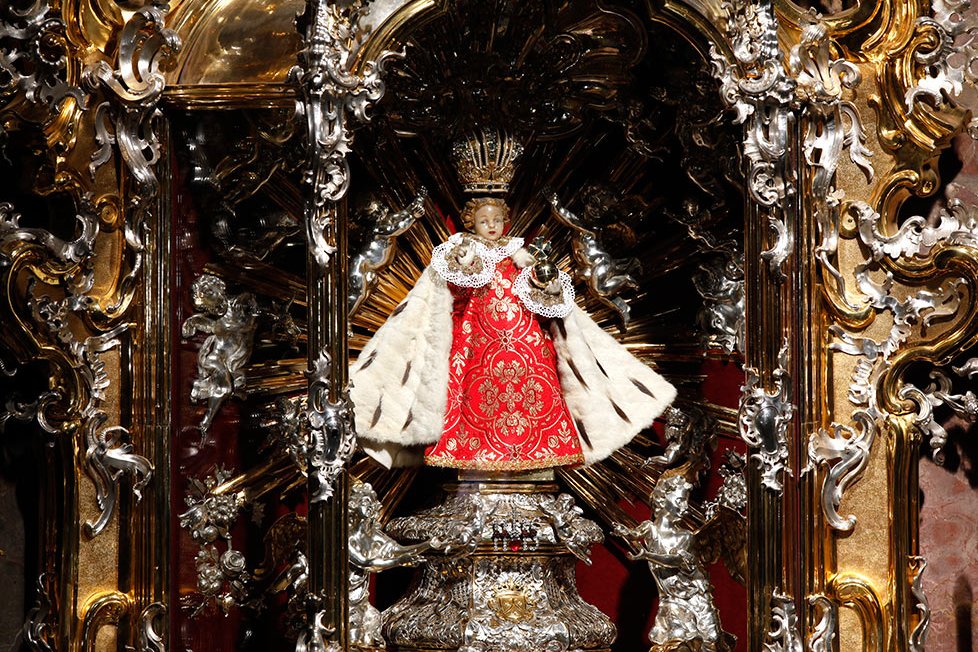
Fotobanka ČTK, René Fluger, Child Jesus of Prague (original statue), 2012. CC BY-SA 3.0, via Wikimedia Commons.
The statue's own documented history, as the Carmelite friars who care for it recount it, begins well before it ever reached Bohemia at all.
From Spain to a Bohemian household
The tradition preserved at the shrine holds that the statue was originally a Spanish devotional piece, and that it came north to Bohemia around 1556, carried by a Spanish noblewoman who had married into a Czech noble family. From there it passed down through at least one generation of that family by inheritance or gift, eventually coming into the hands of Polyxena of Lobkowicz, a devout Bohemian noblewoman closely tied to the court of her era.
In 1628, according to the account kept by the Discalced Carmelites, Polyxena gave the statue to the friars of the Church of Our Lady Victorious, where she had earlier endowed the Carmelite community itself. The words attributed to her on that occasion have been repeated for generations at the shrine: "Behold, I bring you my dearest possession. Honor the Child Jesus, and you shall never want." Whatever the precise wording actually was, the gift itself — a small statue handed from a noble household into the keeping of a religious community in the middle of a politically and religiously turbulent Bohemia — is the hinge on which the rest of the statue's history turns.
War, a rubbish heap, and a friar named Cyril
The Thirty Years' War, which devastated Central Europe for three decades starting in 1618, did not spare Prague's Carmelites. At some point during the conflict's upheavals, the friars were driven from their monastery, and in the disorder the statue was left behind — thrown, by the account long told at the shrine, onto a heap of rubbish behind an altar, where it lay forgotten with both its hands broken off.
Carmelite tradition names the friar who eventually found it again as Cyril, a member of the community who had a particular devotion to the Infant. Praying before the broken, discarded statue, Cyril is said to have heard the Child speak to him, asking him to restore its hands and promising that peace would follow if he did. The hands were repaired, devotion to the statue was renewed, and the episode became, and remains, the central legend explaining both the statue's missing-then-restored hands and the intensity of the devotion that grew up around it in the decades afterward.
It is worth being plain about what this story is and isn't. It comes down through later Carmelite devotional writing rather than through a contemporaneous, independently corroborated account, and different retellings vary on details like exact dates and the precise wording of what Cyril reportedly heard. None of that makes the tradition worthless — it has shaped centuries of genuine piety — but it belongs in the category of cherished Carmelite legend rather than verified historical fact, and that is how it is treated here.
A wardrobe unlike any other statue's
What is not legend, and is documented at the shrine itself today, is the statue's wardrobe — one of the most distinctive features of the whole devotion. The Infant of Prague is regularly redressed in robes that match the liturgical color of the current season or feast: white for Christmas and Easter seasons, green for Ordinary Time, purple for Advent and Lent, red for feasts of martyrs and the Holy Spirit, among others, with gold and other colors reserved for particular solemnities. The custom of dressing the statue is itself old, traceable in spirit back to Polyxena of Lobkowicz's own gift, which reportedly included vestments along with the statue itself.
Over the centuries, the wardrobe has grown into a genuine collection — by some counts numbering in the dozens of distinct robes, housed and maintained at the shrine's own small museum — much of it made up of gifts sent by Catholics, religious communities, and even royal donors from around the world. Robes connected to European royal courts sit alongside more recent additions reflecting the devotion's spread into Asia and elsewhere, a wardrobe that functions as a kind of running record of who, across the centuries, has felt moved to clothe this particular statue with their own hands.
A devotion that outgrew Bohemia
The Infant of Prague's reach extended well past Central Europe through the same religious order that has cared for the original statue since 1628. Discalced Carmelite communities carried reproductions and the associated devotion with them wherever they were established, and it found especially deep and lasting roots in Spanish-speaking Catholicism, where small statues of the crowned, robed Infant became a familiar presence in homes and parish churches across Spain and Latin America.
In the Philippines, the devotion took hold alongside — and inevitably in conversation with — the country's own far larger devotion to the Santo Niño, especially the Santo Niño de Cebu, an image from roughly the same era that bears a notable resemblance to the Prague statue. Filipino Catholics continue to venerate both images, sometimes in the same household, turning to the Child Jesus under either title for blessing, protection, and healing.
What the statue still asks of its visitors
Strip away the uncertain edges of the Cyril legend, and what remains is a plainer, steadier story: a small devotional object, carried out of Spain into a Bohemian noble household, given away by a woman who asked only that it be honored, nearly lost in a war, recovered and mended, and dressed ever since in whatever colors the Church's calendar calls for that week. Four centuries on, the Infant of Prague is still exactly that — a statue the faithful keep returning to redress, by hand, one season at a time.
Trivia
Where is the Infant of Prague, and what is it made of?
How did the statue get to Prague?
Why does the statue have restored hands?
Why is the statue dressed in different robes?
Is devotion to the Infant of Prague found outside the Czech Republic?
Related Reading