The Veil of the Virgin at Chartres: The Relic That Saved a Cathedral

A fire, a disappearance, and three days of dread
The night of June 10, 1194, is the hinge on which the whole story of Chartres Cathedral turns. Lightning struck the building, and fire spread through the wooden roof structure with the speed these medieval disasters always had — by morning, almost nothing remained standing but the crypt beneath the building and the two western towers with their already-ancient Royal Portal. The cathedral that burned that night was itself a product of an earlier fire, the Romanesque church built after a blaze in 1020; Chartres, like many medieval cathedral towns, had a long and grim history of losing its church to flame roughly once a century.
Rama, Chartres cathedral 2850 (2009). Public domain, via Wikimedia Commons.
What made this fire different was what the clergy feared had been lost along with the building: a length of cloth kept in the cathedral since the ninth or tenth century, venerated as a garment that had belonged to the Virgin Mary. For three days, by the account Chartres has preserved and retold ever since, no one knew whether the relic had survived. It was eventually found intact, reportedly because the priests responsible for guarding it had sheltered behind iron trapdoors when the flames broke through, protecting both themselves and what they carried.
That the relic turned up safe amid total devastation elsewhere in the building struck contemporaries as more than good fortune. A papal legate happened to be in Chartres at the time of the fire and helped spread word of what had happened across Europe — and the story that circulated wasn't simply "the cathedral burned," but that the Virgin's own relic had been spared, as if by her own choice, from a fire that consumed everything around it. Funds began arriving from royal and noble patrons, and from ordinary pilgrims, almost immediately. Reconstruction started within months rather than years, an unusually fast response for a project of this scale. The result, built mostly between 1194 and 1220 in the newly fashionable Gothic style, is the cathedral that still stands at Chartres today — meaning that, in a very direct sense, the building celebrated as one of the masterpieces of Gothic architecture exists because its community believed a relic had been providentially preserved and treated that belief as a mandate to build something greater than what had burned.
What the relic was said to be, and where it came from
The earliest written account of the relic at Chartres comes from the chronicler Dudo of Saint-Quentin, writing around the year 1000, by which point the cloth had already been placed in its own reliquary. The fuller story commonly told about its origins — that it was donated to the cathedral in 876 AD by Charles the Bald, grandson of Charlemagne and king of West Francia — first appears in texts from the early 12th century. A later and more romantic legend, found in the medieval epic poem known as the Pèlerinage de Charlemagne, pushed the story back a generation further, claiming Charlemagne himself had received the relic from a Byzantine emperor during a legendary crusade to Jerusalem and passed it down to his grandson. Historians generally treat the Charlemagne version as a later embellishment invented to add prestige to the relic — the more sober account, crediting Charles the Bald directly, with the garment arriving as a diplomatic gift connected to Constantinople, is the one better supported by the documentary record.
Whichever version is accepted, the relic's reputation for miraculous protection accumulated over the following centuries in ways that mirrored similar Marian relics venerated in Constantinople itself. Chartres' own tradition credited the garment with having saved the city from a Viking siege in 911, decades before the earliest securely dated written account of the relic even exists — a reminder that medieval relic traditions often grew backward in time, attaching older miracles to a relic once its reputation was established, rather than the miracle stories necessarily preceding the relic's arrival.
What the cloth turned out to be
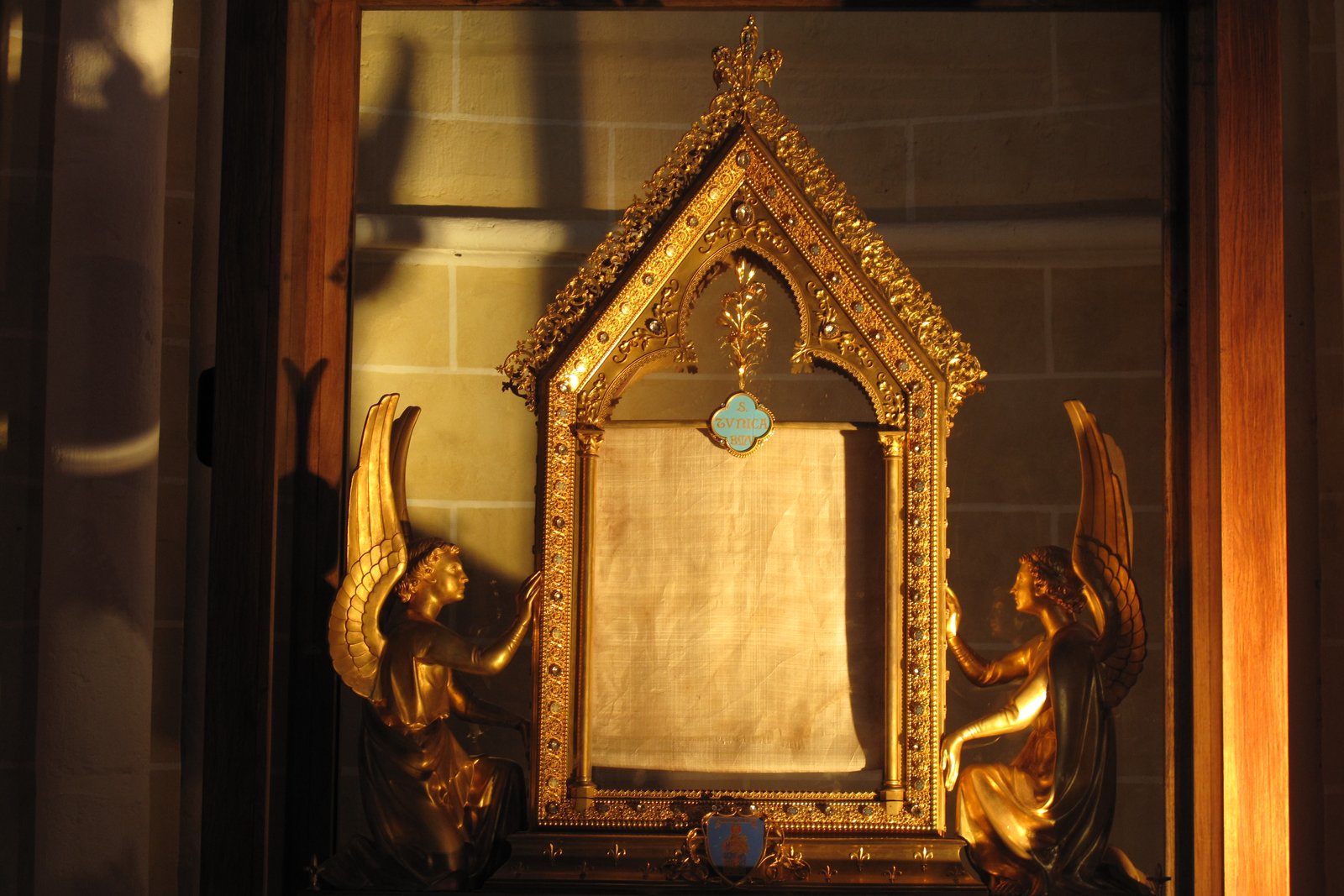
For centuries, the relic stayed hidden inside its reliquary, unseen even by most of the clergy who venerated it. That changed in 1712, when the reliquary was formally opened for examination. What emerged surprised observers: rather than the plain linen undergarment later popular tradition had assumed — a camisia, in the ordinary Latin sense of a chemise or shift — the reliquary held two long bands of markedly finer material: one length of silk, wrapped inside a second band combining silk and linen with embroidered decoration. By the early 19th century, as this more luxurious material became better known, the relic had come to be popularly called the Virgin's veil rather than the "holy shirt" its older name suggested — the English title most commonly used today, though older scholarship notes the garment was more often described in medieval sources as a chemise, tunic, or shawl than literally as a veil.
The silk's quality and style have drawn the attention of textile historians in more recent scholarship, most notably the medievalist E. Jane Burns, whose research situates the cloth within a broader pattern: luxury Syrian silks, prized across the medieval Mediterranean and eastern Christian world, circulating westward as diplomatic gifts and ending up wrapped around relics meant to evoke the sanctity of their distant origin. That identification matters for dating. Syrian silk weaving of the style found at Chartres is generally associated by textile scholars with a period well after the first century AD — meaning the physical cloth inside the reliquary most likely was not woven during the lifetime of the Virgin Mary, whatever older layer of tradition or earlier relic it may have once wrapped or replaced.
Material dating and the question of veneration
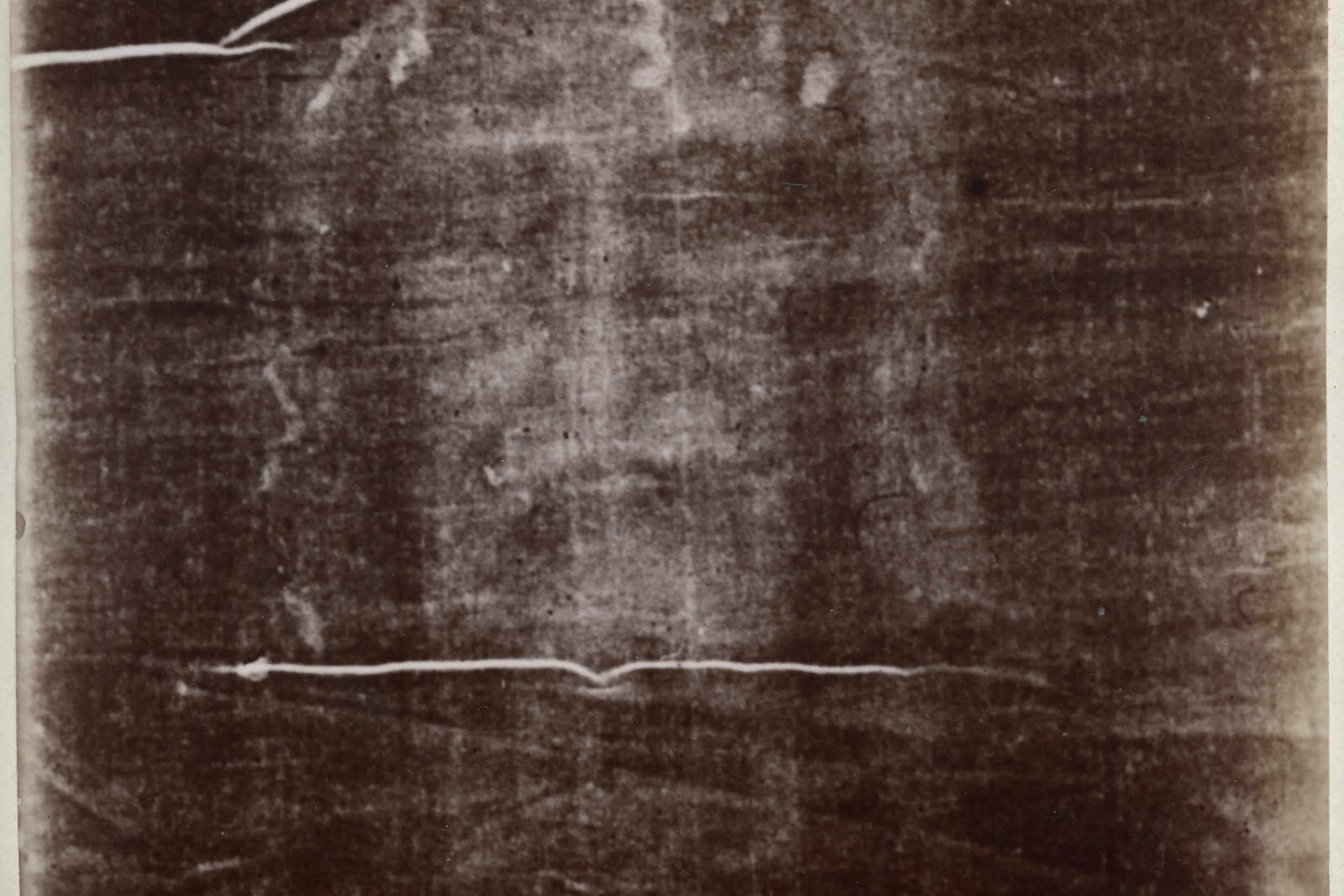
That gap between the cloth's probable date of weaving and the first-century setting of the devotion attached to it is, in miniature, the same tension that runs through almost every relic examined by modern textile or material science — the same tension at work, for instance, in the 1988 carbon dating of the Shroud of Turin, which returned a medieval date range that scholars on multiple sides of that debate continue to argue over without resolving the underlying question of veneration. Chartres' relic has not undergone the same kind of direct scientific dating test the Shroud received; what exists is a stylistic identification of the silk's weaving tradition, not a radiocarbon result pinpointing a year. Even so, the logic the Church applies is the same in both cases, and it is worth stating plainly rather than skipping past: identifying when and where a piece of cloth was woven is a separate question from whether centuries of veneration directed at it — and at what it represents — carries spiritual meaning for the people who have knelt before it.
The Catechism of the Catholic Church lists the veneration of relics among the Church's encouraged forms of popular piety (no. 1674), without requiring that any particular relic pass a test of material authenticity before the devotion attached to it can be considered legitimate. That framework, formally traced back to the Second Council of Nicaea's teaching that honor shown to a sacred object "passes to the prototype" it represents, is what has let devotions like the one at Chartres survive the same way devotion to fragments of the True Cross has survived skeptical scrutiny going back to the Reformation: the tradition being honored is bigger than, and does not stand or fall with, any single forensic finding about the object itself.
A pilgrimage destination built around a relic
None of this historical and scientific nuance much troubled the medieval pilgrims who made Chartres one of the most visited Marian shrines in Europe by the close of the 12th century. Four great annual fairs coincided with the principal feast days of the Virgin — the Presentation, the Annunciation, the Assumption, and the Nativity — drawing crowds who came explicitly, in the words preserved from the period, "to see the cloak of the Virgin." The cathedral's economy, its urban layout, and its very architectural ambition were shaped around hosting and impressing that pilgrim traffic, in ways few other medieval cathedral towns could match.
That relationship between relic and building has outlasted the medieval pilgrimage economy itself. The Sancta Camisia remains on permanent display today at Chartres, in a glass-fronted reliquary in a chapel off the ambulatory, with a smaller fragment also kept in the Notre-Dame-Sous-Terre chapel of the crypt below — the same crypt that was one of only a handful of structures left standing after the fire of 1194 first put the relic's survival, and the cathedral's rebuilding, into motion.
Trivia
What is the Sancta Camisia at Chartres Cathedral?
Did the relic survive the 1194 fire at Chartres?
What is the relic actually made of, and does that disprove its authenticity?
Why was Charlemagne sometimes credited with bringing the relic instead of Charles the Bald?
Does the Catholic Church teach that the Chartres relic is definitely authentic?
You May Also Like

Related Reading